



A medical tech shield for women
The female technology market is burgeoning in the Greater Bay Area, helping women solve health-related problems, including infertility. Chen Shuman reports from Hong Kong.







Women's healthcare needs have catapulted to the forefront of the technology age as the economic empowerment of women climbs.
In the Guangdong-Hong Kong-Macao Greater Bay Area, medical and biotechnology specialists have risen to the occasion by seeking solutions to help women enjoy healthier lives.
Globally, a growing number of biotech companies targeting women's health issues, including fertility, pregnancy, nursing and reproductive-system healthcare, have mushroomed in recent years, especially in Europe and North America.
Femtech - female technology - is now an emerging business that applies a range of technology-focused medical products and services to help solve women's health problems.
According to a recent report by Frost & Sullivan, a US-based business-research and consulting firm, the worldwide femtech market is estimated to hit $1.15 billion by 2025, up from $648 million last year, showing a compounded annual growth rate of 12.2 percent.
Gearing itself up as an international hub for innovation and technology, the Greater Bay Area is set to embrace this development trend, with some startups having set foot in the region.
"Females account for nearly 50 percent of the nation's population. Their health deserves more precise care. That's what we intend to do and are striving for," said Ming Wai-kit, assistant professor of public health at the City University of Hong Kong and a Hong Kong entrepreneur who founded a medical technology company in Shenzhen.
Solving health issues
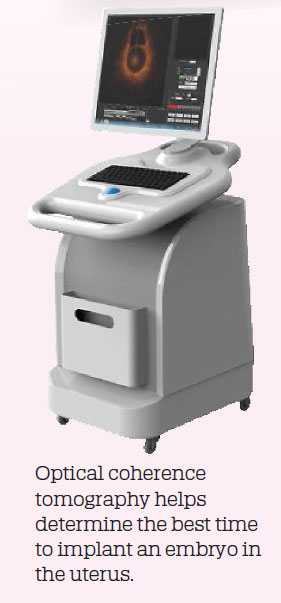
The 36-year-old founder of Shenzhen OCTIS Medical Technology Co, who heads a 15-member research and development team, has developed a noninvasive optical interference imaging technology that can inspect the endometrium in 3D without damaging the uterus.
Optical coherence tomography uses small-scale but high-resolution images to detect the best timing to implant an embryo in the uterus. It can raise the success rate of artificial fertilization to above 70 percent for infertile women.
In February 2020, the company obtained the permit for the medical device production enterprise issued by the State Food and Drug Administration. The OCT imaging equipment has received an investment of more than 5 million yuan ($783,600), and is expected to enter the market within three years.
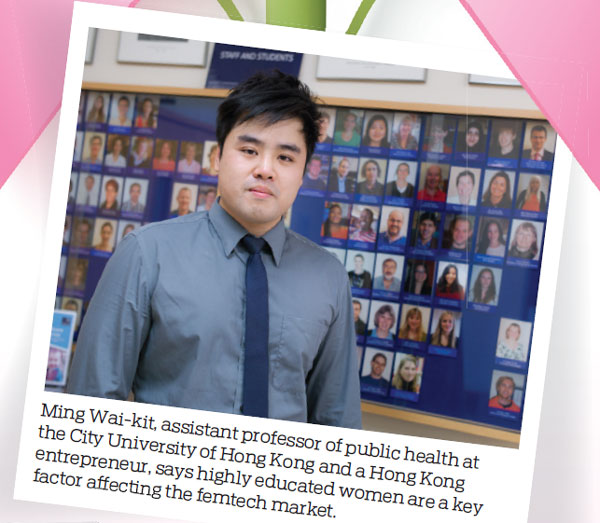
Ming, who obtained postdoctoral training at Harvard University, founded Shenzhen Octis with a team of optical experts to better apply what they've learned to help more women.
He recalled that during his one-year internship at the obstetrics and gynecology unit of the First Affiliated Hospital of Jinan University in 2010, he was delighted to welcome a new life - a symbol of hope and liveliness - to the world.
However, many women longing for a baby remain deprived of that joy. "After seeing so many women struggling to have a baby, I began thinking if I could find a way to help them," Ming said.
His team is not alone in trying to improve women's health.
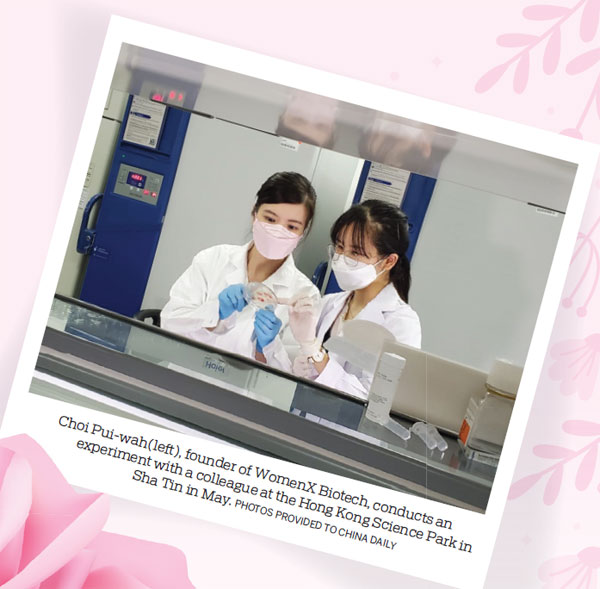
Choi Pui-wah, who founded WomenX Biotech in Hong Kong, also saw the business opportunities in the women's healthcare market. Armed with a doctoral degree in biochemistry in 2013, she developed a new technology of using menstruation blood to detect cervical cancer, which is more convenient and cheaper than traditional methods.
According to the World Health Organization, cervical cancer is the fourth-most common form of the disease among women worldwide, caused by the persistent infection of a high-risk human papillomavirus.
Choi said the new technology she developed still needs at least four years to go through all the clinical trials and registration procedures before it can hit the market. But she is confident the product will be competitive enough.
Her company has received about HK$9 million ($1.16 million) in funds to develop the product in the next four years through Hong Kong Science and Technology Parks Corp and the Innovation and Technology Bureau. The company is also teaming up with researchers of the Chinese University of Hong Kong and Jinan University.
Choi's intention in setting up WomenX Biotech in 2019 was to find a more comfortable and convenient method to detect common diseases among women in the early stages.
"Some of my friends didn't know what they were suffering from until it was too late, and the cancerous tissues or organs had to be removed. With regular medical checkups, many diseases among women, like cervical cancer, can be detected early and the patient would have a higher chance of being cured," Choi said.
However, contrary to growing public acceptance of early vaccination against the human papillomavirus, Choi said the number of people who proactively opt for cervical cancer tests is "relevantly low".
According to a survey conducted by the Hong Kong Anti-Cancer Society in 2015, about 38 percent of 303 women interviewed said they had never gone for any medical test for cervical cancer. They cited various reasons, such as the unpleasant inspection process, unawareness of such tests and a strong conviction that they were in good health.
Choi explained that because of cultural influences, Asian women tend to be more sensitive to intimacy issues. "The common examination methods nowadays, whether it's a Pap smear or a visual inspection of the cervix with acetic acid, are all invasive, and fewer women are willing to accept such medical screening," she said. "Needless to say, they take going to the hospital as a time-consuming thing."
The different attitude to cervical cancer screening between Western and Asian people inspired Choi to create a noninvasive and more-convenient method to detect the disease by testing menstruation blood.
Menstruation blood is produced monthly so it can be easily obtained. More importantly, the blood passes through the cervix, enabling cancer cells to be detected by testing the blood collected, she said.
It's also more convenient as the test can be done at home and could be up to 40 percent cheaper than going to the hospital, Choi said, adding that a traditional cervical screening in Guangdong province costs about 200 yuan.
'Great' market potential
Billy Mak Sui-choi, associate professor of the Department of Finance and Decision Sciences at Hong Kong Baptist University, said the femtech market in the Greater Bay Area has great potential for expansion.
He said cities in the region, particularly Hong Kong, are strong in scientific research, which is the basis for femtech companies to grow. The University of Hong Kong and the Chinese University of Hong Kong are among the best in the world in medical research, he added.
The Greater Bay Area, which comprises Hong Kong, Macao and nine cities in Guangdong with a total population of 86 million, is one of the most vibrant economic regions, Mak said. Its large population also helps to boost consumption of femtech products.
Noting the different mechanisms for registering medical devices between the Chinese mainland and the two special administrative regions, Mak said he hopes that a common registration system could be set up soon to help young entrepreneurs start businesses in the Greater Bay Area.
Ming and Choi are optimistic about the femtech market's prospects in the region. Ming said the key factors that could influence the market include a sufficient number of women, who are highly educated and more open to new concepts and services, and their rising income.
According to a report by the National Bureau of Statistics, the number of female postgraduate students on the mainland stood at 1.45 million last year, accounting for 50.6 percent of all postgraduate students. In 2019, iResearch Consulting - a mainland-based market research and consulting firm - reported that the number of middle-class women in the country exceeded 70 million in the previous year, making up 11.3 percent of the total female population.
"The femtech market's development relies on the support of high-end technologies, such as artificial intelligence and big data, which enable the products and their developers to deal with the precise health issues of each individual," Choi said.
"As these technologies are constantly upgraded, we'll have a solid basis to develop the femtech business," she said.
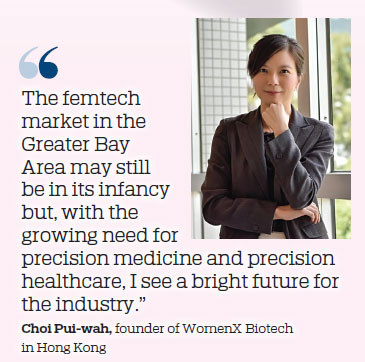
"The pandemic has made people more concerned about their health. The femtech market in the Greater Bay Area may still be in its infancy but, with the growing need for precision medicine and precision healthcare, I see a bright future for the industry."



- Labubu lights up Shanghai lantern show
- Cherry blossom festival in Yongfu town celebrates agricultural innovation and cultural exchange
- China's first domestically built cruise ship welcomes its 1 millionth guest
- The Devil Still Dances: High Vigilance against Japanese Militarism's Infiltration in Sports and Culture Fields
- 189 historical artifacts of Japanese invasion donated to museum in NE China
- Death toll rises to 8 in North China factory explosion












