Country's production capacity, consumption potential will carry the day







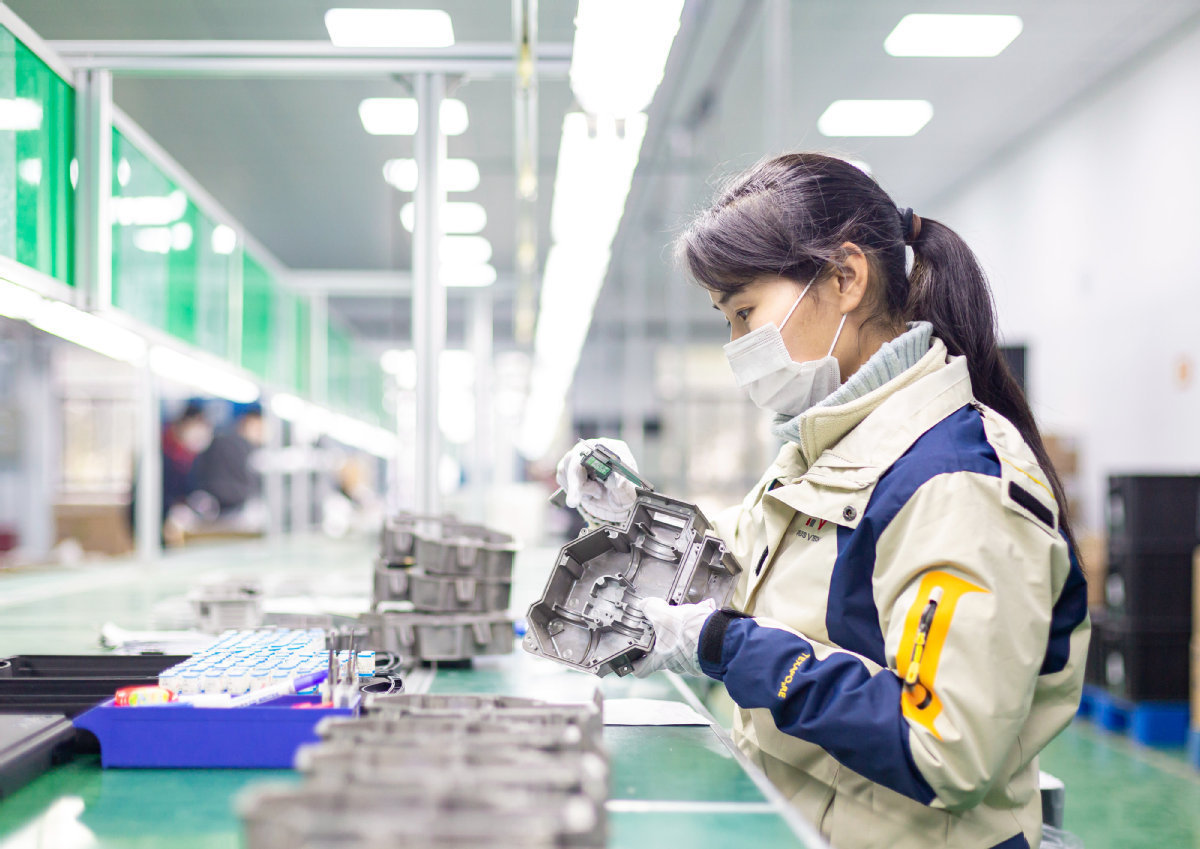
Even though the COVID-19 pandemic has created a massive impact on the industry chains of various countries, and impelled many multinationals to reconsider the value of efficiency-oriented supply chain management practiced in China, there is still no sign the country's position as the world's core production center has been weakened.
It is true that China's labor cost advantage is shrinking, but that doesn't necessarily mean it's now more expensive to innovate and manufacture in China. Labor cost can be determined by a country's resource endowment, but it is only one component of the overall cost. The supply of raw materials, the completeness of capital resources and the proportion of high-quality labor force can all determine the production cost.
Apart from resource endowments, a number of factors-technological progress, economic scale, industrial agglomeration and so forth-can drive the product cost down. Compared with other emerging markets, China still has some obvious advantages in these aspects. This means that even if Chinese companies are excluded from the supply chain, there is no space for substantial reduction in the overall cost of manufacturing businesses across the world.
Pushed by accelerated restructuring of the global value chain, China may lose its comparative advantage in certain products or industries, but as a whole, its production capacity and consumption potential are still hugely attractive to multinational companies. After all, it's hard for them to ignore the fast-growing Chinese market and its huge consumer base.
Moreover, at a time when multinational corporations are suffering from low cash flows amid the world's economic recovery, raising more money to restructure their supply chains outside China certainly is unwise and costly, because China's infrastructure for foreign trade is mature and has been time-tested.
In contrast, India and Southeast Asian economies lack efficient and high-capacity ports in handling large container vessels and sea freight services connecting major markets. That means, trade needs to be transshipped through Singapore or China's Hong Kong Special Administrative Region, which will take more time and money.
On the other hand, the evolution of the global supply chains requires new countries to take over China's status, but there are currently no countries or economic blocs with such potential and capability.
With business maps changing in many countries, the development of global industry chain will show a trend driven by knowledge, digitization and capitalization in the coming years. The pattern of comparative advantage in the global division of labor will be redefined during this process.
Despite some developing countries having comparative advantages in labor costs, their development of digital economy is lagging and they need more hard and soft infrastructure to support this move. Developed countries also face other obstacles such as the implementation of digital service tax and the trade-off between personal privacy protection and business efficiency.
In comparison with them, China has notable advantages in research and development in this fast-growing area, especially in the application segment. However, it is vital and necessary for the government to take measures to cope with the barriers as some institutions in certain developed countries label China's efforts as "digital authoritarianism "and try to isolate China from the international standards in digital economy and related developments, therefore hoping to curb the country's competitive advantage in the next stage.
With many countries setting goals to further cut carbon emissions, green and low-carbon production methods will mainly affect developing countries that depend on energy exports or are in the process of industrialization.
Under such circumstances, the element of climate change places an additional constraint on the catch-up process of latecomers. In the context of low-carbon and green development, carbon tariffs supported by developed economies may make it more difficult for them to replicate the export-oriented model of China.
Apparently, China is less affected compared with these countries, as its industrialization process has already entered an innovation-driven stage through extensive expansion of manufacturing businesses and it has already invested more capital in green energy generation to support its foreign trade sector.
On the other hand, although high energy-consuming and carbon-intensive businesses may be impacted by industrial upgrading or external challenges, China's fast-growing services sector, green technologies, green industries and the financial market will help them ease the pressure during their transformation.