



US short of funds for infrastructure, but not wars







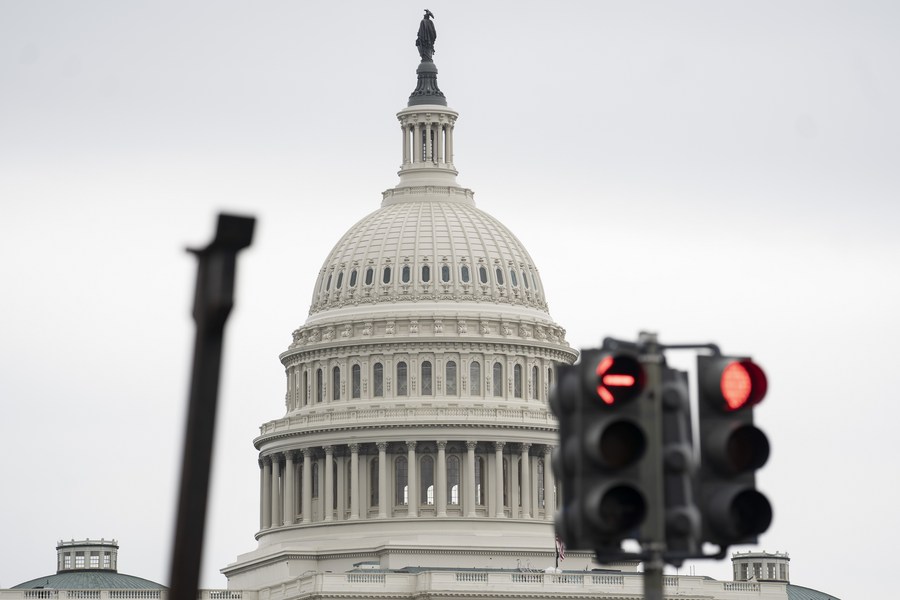
United States President Joe Biden announced a $2 trillion "American Jobs Plan" on March 31, saying it is mainly in response to the "climate crisis" and "the ambitions of China". According to Biden's plan, the administration will spend $621 billion to build or improve the country's transportation infrastructure including highways, bridges, roads and airports, and $689 billion on community infrastructure including providing drinking water, housing and broadband connection for residents, and building schools and Veterans Health Administration hospitals in the next eight years.
The US Congress is not a stranger to presidents' infrastructure initiatives. In February 2018, previous president Donald Trump announced a $1.5 trillion infrastructure plan without any specific funding proposals, only saying that $200 billion of the amount would come directly from the federal budget. But unlike Trump, Biden's infrastructure plan enhances the role of federal funds in US infrastructure investment.
Yet the Biden administration faces a severe fiscal situation. In the fiscal year 2021, the US' federal fiscal deficit will account for 13.4 percent of GDP, the second highest since 1945. Alleging that China is "eating our lunch", Biden has said his plan will "put us in a position to win the global competition with China in the upcoming years".
The frequent mention of China when talking about a domestic infrastructure plan might seem odd. But it would make sense if one realizes that Biden's signature infrastructure plan is facing strong opposition and feasibility problems. Many are skeptical about the financial feasibility of his plan, which Biden says will be paid, for instance, by increasing the corporate tax rate to 28 percent, establishing a minimum tax on corporate book income, raising the tax rate on foreign profits, and eliminating preferences for fossil fuels.
Biden has also said that he aims to collect sufficient revenue to fund these investments through his "Made in America Tax Plan" and prompt US companies that have established production units overseas to return to the US. However, Republicans and prominent business groups, such as the US Chamber of Commerce, are opposed to the plan, particularly the proposed tax increase, arguing that it will blunt the US' investment and global competitiveness.
Although the US Congress' cautious attitude toward the infrastructure plan has forced Biden to continuously emphasize China's challenges to get it passed, the Congress has been generous in approving war funding, as it did in the case of the US wars in Afghanistan and Iraq. For instance, in 2001, the US Congress passed an "authorization for use of military force", which allowed then president George W. Bush to use force against any entity "he determines" to have connection with those involved in the Sept 11, 2001, terrorist attacks.
According to the Costs of War project of Brown University's Watson Institute for International and Public Affairs, the wars in Afghanistan and Iraq have cost the US$2.31 trillion. According to the data from the Special Inspector General for Afghanistan Reconstruction, the US' leading oversight authority on Afghanistan reconstruction, Washington spent $829 billion on the war in Afghanistan from 2001 to 2020, which is more than three times the GDP of Afghanistan during the same period.
Yet the war which resulted in the deaths of at least 66,000 Afghan armed forces personnel and more than 47,000 Afghan civilians ended with the US' hasty and chaotic withdrawal from the country.
The US plan to rebuild Afghanistan not only failed to restore peace in the country and return Afghan people's life to normal, but also gave rise to rampant corruption. As of March 2021, the US had spent only $131.3 billion, or just 15.9 percent of the total cost of the war, on Afghanistan's reconstruction. And the Afghan security forces, which the US spent $82.9 billion to build and supply equipment, provide training and pay salaries, quickly collapsed in the face of the Taliban's offensive.
One study conducted in 2008 estimated that some 40 percent of the money allocated for Afghanistan's reconstruction actually went back to the donor countries in the form of corporate profits and consultants' fees. Only about 12 percent of US' reconstruction assistance between 2002 and 2021 actually went to the Afghan government.
Generally speaking, the cost of the war in Afghanistan is higher than the infrastructure investment plan of Biden. Despite that, Congress may find it difficult to reach an agreement on long-term infrastructure investment in the US, although it has been very generous in approving huge funding for the wars in Afghanistan and Iraq, which gave rise to shocking levels of corruption and resulted in humanitarian disasters.
As such, Biden's infrastructure plan, which lacks proper projections and implementation strategies, may continue to face problems in the Congress. Which is a manifestation of the failure of US democracy.
The author is a researcher in US economy studies at the Chinese Academy of Social Sciences.
The views don't necessarily reflect those of China Daily.
If you have a specific expertise, or would like to share your thought about our stories, then send us your writings at opinion@chinadaily.com.cn, and comment@chinadaily.com.cn.





