



Xinjiang Population Dynamics and Data







III. Demographic Changes in the Uygur Population
Xinjiang has enjoyed peace and development since 1949. After the Xinjiang Uygur Autonomous Region was established in 1955, the CPC and the central government implemented regional autonomy to ensure the equal status of all ethnic groups, and adopted a series of preferential policies to assist and support regional development. Ethnic minority groups in Xinjiang, including the Uygurs, entered an optimal period for development.
The Uygur population in Xinjiang has continued to grow.
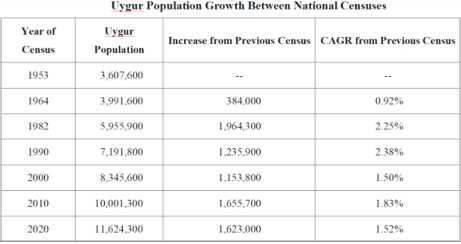
These data show that since the founding of the PRC, the Uygur population has maintained a relatively high growth rate, a trend shared with the total population growth of the region.
In particular, the Uygur population grew at a CAGR of 1.67 percent during the first two decades in the 21st century, which was much higher than that of the country's ethnic minority population, which stood at 0.83 percent.
The Uygur population is on average younger than the overall region. In 2020, in the 0-14, 15-59, and 60 and above age groups, the Uygur proportions were 30.51 percent, 60.95 percent and 8.54 percent, while the overall figures for the region were 22.46 percent, 66.26 percent and 11.28 percent.
The education level of the Uygur population has also continued to improve. According to data from the seventh national census in 2020, 8,944 per 100,000 Uygurs had received a university education, an increase of 6,540 compared to 2000. The average years in education for those aged 15 and above also grew from 7.06 to 9.19.
Xinjiang's Uygurs are mainly distributed in Kashgar Prefecture, Hotan Prefecture, Aksu Prefecture, and Kizilsu Kirgiz Autonomous Prefecture in the southern part of the region. According to data from the 2020 national census, Uygurs accounted for 83.74 percent of the population in these four prefectures, representing 74.01 percent of the total Uygur population in Xinjiang. The Uygur population has surpassed 2 million in both Kashgar and Hotan, and is approaching 2 million in Aksu.
IV. Factors Contributing to Xinjiang's Demographic Development
Along with the process of industrialization, urbanization, and modernization, Xinjiang's demographic development went through three periods of growth:
?high birth rates, high death rates and low growth rates;
?high birth rates, low death rates and high growth rates;
?low birth rates, low death rates and low growth rates.
This trend results from a combination of factors such as economic and social development, evolving policies and regulations, and changes in views on marriage and childbearing. It conforms clearly to general trends of demographic development elsewhere in the world.
Economic and social development: Commendable results have been achieved in many fields in Xinjiang since the founding of the PRC. From 1952 to 2020, Xinjiang's GDP grew from RMB791 million to RMB1.38 trillion, and per capita regional GDP increased from RMB166 to RMB53,593.
Steady progress has been made in education. In 1949, Xinjiang had only 1 college, 9 secondary schools, and 1,355 primary schools. Only 19.8 percent of school-age children were receiving education at school and the illiteracy rate was over 90 percent. In the 70 years since, a complete education system with institutions providing education from preschool through higher education has been put in place. By 2020, Xinjiang had kindergartens in all villages, and 3,641 primary schools, 1,211 regular secondary schools, 147 secondary vocational schools (excluding skilled workers schools), 56 higher education institutions, and 6 adult colleges across the region. The gross enrollment rate of preschool institutions was over 98 percent, the net enrollment rate of primary schools was almost 100 percent, the completion rate of nine-year compulsory education was over 95 percent, and the gross enrollment rate of high schools was over 98 percent. In Kashgar, Hotan, Aksu, and Kizilsu prefectures, 15-year free education lasting from preschool to high school is available. From 1951 to 2020, Xinjiang produced a total of nearly 2.12 million college graduates, of whom 767,000(36.3 percent) are ethnic minorities.
A significant improvement has been seen in public health. Before the founding of the PRC, Xinjiang was poorly provided with medical services. It had only 54 medical institutions with 696 beds, placing the medical service capacity at 0.16 beds and 0.019 doctors per 1,000 people. By 2019, a basic health care system had been set up, with 18,376 medical institutions covering urban and rural areas, providing a total of 186,426 beds. The infant mortality rate dropped from over 400 per 1,000 in 1949 to 6.75 per 1,000 in 2020. The average life expectancy rose from less than 30 in 1949 to 74.7 in 2019.
Evolving policies and regulations: The application of family planning measures in China was gradually extended from coastal and inland to border regions, from urban to rural areas, and from the Han people to ethnic minorities. Preferential policies were implemented for ethnic minority groups.
In line with local conditions and in accordance with state laws and regulations, Xinjiang formulated its own family planning policies. Family planning was first applied to the Han people in the region in the early 1970s, and ethnic minorities were exempt until the mid and late 1980s. The Measures on Family Planning released by the autonomous region in 1992 stipulated that urban Han residents could have one child per couple and those residing in farming and pastoral areas could have two, while for ethnic minorities, urban residents could have two children per couple and those in farming and pastoral areas could have three. Ethnic minority groups with smaller populations were not required to follow the family planning policy. This was one of the main reasons why the ethnic minority populations in Xinjiang maintained a rapid growth rate.
In parallel with the region's economic and social development, the different ethnic groups began to develop similar expectations in terms of family structure. Therefore, Xinjiang amended the Regulations on Population and Family Planning in 2017, introducing universal family planning policies for all ethnic groups: two children per couple for urban residents and three per couple for rural residents. In line with future adjustments to national laws and policies regarding population and family planning, Xinjiang will further modify and improve relevant local regulations and policies.
Xinjiang is committed to protecting the health of women and children, preventing and reducing birth defects, and improving the quality of family life in implementing family planning policies. Couples are now better informed on safe, effective and proper contraception, and are choosing their own preferred method. Women of childbearing age are entitled to voluntary tubal ligation surgery and intrauterine devices to avoid unwanted pregnancies and frequent childbirth.
Changes in views on marriage and childbearing: In the past, under the prolonged, pervasive and toxic influence of religious extremism, the life of a large number of people in Xinjiang and particularly in the southern part of the region was subject to severe interference-early marriage and childbearing, and frequent pregnancy and childbirth were commonplace among ethnic minorities.
In recent years, law-based deradicalization has been implemented in Xinjiang. The interference of religious extremism has been eradicated in administration, judicature, education, marriage and health care. The public has become more aware of the dangers of religious extremism. Their views on marriage, childbearing and family have changed accordingly.
The economic, social and family status of women of all ethnic groups has improved, allowing them more opportunities to obtain secondary and higher education, and take an active part in economic and social life. The number and proportion of women in employment have significantly increased. In 2019 for example, 228,100 women joined the workforce in cities and towns across Xinjiang, accounting for 47.43 percent of the total newly employed in urban areas.
Late marriage and childbearing, and sound maternal and child care have penetrated deep into the hearts of local people and become the mainstream social attitude.


- Spotted seals seen giving birth on land for the first time in China
- Nation's satellite data reception coverage reaches new heights
- Central govt to help build Shanghai into a green global shipping hub
- Grand community banquet attracts 2,600 guests in Chongqing
- Giant pandas filmed enjoying their meals at Shaanxi conservation base
- Smart Dragon 3 rocket lifts off at sea with seven satellites











