



US uses politics of fear to target China







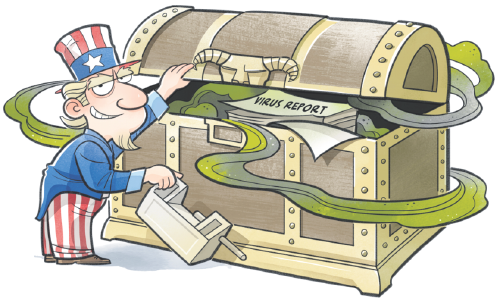
The newly released US intelligence report shows US President Joe Biden has not forsaken the policy of his predecessor Donald Trump, even though the global situation demands that he abandon the practice of garnering support by spreading political fear of imaginary enemies.
When Biden won the US presidential election last year, many expected him to put Sino-US relations back on the right track after the four tumultuous years of the Trump administration. But even more than seven months into his presidency, Biden has not changed the US' policy toward China. Instead, he has continued to push the bilateral relationship downhill, and made threats and rhetoric part of his China policy.
The Biden administration has done a lot to boost the US' competitiveness in the global market and repair the damage caused by Trump's "America first" policy to the US' global image and influence. The common feature of these disparate policy initiatives is their focus on the "China threat" theory.
Biden has repeatedly said "America is back" and worked to rebuild the US' alliances with Western and Asia-Pacific countries, and restore its global leadership while emphasizing the importance of democratic values to consolidate the US' relations with its allies. Domestically, the US Congress has passed a number of acts to boost investment, and research and innovation in the infrastructure sector. Yet all those policies have anti-Chinese undercurrents.
Even on the withdrawal of US troops from Afghanistan, Biden tried to rationalize his decision by saying China and some other countries "would love nothing more than the United States to continue to funnel billions of dollars in resources and attention into stabilizing Afghanistan indefinitely".
The "China threat" theory and China-bashing seem to have become the norm in US political discourse. Biden himself has called China "the most serious competitor". And US Secretary of State Antony Blinken and National Security Advisor Jake Sullivan have said China is the "greatest long-term national security threat".
In fact, for most of the US administration officials, China is the imaginary enemy, and democracy versus autocracy is the main point of contention between the two sides.
Cold War-like rhetoric aside, the administration has also used US domestic laws and regulations to make its China policy more confrontational. China seems to be "driving" the Biden administration's actions on both the foreign and domestic fronts. In April, a bipartisan legislation, the "Strategic Competition Act of 2021", was enacted to give the US the upper hand against China in global market competitions.
Also, the US has tried to bring its allies under an anti-China umbrella. The Biden administration has elevated the Quad, as part of the US' broader Indo-Pacific strategy, from a ministerial-to a summit-level mechanism. And the NATO summit in Brussels in June, for the first time, said China was a "systemic challenge". The US is trying to build new anti-Chinese alliances, too, including so-called democracy alliance, tech alliance and supply chain alliance.
Given his efforts to contain China, it sounded surreal when Biden told a joint session of Congress one day shy of his 100th day in the White House that, "America is rising anew, choosing hope over fear, truth over lies, and light over darkness."
What he has done in relation to China is just the opposite, as the politics of fear now reigns in Washington and many Western capitals.
The politics of fear is not new to the US. Whenever the Americans have felt a threat, real or imaginary, they have used the politics of fear to garner public support. In the late 1790s, it appeared in the form of the Alien and Seditions Acts amid widespread fear that a war with France was imminent. In the late 1910s, it took the form of Red Scare precipitated by World War I and the October Revolution in Russia. During World War II, we saw its reflection in the forced relocation of ethnic Japanese. And in the late 1940s and 1950s, it took the form of McCarthyism when Americans feared communist infiltration of the US government.
The reason why the US has resorted to the politics of fear is that it helps protect the incumbent administration by garnering more popular support.
These fear-driven policies have had serious consequences, though. Whenever US administrations used such policies, innocent people were persecuted and victimized, justice was trampled and intolerance prevailed. And the political environment, both domestic and international, became poisonous, making it almost impossible to hold meaningful dialogues and promote cooperation.
So Biden's China policy seems to be a recipe for disaster, as Asian Americans have been, on many occasions, the targets of racism and hate crimes, and US scientists who have worked with their Chinese counterparts have been investigated or persecuted. Worse, Biden's China policy has prompted many observers to warn that the US is triggering a new Cold War.
Far-sighted politicians should look for hope instead of using fear to further their agenda. In a world of growing interdependence, many issues of common concern, including the COVID-19 pandemic still raging in many parts of the world, climate change, the security and political uncertainties created by the Taliban's return to power in Afghanistan, and the common cause of alleviating poverty and promoting development across the world, call for joint efforts of the international community, including the US and China.
As former US president Franklin D. Roosevelt said, "the only thing we have to fear is fear itself". So it's time the Biden administration stopped trying to instill fear in the US public and people in other countries about the rise of China and put its China policy back on the right track.
The author is a professor at the School of English Language, Literature and Culture at Beijing International Studies University.
The views don't necessarily reflect those of China Daily.
If you have a specific expertise, or would like to share your thought about our stories, then send us your writings at opinion@chinadaily.com.cn, and comment@chinadaily.com.cn.





