Ban on for-profit tutoring offers relief, more equality in education







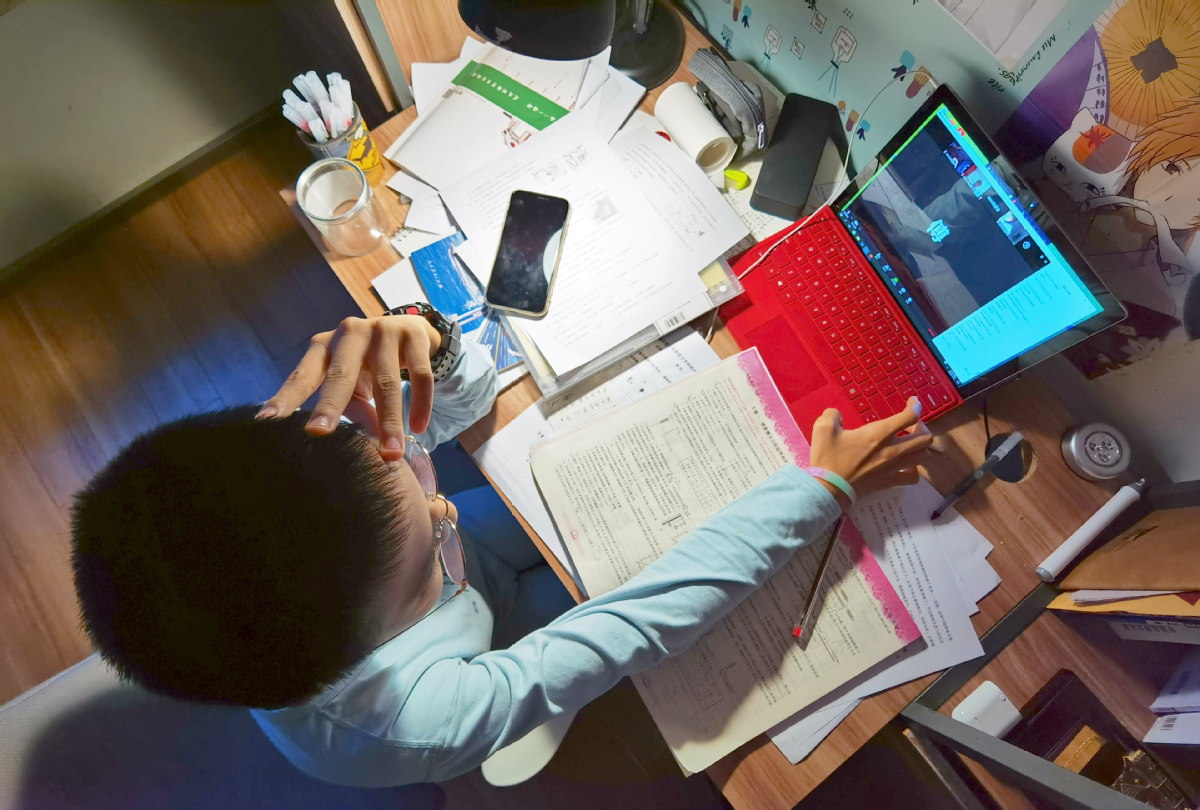
After years of rapid and uncontrolled expansion, the winter of China's tutoring education has finally come. Known as "double reduction", the new policy, issued recently by the general offices of the Communist Party of China Central Committee and the State Council, aims to ensure education equality and ease the burden of excessive homework and off-campus tutoring for students.
This undoubtedly put the top three tutoring firms -- New Oriental, TAL Education Group and GaoTu Techedu -- into a quagmire by banning off-campus training institutions from raising funds and halting approvals for new institutions that provide training in core curriculum subjects.
It can be argued that online education played an important role in maintaining order, especially during last year, when the COVID-19 pandemic suddenly emerged. After all, as a temporary communication tool under certain conditions, online education provided by the top three tutoring firms and many other online education platforms did offer a convenient way for both teachers and students to continue their teaching. The contribution of online education cannot be understated.
However, the problem behind it is that after years uncontrolled expansion, the industry has accumulated excessive capital, which exacerbates education equality, not only between urban and rural areas, but also between students who can afford it and those who cannot within a certain area. Therefore, the crackdown on the extreme capitalization in the tutoring industry and the promotion of equal access to education could not come soon enough.
Students have suffered from the burdens of after-school tutors and too much homework for a long time. Overtime classes in school or after school -- a product of the intense peer pressure in the hyper-competitive education field -- have robbed students of any time to go outdoors or enjoy a real rest.
Even their parents are tired. All parents hope children can have a happy childhood, but they couldn't stop driving their kids to all kinds of extra training classes over fears of their kids falling behind in the competition over scores. Parents will do almost anything to improve the educational prospects of their children, even if that means spending huge sums of money on tutoring. Yet, these endless investments can only serve to transfer their anxiety and pressure to their children, without much benefit to the kids' growth and development.
After-school tutoring has a competitive relationship with teachers, as it can disturb normal teaching efforts. For example, if some students learn something new in advance during the summer holiday, while others have not, it will create difficulties for the teacher to effectively manage and guide the class in learning.
The after-school tutoring industry considers the business a lucrative venture, only caring about how to expand and maximize profits rather than improving teaching. In particular, the industry has drawn fire for its tendency to use false and exaggerated advertising to play on parental anxieties and for fueling the supposed "involution" -- developing in a direction of more complexity, with little gain -- of Chinese education.
As Neil Postman says in his book Amusing Ourselves to Death, "Our education is becoming more and more like entertainment. We care about how to advertise our programs rather than what we can offer to students."
All participants in the chain of education used to suffer from the burden of extreme capitalization in the tutoring education. They feel exhausted from it, and they don't want to do it, but they have to. They have no chance unless they finally escape from this chain of society, which cannot be possible. Thus, involution can vividly describe this phenomenon.
From the above analysis, we can see that it is not online education, but the rather extreme capitalization in tutoring education that disrupts our normal education. If we can make good use of communication tools and take control of extreme capitalization in education, we can finally guide online education to good.
Examples of this are already emerging, such as Chengdu No 7 High School's Distance Education Cooperation Program, established in 2000, which provides an avenue to quality education to students from less affluent areas and allows them to participate in classes in real time. To date, the program has been instituted in eight provinces, two autonomous regions and Chongqing municipality in southwest China with more than 309 member high schools, as well as nearly 10,000 students from ethnic minority areas and less-developed regions participating in the program. It empowers these students with quality education together with peers at the Chengdu school every day.
In short, we must distinguish between extreme capitalization in tutoring education and online education, which can bridge the digital divide and benefit society. Only by cracking down on extreme capitalization in education and guiding information technology in a positive direction can we narrow the achievement gap between different areas and hope to reach education equality.
Cheng Weiru is a undergraduate from Jilin University, majoring in advertising.
The opinions expressed here are those of the writer and do not necessarily represent the views of China Daily and China Daily website.
If you have a specific expertise, or would like to share your thought about our stories, then send us your writings at opinion@chinadaily.com.cn, and comment@chinadaily.com.cn.