



India EV goal yet to clear roadblocks







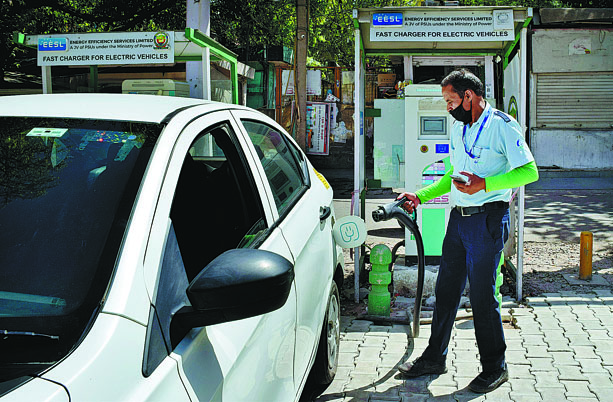
Lack of charging points among barriers as incentives fail to impress carmakers
Ambitious plans for India to shift to electric vehicles, or EVs, hinge on overcoming constraints such as a lack of charging stations, let alone insufficient production facilities to make the clean-technology vehicles and the batteries powering them, experts say.
The government plans to have battery-run vehicles make up 30 percent of all new vehicles sold in India by 2030, but achieving the goal looks daunting.
Ensuring an adequate supply of the raw materials required to make the batteries is another major challenge.
"India doesn't have any large-scale electric vehicle or battery facilities. Nor does it have much ownership of the raw natural resources-cobalt and lithium in particular-that are considered crucial inputs in the production of batteries," said Prabir Kumar Bose, the former director of the school of automotive engineering at Jadavpur University in the state of West Bengal.
The Indian government has mapped out a range of incentives for EV producers as it seeks to gradually phase out conventional combustion engine cars in an effort to counter climate change.
To back the 30 percent target for 2030, the ministry of road transport and highways last week announced EVs would be exempt from registration fees.
The federal government earlier, in its budget, allocated $96.8 million to facilitate the transition under a program called Faster Adoption and Manufacturing of (Hybrid &) Electric Vehicles in India.
Under the program, India will set up 2,877 charging stations in 68 cities across 25 states by 2024. And more measures are likely to be announced by the government to boost the production of the vehicles.
At a forum on Aug 10, India's Minister of Road Transport and Highways Nitin Gadkari said that by 2050, there will be more electric vehicles than conventional ones on India's roads.
Gadkari said batteries were the most important component of the vehicles and constituted at least 50 percent of the upfront cost. The ministry is encouraging innovation in this field, he said.
However, Indian carmakers say the incentives for EV production are inadequate.
For the government's targets to be met, the government must spend billions of dollars to build out a nationwide network of charging stations and provide tax incentives to consumers, among other measures, they said.
Alok Ray, assistant director of the Society of Manufacturers of Electric Vehicles, an association representing Indian EV and component makers, said India should designate some cities for EV-only use.
Keen for change
"Indians want to shift as the price of petrol is… spiraling out of control every day," Ray said.
Sales of the vehicles in India stood at 238,120 units in the 2020-21 fiscal year, according to the manufacturers association.
India's transport sector is a voracious consumer of the world's crude oil. According to official data, the country imported 198.1 million tons of crude worth $62.7 billion in the fiscal year ending March 2021.
Some automobile manufacturers and power utilities have thrown their support behind EVs. Tata Motors and Mahindra Group, two big vehicle makers, and Tata Power have pledged to build 300 rapid-charging stations in five Indian cities by the end of this financial year.
But some, including unions, warn of job losses if the transition is too fast.
"An abrupt and sudden changeover will disrupt the entire system, including vendors, dealers, spare parts manufacturers, mechanics, as well as other stakeholders, thereby impacting the livelihoods of millions of people dependent on the industry," said Amit K. Biswas, a professor at Visva-Bharati University in Santiniketan in West Bengal.
The writer is a freelance journalist for China Daily.










