Chile, China and collective financial statecraft
Investment in bi-oceanic corridors would facilitate exports from the Southern Cone to Asia







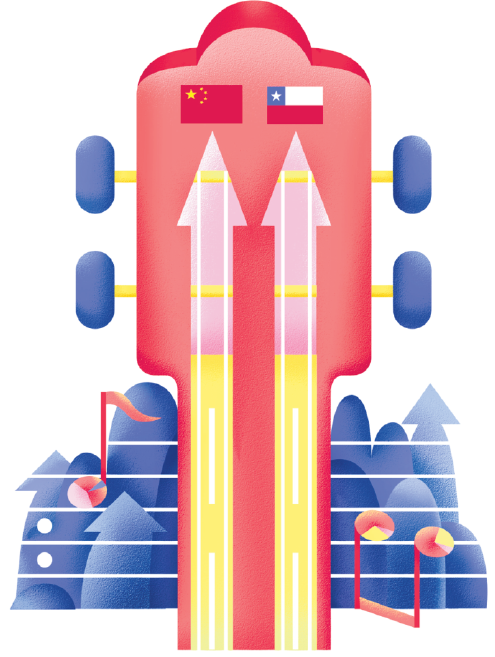
In July 2021, under the government of President Sebastian Pi?era, Chile became a full member of the Asian Infrastructure Investment Bank. In May 2017, then-president Michelle Bachelet was the first foreign head of state to visit the AIIB headquarters in Beijing, when Chile joined the Bank as a prospective member. This shows remarkable continuity, across party lines, in Chile's policy toward Asia in general and China in particular.
After Ecuador, Uruguay, Brazil and Argentina, Chile is the fifth Latin American country to join the bank, which now has 103 members. With 19 Latin American and Caribbean countries having signed memorandums of understanding on the Belt and Road Initiative, the ground has been laid for more extensive cooperation between China and Latin America, taking advantage of the rise of what professor Leslie Elliott Armijo has called collective financial statecraft.
This could not come at a more critical time. Latin America was badly hit by the 2020 recession, with regional GDP falling 6.8 percent, per capita incomes falling to the level of 2010, and poverty levels to those of 2006, with one in three Latin Americans now living under the poverty line. A massive effort to rekindle economic growth in Latin America is needed, something in which China through the AIIB and the New Development Bank, as well as through its policy banks, such as the China Development Bank and the China Eximbank, can play an important role.
Chile has played a pioneering role in relations with China. In 1970, it was the first country in South America to establish diplomatic relations with the People's Republic of China. Later, it was the first country in the region to support China's bid to join the World Trade Organization, the first to support China's status as a market economy, and then, in 2005, the first individual country to sign a free trade agreement with China. Since then, bilateral trade has increased five-fold, from $8 billion to $40 billion in 2020, making Chile China's third-largest trading partner in Latin America.
Since 2010, China has been Chile's biggest trading partner. In 2020, 35 percent of Chile's exports went to China. Although copper forms the bulk of the exports (Chile is the largest producer and exporter of copper, having 29 percent of the world's proven reserves; China is the biggest importer of it), Chile has diversified its exports quite a bit. In 2016, Chile became the top exporter of fruit by value to China, and China became Chile's largest market for its wine (Chile is the fourth-largest wine exporter in the world).Trade has been the key driver of the relationship.
Yet, 10 years after the signing of the FTA, Chinese investment in Chile still lagged behind that in neighboring countries. This started to change in 2016, and accelerated in 2018 with the purchase of one-fourth of Chile's main lithium producer, SQM, by China's Tianqi Lithium, for $4 billion. In 2019, China was not only Chile's top trading partner, but also its biggest source of foreign investment, with $4.8 billion. China was again the No 1 source of foreign investment in Chile in the first half of 2021. China's State Grid has formalized its purchase of Chilean power distributor CGE, for $3 billion. Though estimates vary, Chinese investment in Chile today hovers somewhere around $15 billion.
Chile's joining the AIIB, and the fact that there are now five South American (non-regional) members of the bank, indicates that perhaps the time has come to leverage that presence into joint projects. A key problem in the region is the high logistics and transport costs-twice as high per export unit as the Organization for Economic Cooperation and Development average. This affects the region's competitiveness and ability to grow its share in world markets. Intra-regional infrastructure and connectivity is notoriously deficient in South America. The subcontinent is a huge, underpopulated land mass with some of the highest mountains and longest rivers in the world. The population centers and the most developed areas are largely on the coasts, and cross-country transport facilities are woefully inadequate.
A long-standing major project is that of the bi-oceanic corridors from the Atlantic to the Pacific Ocean, which would make it possible for exporters in countries such as Brazil, Uruguay and Argentina to get their exports via Chilean ports to Asia, where the main demand for them is to be found. In fact, one-fourth of China's agricultural imports comes from these four countries in the Southern Cone. Crossing the Argentine pampas, and then going through the Andes mountains, this is a major engineering and construction project. It would create thousands of jobs and enhance the Southern Cone's competitiveness in world markets. It is also precisely the sort of project, targeted to Asian markets, for which the AIIB was set up in the first place.
The author is former Chilean ambassador to China, a research professor at the Pardee School of Global Studies, Boston University, and a Wilson Center global fellow. The author contributed this article to China Watch, a think tank powered by China Daily. The views do not necessarily reflect those of China Daily.