'Greening the Deserts that Cover a Quarter of Earth's Land Area is a Path to World Peace' — 'Father of the Desert' from Japan and his 30-Year-Efforts at Desertification Control in China







Editor's Note: To celebrate the 100th founding anniversary of the Communist Party of China, we are launching the "100 CPC Stories in 100 Days" series, featuring foreigners who witnessed and participated in the CPC's history and helped the world better understand the CPC. The following is the 66th story of the series.
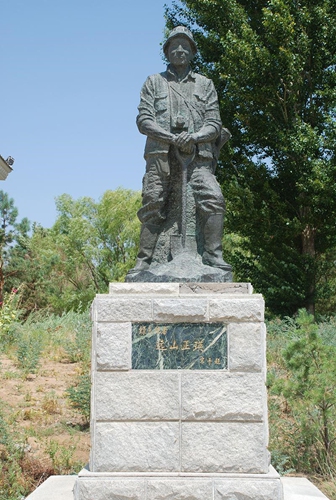
There is a full-sized bronze statue in the Engebei Ecological Demonstration Zone in the Kubuqi Desert of China's Inner Mongolia Autonomous Region, showing a thin man with a shovel in his hands, looking affectionately into the distance at the lush poplar forest. The man is Toyama Seiei, an agriculturist from Japan reputed as "Father of the Desert", who had turned the Engebei Desert green through 30 years of desertification control.
Toyama Seiei's story with China's deserts started in the mid-1930s when he was studying in China. Shocked by the barren land and yellow sands in northwest China, he made it his mission to curb desertification. He even bought a piece of land for experiment in Kubuqi, Inner Mongolia. But Japan's invasion of China shattered his dream, and the sufferings of the Chinese nation and people saddened his heart. As a young scholar, Toyama had no other choice but to return to Japan with a profound sense of guilt and unfinished dreams, and had since buried himself in academic pursuit.
When diplomatic relations between China and Japan normalized in 1972, Toyama, who was then already retired, felt that he could not waste another moment at home. Too often had the screams and cries of the Chinese people butchered by the Japanese troops pierced his sleeps, and too often had he dreamed of returning to the vast deserts in western China. He almost immediately packed his bags and went to Gansu, Ningxia and other places in China, and started his long crusade against desertification.
In 1991, the 84-year-old Toyama went back to Engebei in the heart of the Kubuqi Desert in Inner Mongolia. Engebei, meaning "peace and auspice" in the Mongolian language, is a piece of land that covers a total area of about 300,000 mu (20,000 hectares). Once a flourishing pasture, it was gradually reduced to yellow sands due to natural disasters and wars in modern times. The academics even called the place "cancer of the Earth", because the harsh weather and barren land seemed to be uncontrollable. Still, Toyama settled down and declared "I will not leave before desertification here is controlled."
Many wonder why this old man who could easily enjoy a better life chose to work in such harsh conditions in the desert by the Yellow River. Toyama answered: "I am making atonement, and more importantly, paying a debt of gratitude!" He further explained that, as an island country, Japan had received much help from China. Although some of his peers in Japan had done the most sinful deeds against the Chinese people, the Chinese have instead shown the greatest possible forgiveness. Any Japanese with a conscience should be grateful for at least three acts of kindness from the Chinese: First is the spread of Buddhism to Japan by Jianzhen, an eminent monk in the Tang Dynasty; second is the fact that China did not claim war reparations from Japan after WWII; and thirdly, the Chinese people raised many Japanese orphans who were left behind in China after WWII. "I came to the desert in China as an act of atonement for Japan's aggression. Words are not enough to show our apologies, and we must do good things for China with real actions."
In Engebei, one could often see an old man in his sun helmet, work clothes and high rain boots carrying a tool bag. He was always there in the fields, busy working, summer and winter alike. It is extremely difficult to plant trees in quicksands. One must first dig a pit with a stick, and then nest the salix in the earth, and water it with at least six barrels which would take six round trips. To keep the water, the pit must be 80 centimeters deep, not one centimeter less. The width of the pit, the distance between the saplings and the softness of the soil must also meet strict standards. Thanks to Toyama's strictness, diligence and perseverance, the survival rate miraculously rose from less than 20% to 80%.
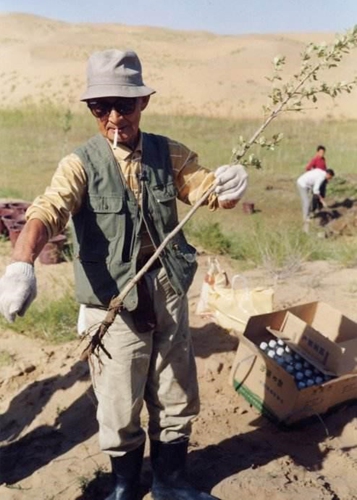
Toyama also initiated the Japan Association for Greening Deserts, and declared that his dream is to green the deserts that cover a quarter of Earth's land area, "because I believe this is the path to world peace!" To raise funds for his cause, he sold many family properties, made speech tours across Japan, and gave interviews to the NHK, calling on Japanese people to "skip one meal a week" to donate money and grass seeds to Engebei. He also called on young Japanese to come to China as volunteers to plant "trees of friendship".
An old Japanese who was in Inner Mongolia during WWII with the invading Japanese troops came to Engebei and said: "My heart was trembling. Years ago I came here with swords and guns; now I brought here saplings. Every tree I plant is a symbol of my deepest atonement."
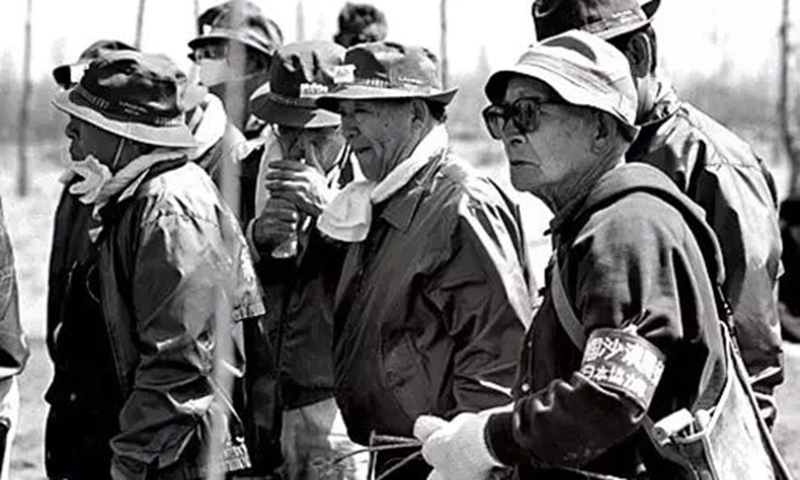
Thirteen years had passed. Inspired by Toyama, more than 7,300 Japanese volunteers, including his children and grandchildren, had come to Engebei and planted more than 3 million trees, turning 40,000 mu (2,668 hectares) of desert green, before Toyama passed away in February 2004 at the age of 97.
In that year, nearly half of the desert in Engebei was covered by vegetation. With poplar trees and green grass, the once barren land was fertile again. A breeding and plantation base, the largest in north and northwest China, was also set up there, providing local farmers a large number of nurseries and cash crops that have increased their production and income. Kubuqi is praised as a model of desertification control by the United Nations, and Engebei is identified as a national ecological demonstration zone, attracting tens of thousands of tourists from home and abroad every year.
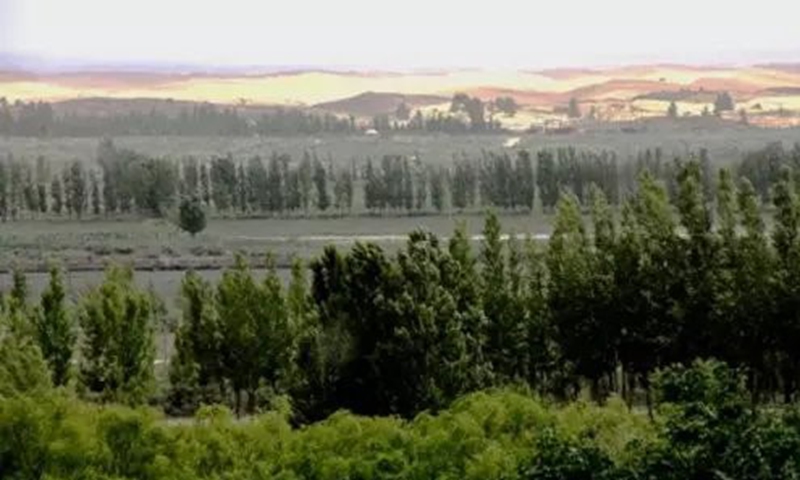
Following Toyama's will, half of his ashes were brought back to Engebei and scattered in this piece of now green land that he affectionately loved and cared for. Toyama is like a seed and a torch. His passing did not mean the end of the desertification efforts in Engebei; instead, inspired by him, young volunteers from all over Japan continue to come to Engebei with seedlings and flower seeds, contributing to China's ecological development. Thanks to the unremitting and concerted efforts of Chinese and foreign friends, the vegetation coverage of Engebei reached 78% and the forest coverage 41% by 2020.
Even decades before, Toyama seemed to have foreseen this great success. He said that environmental issue goes beyond national borders. It needs global efforts, and in this sense, the Japanese are actually helping themselves when they come to green the deserts in China. Driven by his sense of justice, conscience, foresight and broad-mindedness, Toyama Seiei made remarkable contributions to China's ecological conservation and environmental protection, and won the respect of the Chinese people. He not only planted green trees in Engebei, but also sowed the seeds of reconciliation and friendship between China and Japan.



- China moves to set national standards for pre-made dishes
- Chinese company unveils plans for commercial space flights
- Latest addition to Shiziyang Bridge constructions brings main tower above 300 meters
- Hebei's 'ancient pressure cooker' setting internet ablaze
- Major urban renovation restores Xi'an's ancient moat
- China launches nationwide employment assistance program