Robo-cars the next 'big thing' in intelligent era







Self-driving car services roll out in Shenzhen as tech giants scramble for a slice of emerging market
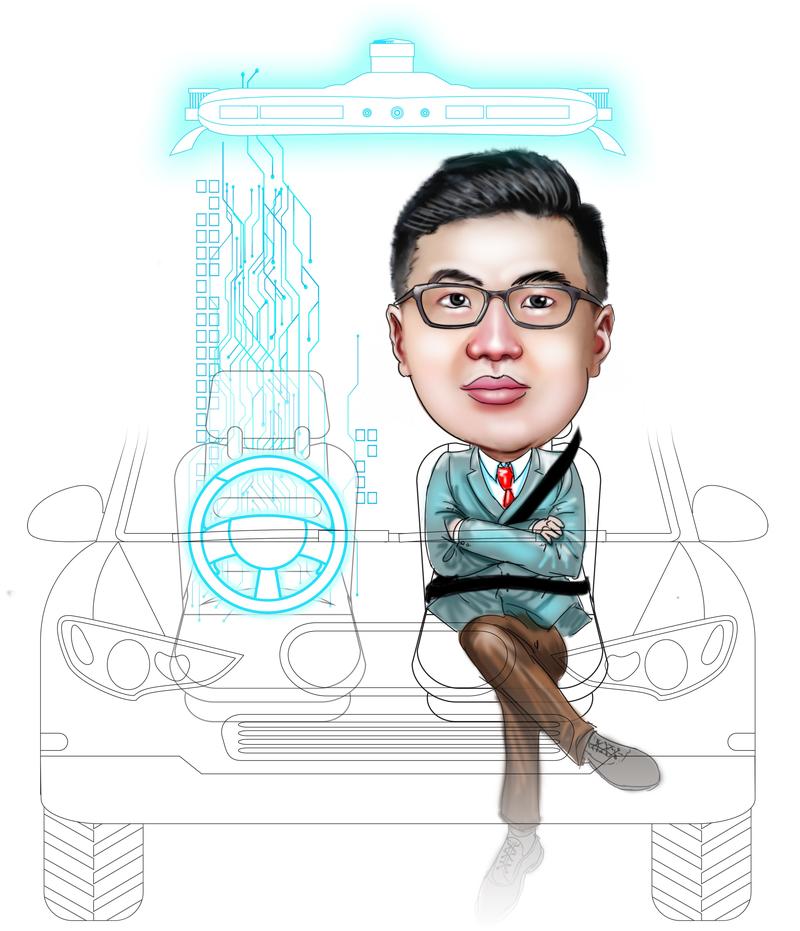
When Liu Xuan saw a blind tuner had left a message on his company's WeChat account saying that he was yearning for a better life with a driverless or robo-car a few month ago, the Shenzhen entrepreneur knew he was doing something of significance — making life better for people, especially, the disabled.
Liu's team immediately got in touch with the tuner and invited him to try their self-driving vehicles. They also made him an "experience officer", who could give advice on improving the services after experiencing the self-driving cars. "Although we are a technology company, we have humanistic care in mind," said Liu, the vice-president and a partner of DeepRoute.ai Company — a Shenzhen-based startup that offers L4 self-driving solutions. Autonomous driving is categorized from L1 to L5, the higher the level, the more intelligent the technology. While L5 represents full self-driving, L4 represents the second highest degree of driving automation.
"We hope we can improve our society through technology," Liu said.
The autonomous-driving business has grown more competitive as it becomes more popular. Chinese mainland and overseas tech giants, including Baidu, Huawei, Google and Microsoft, have been stepping up investments in the emerging market, convinced it will be the next "big thing" in the new intelligent era.
To meet the challenge, Liu said the startup has created core technological strengths. It has developed the DeepRoute-Engine — an inference engine whose inference efficiency could be six times that of an open source deep learning framework on average. With the new technology, power consumption in the deep learning process could be cut by 80 percent, compared with a traditional scheme, which involves the use of energy-consuming computing platforms. Costs could be reduced by half.
The breakthroughs are significant, Liu stressed. "Industry players are generally sensitive to costs. The higher the price, the greater the difficulty for us to achieve mass production and make a profit."
Lower energy consumption matters as high power consumption generated by computing could reduce the maximum mileage of new energy vehicles. While about 1,000 watts could be consumed additionally for powering computing devices and sensors on a driverless vehicle using a traditional scheme, the DeepRoute-Engine scheme would only take up an extra 200 watts, or one-fifth of the former, Liu said.
In April, DeepRoute.ai became the first Shenzhen company to win a permit for running a robo-taxi pilot program in the city. It allows the startup to offer self-driving services to the public.
Self-driving car services went into full operation in Shenzhen on Monday. Users can hail a driverless car on the company's WeChat mini app, with an invitation code sent to them after registration. The operation is confined to the downtown Futian district.
Driverless vehicles have also been used in battling the latest coronavirus outbreak in Shenzhen, with about 14,000 COVID-19 test samples being transported from test centers to hospitals each day.
Liu's company is also operating in other major mainland cities, such as Wuhan, Hangzhou and Xiamen. In Wuhan, Hubei province, the company is working with Dongfeng Motor Corporation — one of China's largest automobile groups — on a project that aims to build the country's largest robo-taxi fleet of at least 200 vehicles by 2022. In Hangzhou, Zhejiang province, it is teaming up with ride-hailing platform Caocao to provide ride-hailing services with hundreds of driverless vehicles during the 19th Asian Games in the eastern city in September next year. The technology is also being used for container trucks at a port in Xiamen, Fujian province, helping the port to upgrade itself into an intelligent one powered by a 5G network.
Liu said the company would first focus on expanding its services in Shenzhen to cover whole areas in the city. "Then we will expand to other first-tier cities (on the mainland) as their relatively strong economic performance and high demand for ride-hailing services will fuel the industry's growth. It will also help us attain our commercial targets," Liu said.
According to global consultancy International Data Corporation, global shipments of L1 to L5 self-driving vehicles are expected to hit 54.25 million units by 2024, with an average annual growth rate of 18.3 percent from 2020 to 2024. L1 and L2 levels are projected to account for 64.4 percent and 34 percent of market share respectively during the period.
L4 self-driving is expected to achieve "small-scale and limited" application mainly in the public and commercial fields over the next five years, IDC said. It expects the number of L4 driverless vehicles shipped to reach 170,000 by 2024, with an average annual growth rate of 111.5 percent between 2020 and 2024.
"Compared with overseas markets, the outlook for the development of the autonomous driving industry in China in the next five years will be more promising, given the country's favorable economic and policy environment," said Li Lianfeng, research director of IDC China.
While major enterprises will continue to play a key role in automobile manufacturing, emerging tech companies will be in an advantageous position in driving the intelligent trend, Li said. In areas like artificial intelligence, data management, chip design, sensing and networking development, the latter will play a bigger role.





- Why do China's cultural and creative products go viral?
- Aviation sci-fi park Nantianmen to open in 2027
- Chinese researchers make breakthrough in green cooling technology
- Former head of national forestry and grassland body under investigation
- A new lease of life: Providing dialysis access in rural China
- China's grain output hits new high in 2025