Experts focus on biodiversity as COP15 approaches







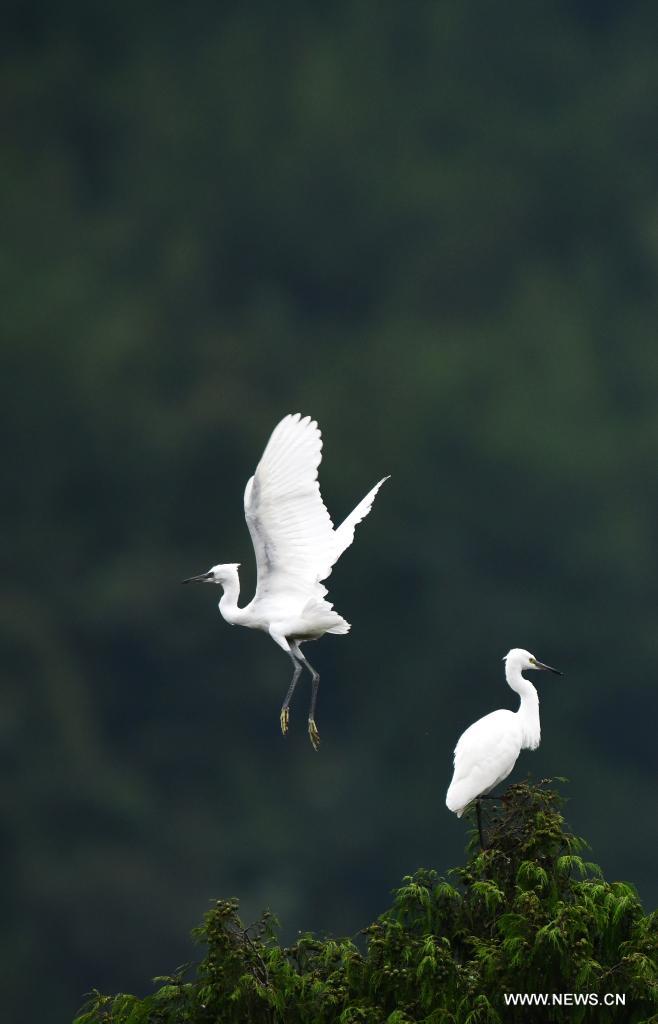
GUIYANG - Experts home and abroad set sights on biodiversity protection during a parallel session held earlier this week at Eco Forum Global Guiyang 2021 in Southwest China's Guizhou province, calling upon governments and citizens to cherish Mother Nature as their most precious asset.
"In recent years, an average of about 75 species are disappearing on a daily basis, and it is estimated that around 1 million species will become extinct by 2050," said Cai Chaolin, vice governor of Guizhou province, during the sub-forum.
Zhang Hai, the session's host and executive director of the global forum's secretariat, also alarmed attendees by citing views from some scholars that human beings are experiencing their sixth mass extinction and the planet's species are disappearing ever faster than in any era across history.
"In the last five mass extinctions, the dominant organisms on Earth were no longer living. Therefore, it is crucial that humanity seize the opportunity for action in the coming decade," Zhang cited mainly from a book written by Richard E. Leakey, who first brought the concept of "the sixth extinction" into global limelight.
Considering the severity of the problem, guest speakers and scholars at the sub-forum appealed for joint action to better protect the earth's ecosystems and expected the approaching 15th meeting of the Conference of the Parties to the Convention on Biological Diversity (COP15) to help chart the course of preserving biodiversity while achieving sustainable development.
In October, China is set to host COP15, reviewing the "post-2020 global biodiversity framework." Themed "Ecological Civilization: Building a Shared Future for All Life on Earth," the meeting is the first global conference convened by the United Nations on the topic of ecological civilization.
COP15 is set to determine whether biodiversity loss will peak by 2030, and core issues will include political commitments, pragmatic approaches and technologies, as well as possible capital investment, according to Zhang Xinsheng, president of the International Union for Conservation of Nature (IUCN).
Established in 1964, IUCN's Red List of Threatened Species is now the world's most comprehensive information source on the global conservation status of species of animals, fungi and plants. The IUCN Red List serves as a critical indicator of the health of the world's biodiversity and a powerful tool to inform and catalyze action for biodiversity conservation and policy change.
During the session, the discussion revolved around the Dasgupta Review, an independent and global review of the economics of biodiversity led by Professor Partha Dasgupta, an economist from the University of Cambridge. The professor regards nature as the most precious asset of all human beings, and he said via video link that more effective measures should be taken to protect the environment before things get worse.
By making an analogy between a company's financial assets and Mother Nature, Justin Lin Yifu, dean of the Institute of New Structural Economics at Peking University, called upon governments around the globe to play a proactive role in managing the "market failure" that occurs during current economic development and environmental protection efforts.
"The conservation of nature and biodiversity is impossible to achieve by one single country's action. Only through global action and necessary measures can the decline of biological species reach its peak by 2030, so that the earth's species can recover," said Lin.





- China seeks public feedback on draft rules for anthropomorphic AI services
- China's top legislature concludes standing committee session
- China adopts revised Civil Aviation Law
- China launches satellite to aid in early extreme weather detection
- Report on mining accident that killed 6 suggests accountability for 42 individuals
- Law aimed at bolstering standard Chinese language education passed