



Rural dwellings stand as proud legacies in Fujian
Ancestral homes of Hakka people fuel tourism influx







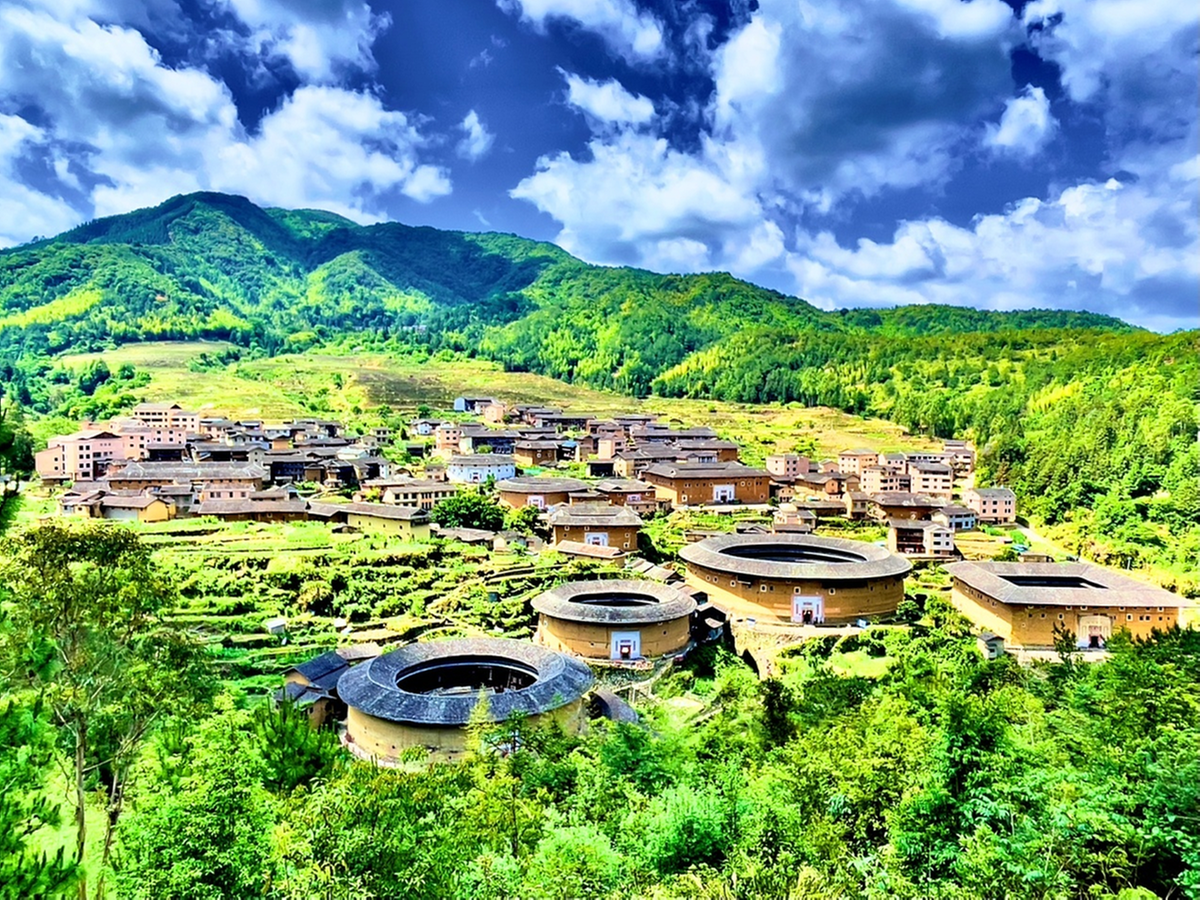
In valleys filled with thick vegetation, different-sized circular and rectangular buildings with faded yellow clay walls lie scattered in mountainous villages in Longyan, Fujian province.
Surrounded by captivating mountains and enticing streams, the dark-brown wooden roofs of these tulou, (earthen buildings) in the city's Yongding district look magnificent at sunset.
A type of rural dwelling in Fujian combining accommodations and fortifications, these architectural wonders have attracted attention at home and abroad in recent years. They are arranged in a way that enables them to blend in with their surroundings, providing visitors with breathtaking views and peace and quiet.
There are more than 23,000 tulou in Yongding. The buildings became well-known after 46 of them were given World Heritage status by the United Nations Educational, Scientific and Cultural Organization in 2008.
The structures were awarded this status, as "they are exceptional examples of a building of tradition and function exemplifying a particular type of communal living and defensive organization, and, in terms of their harmonious relationship with their environment, an outstanding example of human settlement", according to UNESCO.
The resulting tourism influx in the area has not only prevented the buildings from falling into disrepair, but has bolstered local businesses a
Locals said tourism has helped them escape poverty, and is contributing to rural vitalization and improved livelihoods as China embarks on a new journey toward full modernization.
However, in the early 1980s, Yongding was still an area where people had little contact with the outside world and its tulou attracted only a few backpackers.
Lin Rigeng, 71, owner of the Zhencheng Building, a tulou in Hongkeng village, said that until the early 1990s there was no road into the village and few locals had even seen a bicycle.
The Zhencheng Building was built in 1912 by Lin's grandfather, who became a wealthy businessman in Yongding selling tobacco cutters. It took the family nearly five years and a large sum of money to complete the design and construction of the four-story building, which consists of 208 rooms around a central courtyard and covers nearly 5,000 square meters.
Lin has always lived in the building, which is known as the "prince of Hakka tulou" and is one of those placed on the World Heritage List in 2008.
"It's one of only two structures in China that follow the design of the Eight Diagrams-the other being the Temple of Heaven in Beijing," Lin said. The eight diagrams symbolize eight natural phenomena: the sky, earth, thunder, wind, water, fire, mountains and lakes, and they represent early knowledge of the universe in ancient China.
As with Lin's home, the giant multi-storied tulou were built with wood and fortified with mud walls. Constructed from the 15th to 20th centuries, these massive communal homes were sited based on feng shui principles-a pseudoscientific traditional practice originating from ancient China, which claims to use energy forces to harmonize individuals with their environment. The tulou are also purposefully nestled amid tea, tobacco and rice plantations and abundant forests of pine and bamboo.


- Defense minister greets foreign military envoys at Chinese New Year event
- Judicial efforts lead to decline in China's pollution cases
- SPP steps up food and drug safety oversight
- Visually impaired student's rail journey goes viral
- First nighttime high-speed departs from Guangzhou for Wuhan
- Chongqing, Hunan, Guizhou host cross-province Spring Festival celebration












