



China moving toward clean energy and healthy environment







Editor's Note: Energy is vital to economic development and improving people's lives, but power generation also causes environmental pollution. As such, China is now committed to phasing out coal-power plants while increasing the use of clean energy, writes a veteran journalist with China Daily in the first of a series of commentaries.
Coal was very precious in China half a century ago. Each family then used a bucket-like coal stove for cooking. Coal was precious not because it was expensive but because it was rationed. Each household got 200-300 kilograms of coal a month depending on the number of family members.
Understandably, an important criterion for a good housewife was whether she could keep the stove burning till the next supply of coal came. I still remember borrowing coal from neighbors after our household ran out of the rationed stock.
Coal was also the only fuel used by power plants to produce electricity. Low-wattage light bulbs were popular because the government encouraged their use to save energy. And yet power cuts were routine in most cities because of insufficient supply of coal. So, every family had to keep a few candles for lighting during power cuts.
Coal was so precious that when our painting teacher in primary school asked us to draw a picture of industrialized China, most of us drew either a train loaded with coal or chimneys billowing smoke.
When China launched reform and opening-up more than four decades ago, the government realized energy supply is of vital importance to economic development. So many more coal mines were opened in coal-rich Shanxi and neighboring provinces. After a few years, power cuts stopped and sufficient power supply helped China become the world's most important manufacturing hub.
But soon people found that excessive coal consumption caused serious air pollution and environmental deterioration. That's why over past two decades, China has been developing clean energies and reducing the production and use of coal. By the end of 2019, China had phased out more than 100 million kilowatts of outdated coal power capacity, and the ratio of coal-fired power in the total power generation dropped from 65.7 percent in 2012 to 52 percent in 2019.
The opening of the Three Gorges Project at the turn of the century could be regarded as the start of China's drive for clean energy. The hydropower station, one of the biggest in the world, is generating sufficient electricity not only for the neighboring provinces but also for regions further south. Since then China has built a number of hydropower projects of different scales, which have greatly increased the ratio of clean energy in the total energy mix.
To better protect the environment, the government requires more and more power plants to use oil or gas as fuel while those still using coal are required to adopt clean-coal technologies. To make that possible, efforts have been made to explore new oil and gas fields in China while a number of oil and gas pipelines have been built to import them from other countries.
China has also taken steps to generate energy by building large-scale wind power bases, and develop decentralized wind energy stations in the central and eastern regions. Traveling in China, one cannot miss seeing the thousands of wind turbines on both sides of highways and high-speed rail tracks.
Reports say an offshore wind power project with an installed capacity of 400,000 KW started operation in Yancheng, Jiangsu province, in April. By the end of 2020, the total installed capacity of new energy in Jiangsu had increased to 34.96 million KW, up 369.9 percent from 2015.
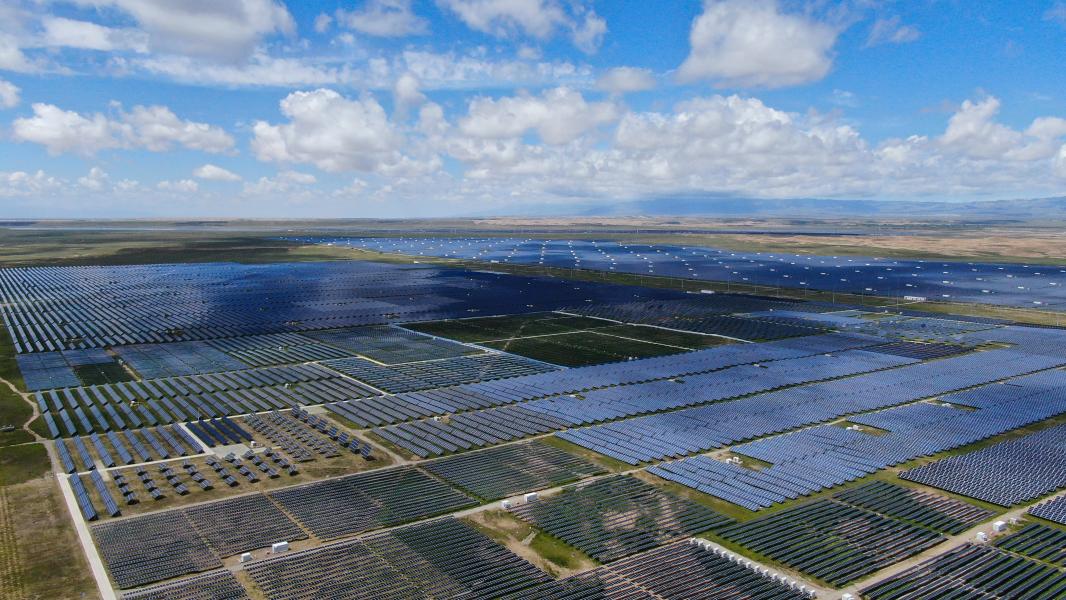
The government is also encouraging the use of solar energy, with experts using photovoltaic panels to not only generate electricity but also fight desertification and help lift villagers in arid areas out of poverty.
In Kubuqi, Inner Mongolian autonomous region, local residents have installed millions of such panels across the desert. After a year or two, they found that thanks to the shade provided by the panels, grass had begun to grow below them, greening the area. In some rural areas, solar power companies have signed contracts with the poor villagers to install solar panels on their roofs. The villagers, apart from using the power generated for free, also sold the surplus power to the companies and earn higher incomes which helped them to emerge out of poverty.
A recent State Council Information Office white paper on energy said that in 2019, coal consumption accounted for 57.7 percent of total energy consumption, down 10.8 percentage points from 2012. On the other hand, the consumption of clean energy, such as natural gas, hydropower, nuclear power, wind power and solar power increased by 8.9 percentage points during the same period.
Step by step, coal is making way for new energy. And someday, it may become difficult to find coal again like it was half a century ago. The difference is that, we will welcome its disappearance.
The author is former deputy editor-in-chief of China Daily.





