



Common stake in well-being







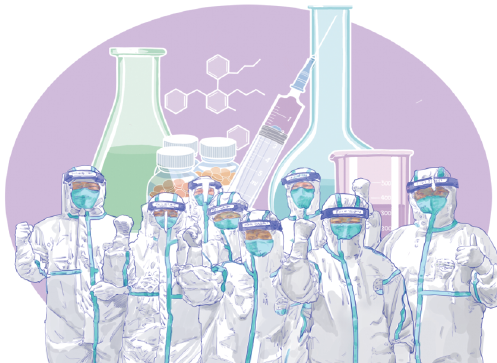
The novel coronavirus outbreak is a reminder of how urgent it is for the international community to join hands to safeguard public health
The 74th World Health Assembly was held virtually from May 24 to June 1, summarizing the World Health Organization's work in the past year and mapping out a plan for the future. Although the novel coronavirus outbreak has to a certain degree been brought under control, the global fight against the pandemic is still grim, with the severity of the situation varying among countries, and repeated resurgences and frequent mutations of the coronavirus occurring. Vaccine inequity compounds the problems. The meeting made clear that the international community needs to make concerted efforts to secure a victory against the virus and prevent future pandemics.
To start with, the pace of global vaccination should be accelerated. Global vaccination has become the most urgent task in the fight against the pandemic. Yet the problem of uneven access to vaccines has become acute. Although the COVID-19 Vaccines Global Access Facility has scored some major achievements, the supply shortage coupled with some countries lacking funds and the vaccine nationalism of some developed countries have resulted in severely inequitable distribution of COVID-19 vaccines. As of April 2021, some high-income countries, including the United States, the United Kingdom and Australia, have snapped up enough COVID-19 vaccine doses to inoculate their populations more than two times. The vaccinated population in these countries account for over 70 percent of the global population that have been vaccinated, whereas in middle- and low-income countries, less than 1 percent of the population has been vaccinated. The inoculation rate of high-income nations is 100 times that of low-income nations. To accelerate the vaccination pace in middle- and low-income nations, the vaccine production capacity must be expanded at a quicker pace, in addition to more equitable distribution of vaccines through the COVAX facility.
On the one hand, there should be better coordination of companies producing the COVID-19 vaccines to promote fairer distribution of the vaccines. On the other hand, major vaccine producing companies should be encouraged to carry out voluntary licensing and technology transfers to enable local vaccine production in middle- and low-income nations.
Second, countries should continue to implement stringent public health measures. From the anti-pandemic experiences of different countries, the pandemic is well under control in countries that have taken comprehensive, rigorous and thorough measures to curb the spread of the virus. The pandemic is rampant in countries that have not taken effective measures or reacted slowly. And the pandemic makes repeated resurgences in countries whose public health measures lack consistency-sometimes loose and sometimes tight-such as India and the UK.
The WHO has called on countries to strengthen their leadership and mobilization capacity and actively adopt public health measures. Effective public health measures include testing, tracing and the quarantining of contacts of people infected with the virus, wearing facial masks, social distancing and psychological counseling services and economic support for the general public.
Third, the global anti-pandemic cooperation should be further strengthened. Because of the high contagiousness and rapid spread of the coronavirus, all countries must remain vigilant until the virus is fully under control in every country. Countries should strengthen their communication and coordination, and jointly build a rigorous infection prevention and control network to prevent the cross-border spread of the virus. The international community should boost production and fair and equitable distribution of medical supplies, including vaccines, testing kits and medicines. The global fight against the pandemic will never achieve success unless the pandemic is under control in underdeveloped nations, which have poor medical conditions and fragile public health systems. Therefore, the international community should continue to dispatch medical teams and provide medical supplies and funds to these countries. To boost global anti-pandemic cooperation, the WHO's leadership role should be strengthened and the coordination mechanism between WHO and other international organizations should be improved.
Fourth, the international community should take effective measures to prevent the outbreak of another pandemic. The sudden outbreak of the novel coronavirus is another reminder of how urgent a task it is for the international community to take effective measures to prevent future pandemics, as the growing global population and continuous damage to the ecological environment have made such outbreaks more likely.
Countries should attach greater significance to pandemic outbreaks and strengthen their preparedness and capacity-building to respond to possible outbreaks. Countries should elevate the importance of pandemic risk prevention to the same height as other threats such as war, terrorism and nuclear disasters by having a more thorough understanding of a pandemic's threat to national security and human security. All countries need to take effective measures to enhance their pandemic preparedness, including formulating prevention plans, increasing investment in public health infrastructure and establishing an institution to coordinate relevant organizations and departments. In the meantime, countries should carry out drills on a regular basis to detect deficiencies in preventative measures and improve them in a timely manner.
At the same time, the global health governance system needs to be improved. The COVID-19 outbreak has exposed the deficiencies in the current global health governance system, including a lack of timeliness and the WHO's lack of authority to coordinate an international public health emergency response, the shortage of funds, the lack of attention paid to the International Health Regulations and the lack of coordination among international organizations.
Furthermore, an international treaty should be formulated targeted at the prevention of and response to future pandemic outbreaks, with the IHR included as part of the treaty. It should include the establishment of a global platform to coordinate the production and efficient and equitable distribution of medical supplies, such as vaccines. In the meantime, an effective fundraising mechanism should be set up, through which funds for everyday use can be raised and speedy fund-raising is possible in the face of a public health emergency.
The author is an associate researcher with the Institute of World Economics and Politics at the Chinese Academy of Social Sciences. The author contributed this article to China Watch, a think tank powered by China Daily. The views do not necessarily reflect those of China Daily.





