



To be relevant, G7 must promote multilateralism







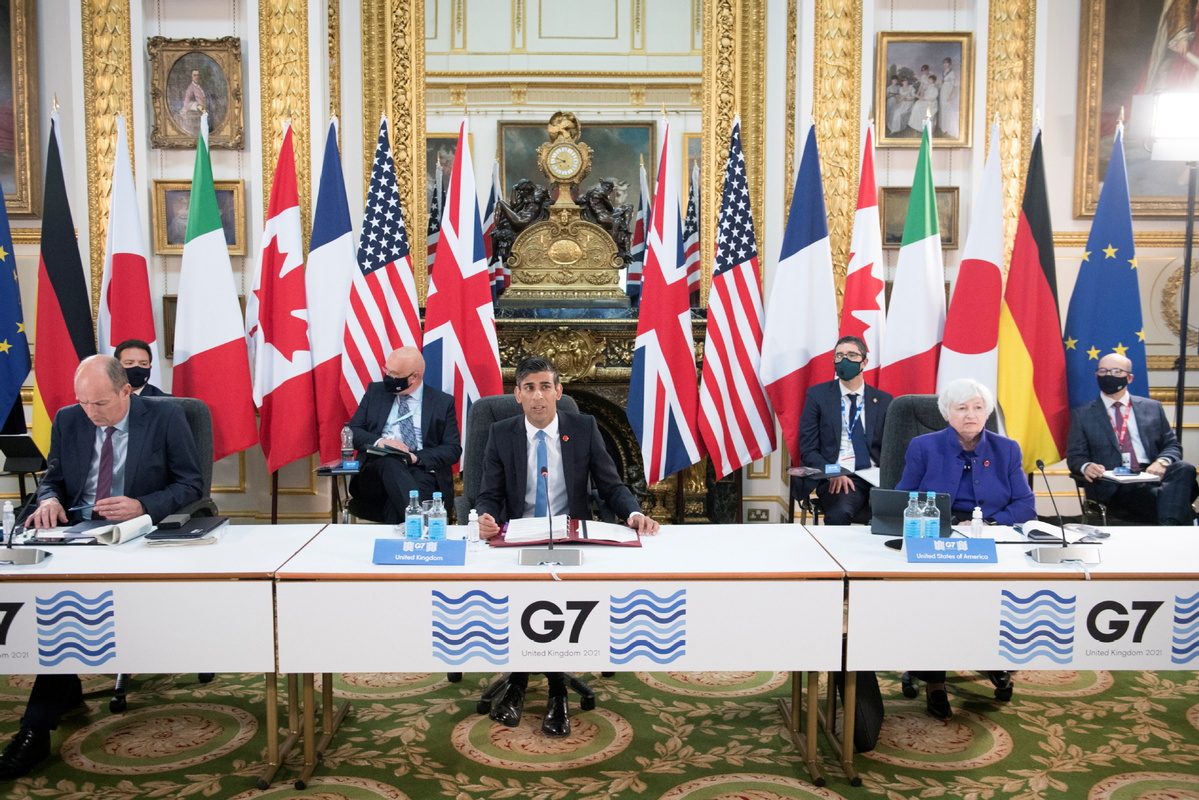
The G7 Summit to be held at Carbis Bay, Cornwall, on the southwest coast of Britain from Friday to Sunday has attracted special attention because it will be the first in-person international gathering since before the pandemic and its theme will be uniting "leading democracies to help the world fight, and then build back batter from coronavirus and create a greener, more prosperous future".
G7 summits normally help better coordinate the member states' policies and address the differences among the seven most industrialized countries. And since the G7 members are the world's most advanced economies, its decisions have a big impact on global economic and political governance.
However, given the fast-changing global landscape and the complex global problems, the G7 has been facing criticism that, as an elite group, it has no right to set an agenda that can have negative impacts on other countries. In 2018, Jim O'Neill and Alessio Terzi, of European think tank Bruegel, wrote: "The G7 in its current formulation, no longer has a reason to exist, and it should be replaced with a more representative group of countries."
Despite not being representative of the international community, the G7 can still establish its legitimacy by upholding multilateralism, promoting the fair distribution of COVID-19 vaccines worldwide, and boosting the global fight against climate change.
The pandemic is still raging in many countries, and can be effectively contained only if all the people in the world are vaccinated. But vaccine distribution remains inequitable with the rich nations hoarding much more vaccine doses than they need — they have secured more than 80 percent of the vaccines while the less-developed countries have got just 0.3 percent of the vaccines. As a result, the virus continues to spread and mutate into deadlier variants.
The worsening situation in developing and less-developed countries could derail global economic recovery and even pose a threat to people in the developed countries, because the health and safety of people in rich countries is inextricably linked to the well-being of the most vulnerable groups in other countries. In fact, global organizations as well as the G7 countries have realized that no country is safe until all countries are safe. As Matt Hancock, British secretary of state for health and social care said: "Globally we are only as strong as the weakest link in the health security chain."
Therefore, by ensuring that developing and less-developed countries get enough vaccines, the G7 will not only be fulfilling its moral responsibility but also serving its member states' interests. To prove its relevance in today's world, the G7 Summit should lead by example. And the best way it can do this is by making sure all countries, whether rich or poor, have equal access to the vaccines.
To begin with, the G7 countries should increase their financial contributions to the COVAX — a global initiative aimed at giving even low-income countries equitable access to the vaccines directed by Gavi, the Vaccine Alliance; the Coalition for Epidemic Preparedness Innovation; and the World Health Organization.
The least the G7 countries could do is to heed the call of UN special envoy and former British prime minister Gordon Brown, who has urged the rich nations to underwrite COVID-19 vaccinations in poor countries, stressing the need to raise some $60 billion over the next two years.
Besides, the rich countries that have hoarded more vaccine doses than they need should donate the excess vaccines to countries that desperately need them to inoculate their front-line workers such as doctors, nurses, lab technicians and vulnerable groups.
More important, to vaccinate the global population and cut the transmission chains of the virus, the G7 leaders must use the summit to waive the patent rights on the vaccines to facilitate the transfer of vaccine technology to pharmaceutical firms in other countries, which will scale up the production and ensure fairer distribution of vaccines. Only in this way can we realize the International Monetary Fund's proposal of vaccinating at least 40 percent of the world population by the end of 2021 and 60 percent by 2022.
Apart from helping boost global efforts to contain the pandemic, the G7 Summit should also focus on combating climate change. As climate change is linked to the spread of infectious diseases, it is necessary and urgent for the world to mitigate its effects and safeguard biodiversity. And as the time to reverse climate change and prevent the extinction of more species is running out, all countries should accord the highest priority to environmental issues.
In this regard, the G7 countries should shoulder more responsibilities than the developing countries in line with the principle of common but differentiated responsibilities. Of course, all countries should make greater efforts to better protect the environment, but we need to recognize the huge disparity in the level of economic development between the advanced and developing countries. As such, leading the global fight against climate change becomes the legal obligation of the G7 countries.
In other words, the G7 Summit should address the pandemic and climate-related problems in order to prove its relevance. And if the G7 members try to evade their responsibilities toward the international community, and instead criticize other countries for not doing enough in the fights against the pandemic and climate change, they will remain mere members of an elite club without actually doing any good for the world or promoting multilateralism.
The author is a professor at and director of the Center for Global Governance and Law, Xiamen University of Technology.
The views don't necessarily reflect those of China Daily.





