How negotiations laid the ground for the PRC







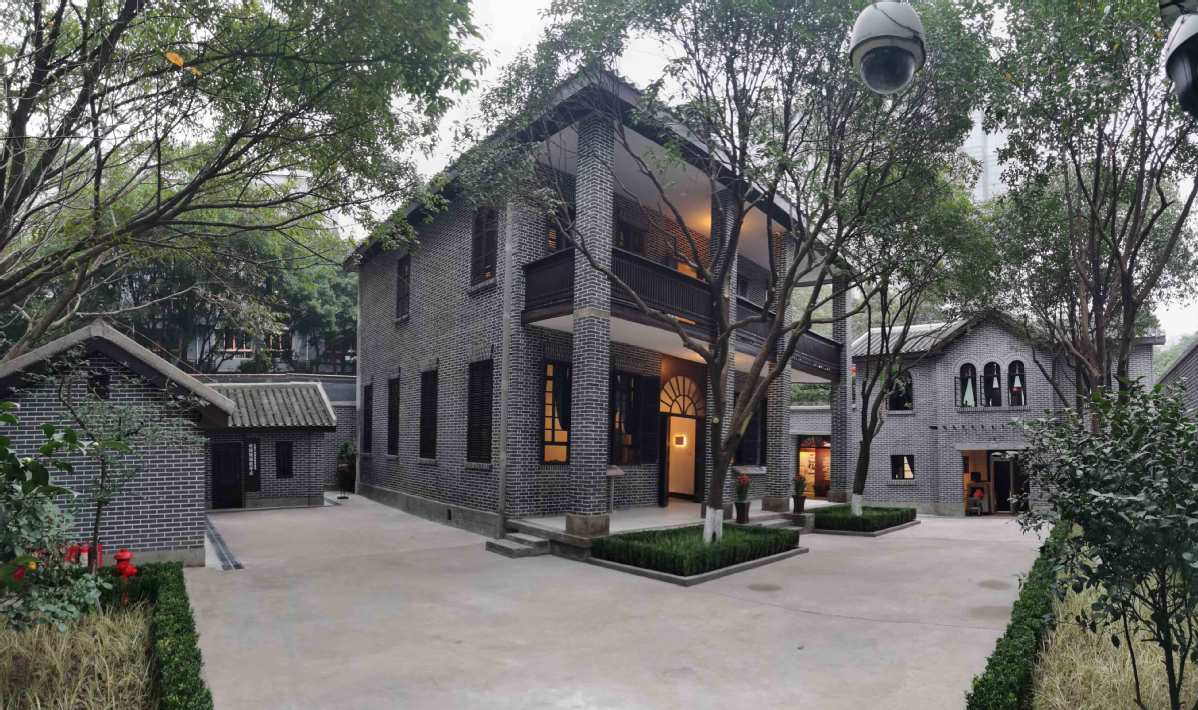
Chongqing was the scene of discussions and multiparty activity that eventually led to the CPC's victory and the founding of New China
Chongqing has a glorious revolutionary history. The city made major contributions to consolidating and strengthening the united front, an early form of multiparty cooperation, and winning the victory of the New Democratic Revolution.
In the city's downtown, the Chinese Democratic Parties History Exhibition Hall tells the story of how the Communist Party of China forged close partnerships with other political parties to build a better future for the people.
The hall was built on a section of the Te Garden, the residence of Xian Ying, founder of the China Democratic League, which served as a popular political meeting place in China's temporary wartime capital.
A large sculpture in the center of the lobby, titled Mao Zedong in Chongqing 1945, vividly recreates a scene where Mao Zedong, Zhou Enlai, leaders of other political parties and celebrities gathered and discussed national affairs.
China is a country of many political parties. Apart from the CPC, there are eight noncommunist parties. Chongqing was the birthplace of three of them: the China Democratic League; the China Democratic National Construction Association; and the Jiusan Society.
Since they were founded, they have established cooperative relations with the CPC to varying degrees. They responded to the CPC's call to hold the Chinese People's Political Consultative Conference, and participated in the CPPCC's First Plenary Session in September 1949 with the CPC and other players.
The meeting saw the adoption of the Common Program as the provisional constitution, and the founding and election of the Central People's Government, which led to the founding of the People's Republic of China.
In 1939, the Southern Bureau was founded on behalf of the CPC Central Committee in Chongqing to engage the Kuomintang and other political parties in the united front to fight Japanese aggression.
Progressive powers
"Led by Zhou Enlai, the Southern Bureau of the CPC Central Committee played a key role in the exchanges between the CPC and other parties," said Lin Yong, a former curator of the exhibition hall.
"The CPC understood that one party alone could never achieve success, and it had to unite all the progressive powers and build the widest revolutionary united front."
In addition, the bureau actively built close connections with foreign embassies, international charities and friendly foreigners who supported China's cause, gaining wide understanding, respect and support from the international community, especially during 43 days of high-level discussions in 1945 that became known as the Chongqing Negotiations.
The discussions between the CPC and the Kuomintang were an important political event at a crucial moment as China faced a choice between war and peace after its victory in the War of Resistance Against Japanese Aggression (1931-45).
"It was the first time the CPC had officially been seen on the international political stage, and it gained worldwide recognition," said Zhou Yong, director of the Chongqing Research Office of CPC History.
"Mao Zedong and other Party members did an extraordinary diplomatic job during their stay in Chongqing, winning understanding and support for the CPC from both the Chinese people and foreign nations."
On Aug 28, 1945, at the invitation of Chiang Kai-shek, then chairman of the National Commission of Military Affairs of China, Mao, chairman of the CPC Central Committee, traveled to Chongqing by special plane from Yan'an, Shaanxi province, for negotiations to realize the people's desire for nationwide peace and democracy.
Several weeks later, on Oct 10, the minutes of the talks between the Kuomintang government and representatives of the CPC, also known as the Double Tenth Agreement, were signed and released to the public.
To unite all possible social forces and establish a wider united front for China's peaceful development, Mao met more than 100 people from all walks of life on the sidelines of the negotiations. They included senior government officials, military officers, business tycoons, scholars, artists and representatives of other political parties and foreign missions.
He introduced them to the CPC's political platform and the development of negotiations with the Kuomintang, and also exchanged ideas about pressing issues such as democracy, domestic solidarity, economic development and how civil war could be avoided.
Mao also met the leaders of the Provisional Government of the Republic of Korea and expressed support for their national independence movement. The provisional government was launched in Shanghai on April 13, 1919, shortly after the Samil Movement declared Korean independence from Japanese rule, and settled in Chongqing in 1939.
On Sept 8, Mao hosted a tea party at the Gui Garden to thank the foreign friends for their support during the war and said he hoped they would continue to assist the Chinese people in the future. The participants included representatives from the China Defense League, the United China Relief and the British Red Cross.
Li Zhongjie, former deputy director of the CPC Central Committee Research Office of the CPC History, said the Southern Bureau made many contributions to the founding of the PRC.
In addition to establishing the united front and multiparty cooperation, "its active international exchanges not only won international sympathy, but also laid the foundations of the PRC's policies on foreign affairs and trained a large number of talented people to govern the country", he said.