Patent pioneer says China now an IP power







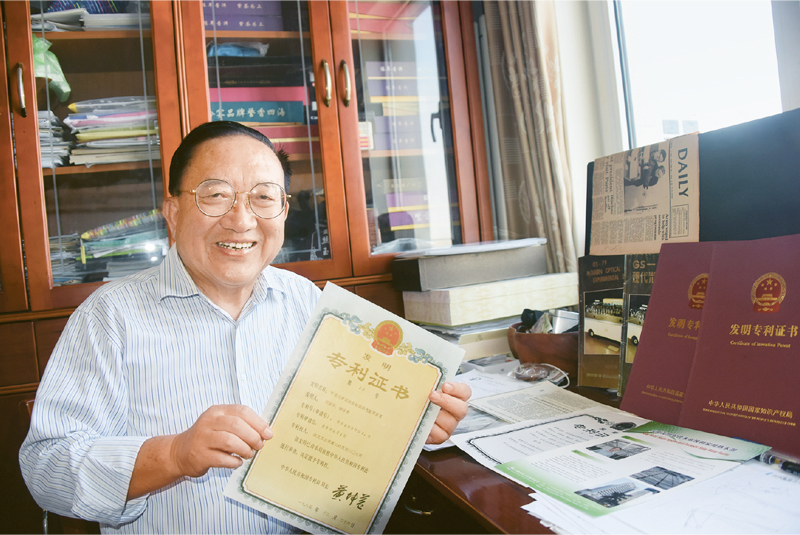
BEIJING-Thirty-six years ago, Hu Guohua lined up overnight outside China's patent office to apply for a patent. The next day, April 1,1985, China's Patent Law came into effect, and the office received more than 3,400 applications.
Eight months later, Hu received a patent certificate. Newspapers splashed photos of the bespectacled engineer.
"The patent system has recognized the value of knowledge, galvanized innovation and fostered development," Hu said in a recent interview.
In 1966, after graduating from Fudan University in Shanghai, Hu became a researcher at an institute under the former Ministry of Aerospace Industry in Beijing.
At the time, most people were not aware of the concept of intellectual property (IP). With recommendation letters, researchers could readily gain access to each others' inventions.
Such practices helped popularize technologies, but could not protect the work and ideas of inventors, which hinders innovation over the long run, Hu said.
When he learned that China would implement the Patent Law, he decided to apply for a patent.
Hu learned that patented inventions should be novel, creative and practical.
"At that time, many of my inventions were made public through exhibitions and academic papers, so they were no longer novel. Therefore, I chose an invention under development-a color display device to help analyze satellite images."
Hu's patent certificate has been in the National Museum of China collection since the patent expired. He kept a copy, saying,"This is an important record of my innovative work."
He started a company in Beijing in 1986 and now has patent rights on at least 10 inventions, including laser anti-counterfeiting labels for tobacco products and laser surgery equipment for treating myopia.
He believes the utility of patents is important and inventions should be made available to the public.
"Nothing is more exciting than innovations that can solve problems in the real world," Hu said.
The 78-year-old scientist has never stopped innovating, and he has witnessed China's growth into a veritable IP power.
In 2019, China surpassed the United States as the top source of international patent applications filed with the World Intellectual Property Organization, and it stayed ahead with 68,720 applications in 2020.
Competition has become much fiercer, but there is no need to line up to file an application as Hu did 36 years ago. The National Intellectual Property Administration has more than 40 centers nationwide, offering quicker services and reducing the duration and cost of IP protection.
The country's patent examination is one of the world's most efficient. Last year, the processing time for high-value patents was reduced to 14 months, and it will be further shortened by the end of this year, according to NIPA.
In recent years, the Chinese government has sought to shift the focus from improving IP quantity to quality, in an effort to boost true indigenous innovation.
China has listed 20 main targets for economic and social development during the 14th Five-Year Plan period (2021-25). The goal of "the number of high-value patents owned per 10,000 people to reach 12" was set for the first time.
The IP watchdog also released policies this year, including ending all patent subsidies and cracking down on improper behavior, to correct the blind pursuit of patent quantity.
And further efforts will be made to promote the transfer of patents and prevent them from lying dormant forever. NIPA plans to offer monetary incentives worth 100 million yuan ($15.6 million), to provincial-level regions that boost the efficiency of patent technology transfers for small and medium-sized enterprises.