



A case for the healthy development of Tibetan culture







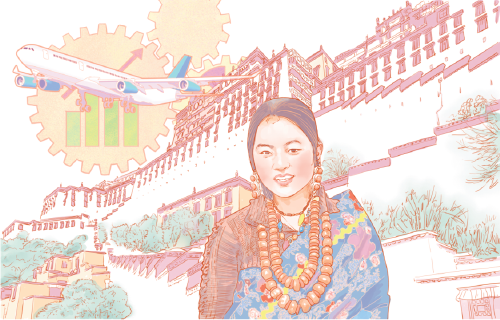
In 2006, I turned an old Tibetan courtyard into a nine-room boutique hotel with a restaurant and a teahouse, in an effort to spark the revival of heritage architecture in Lhasa, capital of the Tibetan autonomous region. Within five years I opened four heritage hotels in Tibet as part of the Shambhala Serai group.
I firmly believe that, alongside language, architecture is a keystone of cultural preservation and identity. Architecture represents an ethnic group's dialogue with its own environment. So in all restorations I undertook in Tibet over the years, only local craftspeople were involved. We did everything in the traditional manner, trying to keep as much of the original buildings intact, using old materials to rebuild new sections that were damaged or had collapsed. Even for paint, pigments were grounded from stone and stored in large metal barrels.
Craftsmanship in Tibet is still taught orally, from father to son, master to apprentice. In the late afternoon, the workers used to take rest. Sitting in a circle, they sang and drank chang, Tibetan liquor. Those were joyous moments filled with laughter. Then they picked up their tools and continued working until dark, singing the whole time.
In Tibet, the concepts of work and relaxation are not in conflict. They blend into a way of life.
At the alleyway crossroad of Tsongsikhang market, dried Tibetan cheese used to be piled high at stalls. The fragrance of red chili and yellow cumin seeds overflowed from the wooden trays of spice vendors.
The juncture of alleyways is an ancient traders' market, in unbroken service since the seventh century when the city of Lhasa was built. Nomads from Kham wearing chunks of amber and turquoise around their necks and red tassels tied to their hair from which coral pieces dangled, chatted into dusk while excitedly trading semi-precious stones, saddles and pelts.
All of this occurred daily, just minutes from the front door of my Tibetan courtyard house. I observed each day how every part of the kaleidoscope in these alleyways was actually a component of an integrated economy. I realized that the success of what we wanted to achieve with our social enterprise would depend upon that integration.
People in the neighborhood were thrilled to see one of their old buildings being restored so painstakingly. It amused those that soon discovered a foreigner was behind it. Sometimes they sang lyrics from a popular song, Shambhala is not far away, adding with laughter, Shambhala is my next door neighbor.
One afternoon I sat in the street with a Muslim iron artisan, who was breaking up metal scraps and re-piecing them in the shape of a lantern. The next day he had made a sample. We adjusted it. The day after, he delivered 10 finished lantern frames. We also had artist An Sang take us back to the factory run by disabled Tibetan artisans. They were reviving the ancient art of Tibetan papermaking. We commissioned them to make antique-looking lantern covers.
Tibetans live by a natural rhythm. There is no separation in their minds between the spiritual and material worlds. Their thought process is intrinsic. Time is somewhat irrelevant. For instance the word guongda (afternoon) really means anytime from lunchtime onward, including all night. Things flow without specific context or deadlines. Living in the old city and interacting with Tibetans every day, I made a conscious effort to step out of our Western, pre-conceived rational thinking box.
Stepping into the world of Tibetans was like swimming into a rich yet dimensionless void in which the intrinsic senses become key to navigating the cross-currents of interconnectivity.
My own concepts of time and space changed. It became clear how even what might seem on the surface to be a small, inconsequential thought or action could have the potential of colossal impact. Within this context, a realization occurred. The inspirational value of even a micro-project, if successful, could have transformational implications on a global scale.
Walking through those busy alleyways, I often stopped to chat with the owner of a small shop selling yak butter. He always cut a tiny sample with a broad knife, offering it to me as I walked by.
Yak butter is essential for Tibetans. Mixing it with black tea, they drink it all day. It provides calories and vitamins they need to survive at the high altitude. Throughout the day, every Tibetan household burns yak butter as offertory candles adorning home shrines. Of course, it is used in cooking. But I found yak butter valuable for another reason; it proved the best protection against sharp ultra-violet rays of the highland sun. Every morning, I rubbed it on my face and arms.
The yak butter sellers in my neighborhood came mostly from Amdo, or eastern Tibet, which is a nomadic region. Yakgrazing patterns have not changed on the highlands for centuries. And yak migration is an integral part of the delicate biodiversity of the Qinghai-Tibet plateau.
I thought about the economic connection with all things. Whatever was happening in our neighborhood was intimately connected with the sustainability of the Qinghai-Tibet Plateau, and in turn climate change. All things are interconnected, in ways that often are not apparent, but always present.
By restoring traditional homes as small family businesses, shops, teahouses or lodges, people would not have to move out, as the developers wanted them to, and some government officials insisted. Neighborhoods could have an economic platform that would help evolve and sustain the culture rather than change or break it. People would continue to live in old neighborhoods, buy yak butter for their tea and family shrines. The nomads in Amdo could continue herding yak.
And the patterns of grazing that has maintained the environmental and ecological balance of the grasslands for millenniums could remain intact.
The author is a US documentary filmmaker and a senior international fellow at the Center for China and Globalization. The views don't necessarily reflect those of China Daily.





