



Battery swaps could boost EV adoption, say industry experts







Battery swaps can help boost electric vehicle penetration in China, especially in the vehicle fleets used in public transportation, said an analyst.
Inadequate charging infrastructure has hindered mass adoption of electric vehicles in China so far.
"China aims to have 80 percent of new vehicles sold in regions with heavy air pollution to be new electric vehicles from this year, and battery swapping provides an approach to decarbonize heavy transport with quick refueling times in addition to facilitating China's transition to green cars by 2035," said Mi Siyi, an analyst with BloombergNEF.
"While home and workplace chargers will be most favored by private EV owners, battery swapping, together with fast-charging stations, can gain more popularity among fleet operators, particularly taxis, ride-hailing vehicles and light commercial vehicles," she said.
Without getting off their cars, passengers can swap a battery merely by pushing a button. China saw 613 battery-swapping stations by the end of March, according to the China Electric Vehicle Charging Infrastructure Promotion Alliance, which has effectively improved users' swapping experience.
The Government Work Report this year stressed that efforts should be made to build more charging pillars and battery swap stations this year. Many institutions believe the time for battery swapping has come.
Mi said she was optimistic about the prospects of China's battery swapping sector in the 14th Five-Year Plan period (2021-25).
"The momentum in EV battery swapping is rising, as there are more large EV fleets on the road, particularly taxis and light commercial vehicles, compared to the 13th Five-Year Plan period (2016-20). Local government incentives will also further support its growth," she said.
"However, challenges remain when it comes to standardized battery design, high capital cost and low utilization rates. This will likely limit the application of battery swapping."
While automakers in China have different battery technologies and standards that are not unified at present, Mi said she believes China's forthcoming new safety standards for battery swapping can help bring more consistency to the industry.
Last August, China approved its first national battery-swapping safety standard for electric vehicles. It said more research needs to be done on battery-swapping, swappable battery packs and battery-swapping interface, as well as any potential failure points.
"With the lack of standardized battery design and unclear ownership and responsibilities among operators, consumers and manufacturers, it will be challenging to spread out shared battery swapping stations," Mi said.
Different battery chemistries and pack designs are favored by automakers depending on the vehicle's specifications and targeted segments, she said.
Battery-swapping stations are also relatively small in amount compared with the traditional charging stations. The more than 600 swapping stations are overshadowed by the 63,600 charging stations across China at the end of last year, according to the China Electric Vehicle Charging Infrastructure Promotion Alliance.
According to Zhang Qinggang, vice-president of the Shenzhen Institutes of Advanced Technology, while the capital expenditure of a battery swapping station is significantly higher due to the costly battery packs, it is highly likely the price will fall as battery price drops.
He estimated that the cost of battery swapping is about 0.35 yuan ($0.05) per kilometer, compared with the average cost of less than 0.2 yuan per kilometer with a charging pole so far.
Many carmakers in China, including Nio, BAIC BJEV, a subsidiary of China's BAIC Group focusing on electric vehicles, Changan Automobile, Xpeng and Li Auto, are all doing their part, believing the trend of battery swapping is on the way.
Chinese electric car startup Nio, for example, has been pioneering battery swap technology since late 2015. A total of 197 Nio battery swapping stations have been built across China by the end of March this year in around 80 cities, which allows a car to replace a fully charged battery in less than three minutes, and the number is expected to jump to 500 by the end of this year, it said.
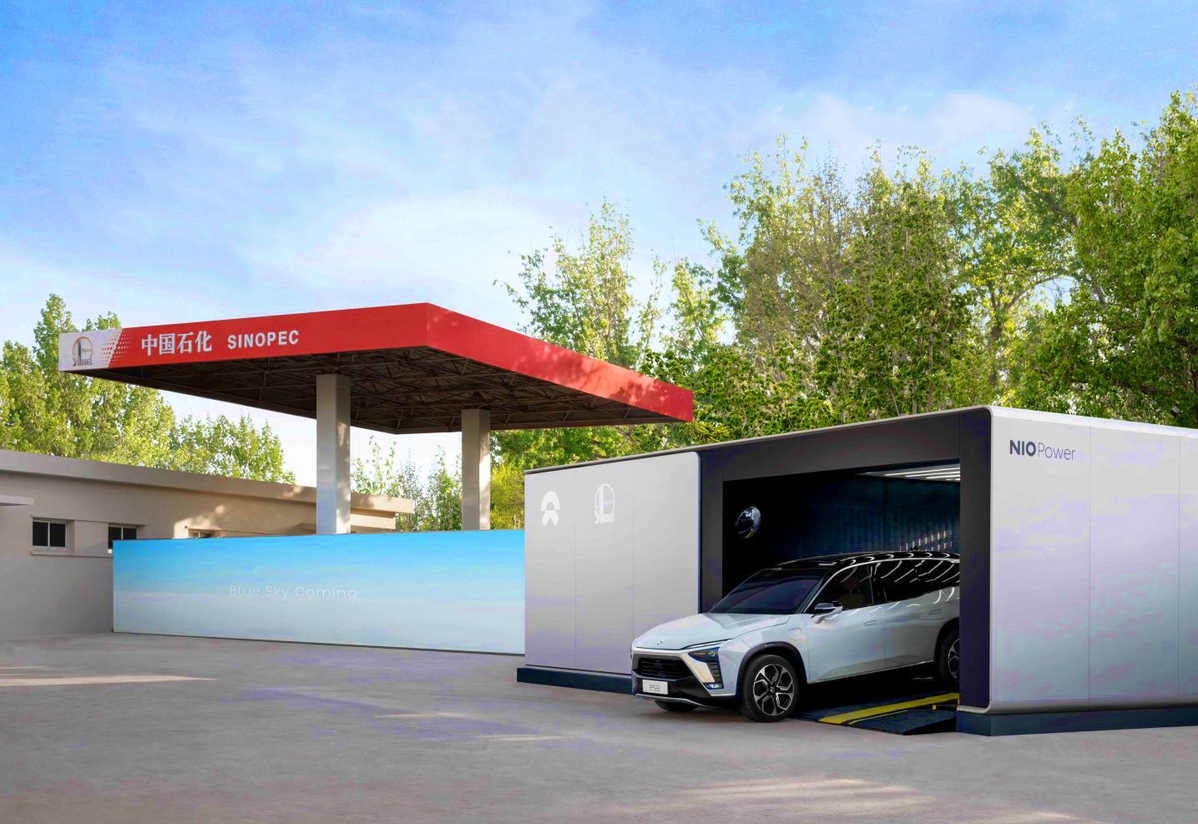
It has also recently signed an agreement with China's oil giant China Petrochemical Corp, better known as Sinopec, for strategic cooperation on battery swapping stations. Nio's first Power Swap Station 2.0 was officially launched at a Sinopec service station in Beijing in April, a move that will tap the potential of both sides and be a milestone for the country's electric vehicle development, said Nio.
Both sides will come up with various measures in the fields of the battery swapping station layout, new materials as well as intelligent vehicles, to jointly push forward the country's new energy vehicle development, said the State-owned oil behemoth.
China saw its EV infrastructure developing rapidly in recent years. It installed 284,000 public EV charging outlets in 2020, including 112,000 in December alone-more than the entire US public charging network-according to data published by BloombergNEF.
China's increasing availability of publicly available EV charging outlets is also driven by the country's efforts to create the infrastructure ahead of demand and higher levels of EV adoption. The ratio between the number of public charging points and the size of China's EV fleet is already much lower than that in other countries, it said.
China's EV owners are mostly high-rise dwellers in cities that also have stringent policies and incentives aimed at limiting sales of new internal combustion engines so as to reduce pollution levels, according to Colin McKerracher, BNEF's head of advanced transport.
In 2020, almost 1.37 million new energy vehicles were sold, and the figure is expected to hit 1.8 million this year.




















