Greater ambition, stronger action







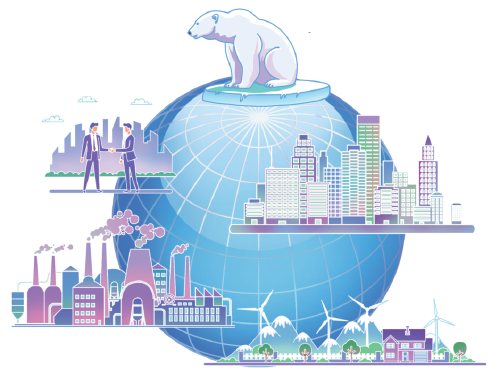
Countries need to deliver on their shared commitment to tackle the climate crisis with more urgency and resolve
The Leaders Summit on Climate held on Earth Day drew global attention. Some say the summit convened by US President Joe Biden was a sign that he is seeking to assert US leadership in the global climate talks as he vowed to cut US annual greenhouse gas emissions by 50 to 52 percent from 2005 levels by 2030, having fulfilled his commitment to rejoin the Paris Agreement on his first day in office. Some say the United Kingdom and the European Union are supporting their ally, the United States, by announcing world-leading ambitious new targets to cut carbon emissions by 2030. Some say that the Chinese leader's attendance at the summit showcased the easing of China-US tensions against the backdrop of deteriorating bilateral relations since the outbreak of the novel coronavirus. All these remarks, from the perspectives of global climate governance, international relations or geopolitics, make sense. But more importantly, the summit, was about tackling the climate crisis. Putting other things aside, we should focus on safeguarding the ecosystems that we all depend on.
Since the industrial revolution, environmental challenges such as climate change, biodiversity loss and pollution have grown in number and severity as a result of ever-increasing greenhouse gas emissions and pollutants, disrupting the balance in the Earth's ecosystems and laying bare the growing tensions in the relationship between humans and nature. In a report titled Making Peace with Nature, the United Nations Environment Programme pointed out that climate change, biodiversity loss, and environmental pollution are the three major crises that the Earth is confronted with. The three interlinked crises threaten humanity's viability as a species.
Among the three aforementioned crises, climate change poses the most severe challenge and is the one in most urgent need of solving. According to a special report on global warming of 1.5 C released by the Intergovernmental Panel on Climate Change, human-induced warming reached approximately 1 C above pre-industrial levels in 2017, increasing at 0.2 C per decade. The report concludes that because of human activities, climate change has already had disruptive effects on humanity's production activities and life, especially in vulnerable regions including the less developed countries and small islands. The impact of climate change could transform from quantitative change toward qualitative change when global warming increases from 1.5 C to 2 C above pre-industrial levels. Therefore, it is imperative to limit the global temperature increase to 1.5 C above pre-industrial levels.
The Paris Agreement was adopted at the 2015 UN Climate Change Conference, providing a durable framework guiding the global effort to combat climate change from 2020. However, since the signing of the agreement, there has been a continued upward trend in global greenhouse gas emissions and countries' climate actions have failed to put humanity on a path to meet the Paris Agreement goals. In an article, UN Secretary-General Antonio Guterres called on nations to redouble their efforts and submit stronger, more ambitious national climate action plans to cut global emissions by 45 percent by 2030 from 2010 levels to reach net zero emissions by 2050.
Although the UK, the EU, the US and Japan have made public their 2030 emission reduction targets and carbon neutrality pledge by 2050 and China has pledged to strive to achieve carbon neutrality before 2060, current levels of climate ambition are very far from putting us on a pathway that will ensure that the average global temperature does not increase more than 1.5 C above pre-industrial levels.
State leaders have exhibited firm solidarity and the willingness to jointly cope with the climate crisis at the Leaders Summit on Climate. But, more importantly, they now need to translate those commitments into concrete, immediate action by exploring effective pathways to lead their countries to achieve carbon neutrality by 2050.Only by doing so can we Earth dwellers avoid disastrous consequences from the climate crisis.
Even if a deal on carbon neutrality can be reached at the COP 26 to be held in Glasgow, Scotland, in November, we should not be overly optimistic from the perspective of preventing the worst impacts of climate change.
Since the first Earth Day was celebrated in the US on April 22, 1970, the environmental movement has sprung up, increasing public awareness of the world's environmental problems and governments' awareness of the gravity of environmental protection. Since then, environmental protection agencies have been established in countries around the world and a string of international environmental protection agencies and organizations have been founded. At the global level, international conventions aimed at curbing climate change have been signed one after another.
However, unfortunately, over the past five decades, the global temperature has continued to rise and humanity has been grappling with environmental challenges that have grown into crises. Frequent extreme weather events induced by climate change, such as heat and cold waves, floods and typhoons, have posed severe challenges to human survival and development. The Leaders Summit on Climate has achieved results, but these are far from enough to solve the climate crisis.
Although the summit has to a certain extent boosted global confidence in jointly tackling the climate crisis, we still have a long way to go before getting the climate crisis under control. Countries need to shelve their differences, stand in firm solidarity, and take immediate concrete actions.
The author is a professor at Beijing Jiaotong University and vice-chairman of the Chinese Association of Development Strategy Studies. The author contributed this article to China Watch, a think tank powered by China Daily. The views do not necessarily reflect those of China Daily.