Asian century won't come until global governance becomes more inclusive







"Asian Century" is becoming a buzzword. More and more people trust "The Asian Century Is Set to Begin", "The Asian Century has arrived" or "This is the Asian Century: Seven reasons to be optimistic about it". The confidence is founded on the increasing economic significance.
An article mentioned above quoted what Indian Prime Minister Narendra Modi stated in an Asian Infrastructure Investment Bank conference: "Now the continent finds itself at the centre of global economic activity…. It has become the main growth engine of the world. In fact, we are now living through what many have termed the Asian Century."
The growth performance of Asian economies has been indeed remarkable in the past half century. In 1970, the total GDP of developing economies in Asia (excluding Japan and Israel) was $1.42 trillion, or 10.9 percent of Europe and Northern America (mostly developed economies).
In 2019, the ratio became 63.7 percent. Asia's catch-up is more stunning in manufacturing sector. In 1970, the manufacturing added value of developing Asia accounted only a tiny fraction of Europe and Northern America (6.7 percent). While it has surpassed the latter since 2015 (Figure 1).
Dynamic manufacturing is a meaningful indicator for sustained economic development as it can create employment, boost income, drive technological progress and generate multiple virtuous linkages in the economy (UNCTAD 2016). Yes, we do have good reasons to expect robust growth to be continued in this region.
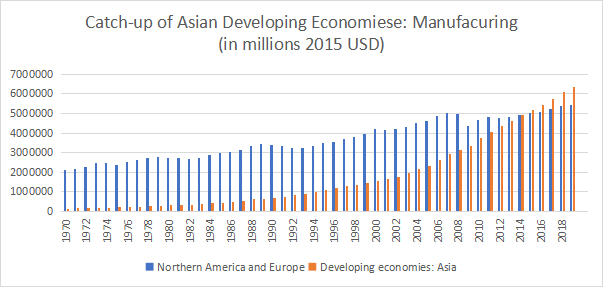
Source: UNCTADStat
However, economic expansion alone does not justify the claim of Asian Century. Despite the shrinking share in the world output, the advanced economies have managed to entrench their position in global governance.
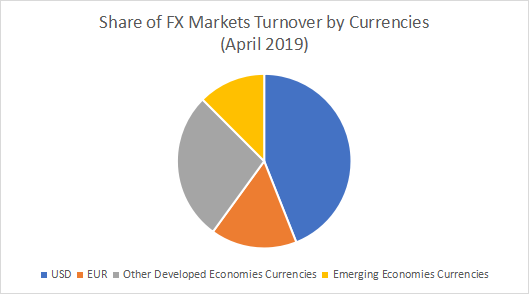
A well-known story is the dollar dominance. In the international merchandise trade transactions, Gopinath (IMF Chief Economist) found that USD share as an invoicing currency is around 3.1-4.7 times the US share in world trade volume. BIS survey (Figure 2) also showed the "US dollar remains the world's dominant vehicle currency". USD (88.3 percent), Euro (32.3 percent) and other developed countries currencies account 175 percent of foreign exchange market turnover (total is 200 percent).
Despite being the second-largest economy, the share of China's RMB is only 4.3 percent. Besides currency dominance, the advanced economies are more influential in driving global agenda across the board, from finance to trade, from investment to development.
In the IMF, among the 20 biggest shareholding member states, 12 are developed economies with the total voting share of 48.77 percent, and 8 developing countries own less half (20.01 percent).
In the WTO, developing members are defending their established rights on Special and Differentiated Treatment, while the development deficits in the trading rules have been ignored.
All in all, the Asia's growth success has not adequately translated into a more inclusive global governance. Then on what ground can we take the Asian Century is coming? In addition, such imbalance between governance architecture and the changing economic landscape has proved to be detrimental to multilateral cooperation in recent years.
Fortunately, the world keeps evolving. Asian economies now may find that it is time to make a difference. In 2021 and 2022, India and China will host BRICS summit. In 2022 and 2023, Indonesia and India will become the G20 Presidency. In 2022, Thailand will be the APEC host. With this "happy coincidence" that those important summits hosted in the region, Asian countries may have an opportunity to advance their shared agenda.
The to-do list could be long: ending covid pandemic, easing debt distress, boosting economic recovery, promoting industrialization, advancing green and digital transformation, encouraging technology transfer and knowledge sharing, promoting trade and FDI for development, etc. But if Asian leaders have a bolder vision, they need go beyond those topics to push forward those more fundamental initiatives as well. Here are three overarching suggestions:
1.Strengthening coordination. The host countries are normally more privileged in shaping summit agenda. ASEAN, China and India may consider holding a trilateral summit as soon as they can to explore common ground that concerns both themselves and the whole developing world. Then they can coordinate respective agenda proposals to create some synergy effects within the future three Asian years.
2.Scaling up South-South Cooperation. SSC is not just providing aid resources but has integrated a variety of economic cooperation in finance, trade, investment, and industrialization etc. (UNCTAD 2020). Having the world's biggest developing economies in the region, Asia is in a unique position to develop a shared agenda to scale up SSC, which would provide a pivot for southern countries to make global governance more development friendly. For example, BRICS could be further expanded so as to play a more active role in fostering SSC.
3.Stabilizing globalization. Globalization is in trouble (Rodrik 2019). Hyper-globalization has exacerbated inequality that caused strong backlash. While de-globalization would cost global prosperity due to the disruption of trade, finance, or human-to-human exchange. The world needs a stable globalization that can balance integration and differences.
Asia is the world's most diversified region. The philosophy of "harmony without uniformity" has been widely recognized by the people here. Hence, the Asian countries could have the wisdom to initiate innovative plans to advance an inclusive, stable, and balanced globalization and its governance. Should it be the case, we then may claim the arrival of Asian Century, which is exactly also the Future We Want: sustainable development and prosperity for all.
The author is an economic affairs officer, UNCTAD. The opinions expressed here are those of the writer and do not necessarily represent the views of China Daily and China Daily website.
If you have a specific expertise and would like to contribute to China Daily, please contact us at opinion@chinadaily.com.cn, and comment@chinadaily.com.cn.