



Postpartum market experiencing rapid business expansion







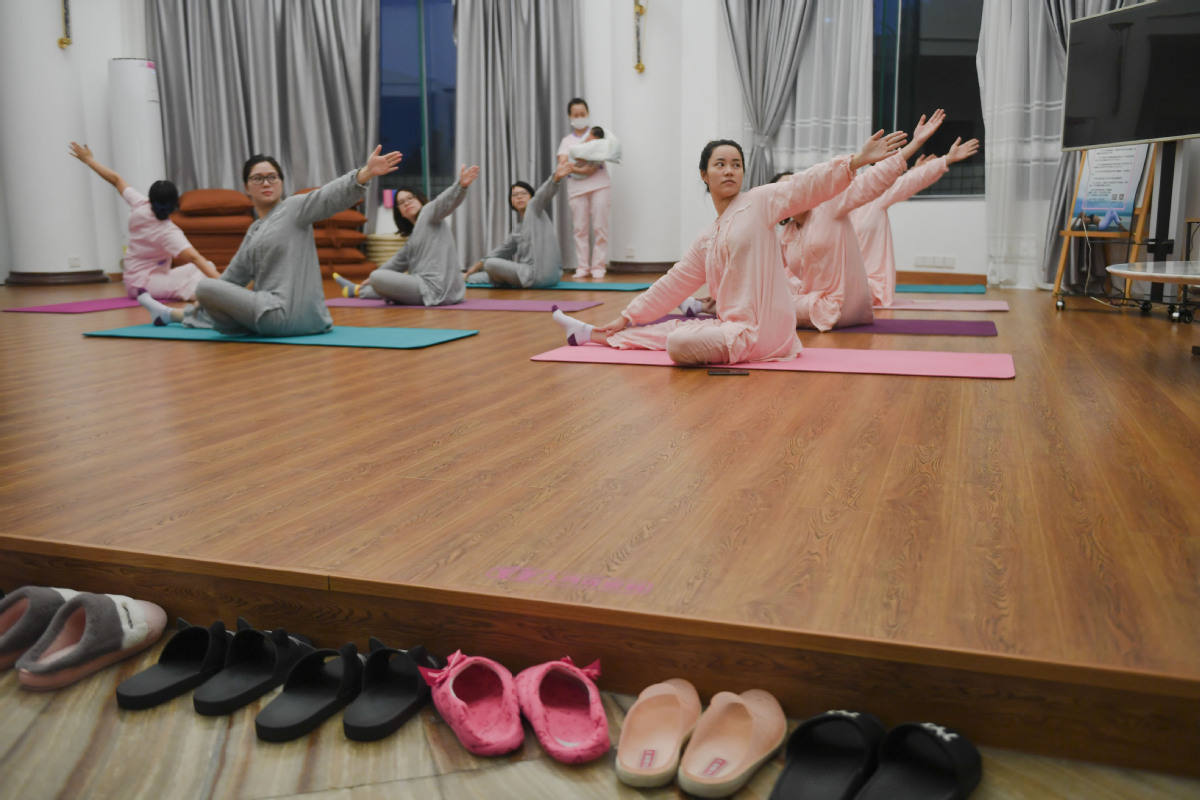
China's postpartum recovery market has been rapidly developing in recent years thanks to rising public health awareness, consumption upgrades and supportive government policies.
Postpartum recovery refers to the rehabilitation process that a mother adopts in order to get her body shape and functions back to normal after giving birth.
According to a report released by market research institute leadleo.com, China's postpartum recovery market is expected to reach 14.48 billion yuan ($2.2 billion) by 2023. Between 2014 and 2018, the market scale surged from 920 million yuan to 3.95 billion yuan, with a compound annual growth rate of 43.9 percent.
Li Chengping, an analyst at VCBeat, an online healthcare website, said that after giving birth, moms often face pelvic, uterine, urinary tract and mammary issues. However, after labor, many new moms have traditionally concentrated solely on their babies and neglected their own health problems.
"In the new era, the post-1980 and post-1990 generations tend to pursue more scientific and systematic postpartum rehabilitation, contributing to the rise of the sector," Li said.
She added that after the introduction of the second-child policy, the government has been stepping up efforts in constructing maternal and baby care projects and encouraging rehabilitation equipment manufacturers to enhance innovations.
"More and more new moms are turning to professional institutions for postpartum recovery where they are offered recovery therapy using rehabilitation devices," Li said.
According to a report jointly released by Meiyou, an online platform catering to women's needs, and intelligent information platform MobTech, the number of maternal care centers nationwide providing postpartum recovery and maternal and child health services skyrocketed from 550 in 2013 to 4,400 in 2019. The number further expanded to 4,800 in 2020.
Apart from postpartum recovery devices, health supplements that help mothers become more regular and get their figures back are also popular among new moms.
"Before the birth of my child, I took various types of health supplements such as folic acid, multivitamins and calcium. After giving birth, I had been suffering from postpartum constipation. Therefore, I took probiotic supplements every day. Now, my symptoms are relieved and my body feels light," said Wang Jingzhen, a post-1990 mom who works at a commercial bank in Shanghai.
"We've noticed that moms born between 1970 and 1985 care more about their husbands and children than themselves. Instead of buying something for themselves, they would rather purchase items for their family. In contrast, post-1985 moms started to spend more time and money on themselves," said Chen Qiang, chairman of Burdock Biotechnology (Dezhou) Co Ltd, the parent company of Mama& Sweeties, which manufacturers probiotic supplements for moms.
With rising awareness, industry experts said vast market potential for China's postpartum recovery sector remains untapped.
Wen Zhihong, a partner with Beijing-based Hejun Consulting Group, said: "Postpartum recovery is a newly emerging sector in China. The sector is promising. However, currently there are few renowned and established brands. Enterprises in the sector should carefully think of marketing strategies to build brand images and acquire customers in a cost-effective way."
And savvy companies are already doing so.
To enhance public recognition and build up brand image, many postpartum recovery brands-such as Suzhou, Jiangsu province-based pelvic floor recovery device provider Dayue, and Shanghai-based maternal underwear brand Infansy's-chose to run advertisements on Xiaohongshu (Little Red Book), an Instagram-like platform where users share life experiences.
Meanwhile, Mama & Sweeties introduced community marketing. It created chat groups on social media platform WeChat and invited moms to join the groups. The moms that are already in the chat group get more moms into the chat group, forming an online community where moms share their child-raising and postpartum recovery experiences.
"Moms have the willingness to look for advice and share experiences. Every mom who has used our products can be a key opinion consumer, whose recommendation is the best way of marketing," Chen said.
"As new moms with no experience, we tend to look for advice from experienced moms. Just after I had my child, I joined several WeChat groups asking about what products to buy and how to raise my baby," said He Yang, 30, an office clerk at an advertising agency in Beijing.
Apart from efforts taken by companies, Wen suggested that the government should normalize the market so that the sector is able to develop in a sustainable way.
"Currently, most of the postpartum rehabilitation institutions are healthcare service institutions without medical qualifications. The government should establish qualification requirements for the institutions. In addition, a fixed department to supervise the sector should be specified," he said.
Besides, he added that maternal and baby hospitals should set up postpartum departments. If government budgets allow, local governments should offer subsidies to postpartum rehabilitation institutions and new moms.
During the 13th Five-Year Plan period (2016-20), the central government invested 11.08 billion yuan in implementing maternal and child healthcare projects, and supported the construction of 617 maternal and child care institutions.
A service network based on maternal and child care institutions and grassroots level medical institutions, and supported by comprehensive and specialized hospitals, was basically formed. The network will lay a solid foundation for the service upgrade of the sector in the future, said the National Health Commission.




















