



Martyrs' graveyards welcome new tourists







Tradition
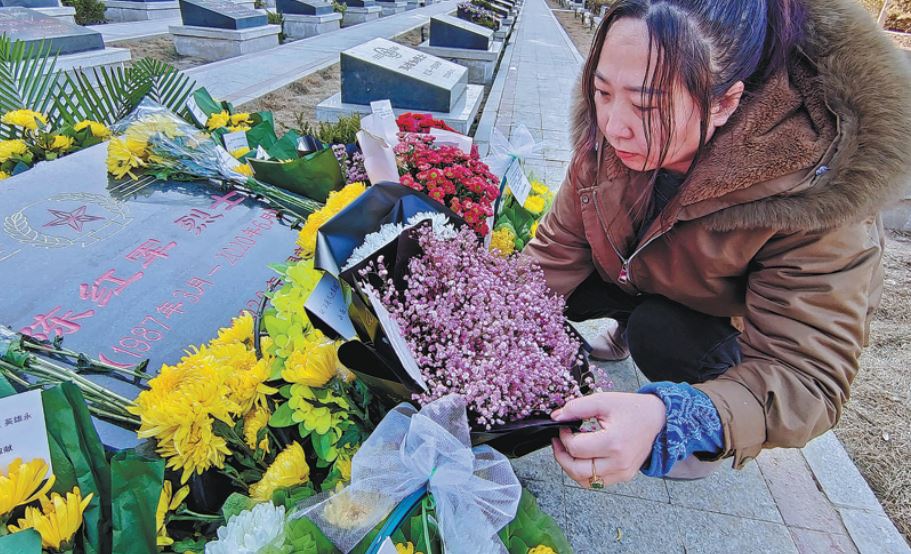
Since ancient times, China has honored those who sacrificed their lives for the public good. That tradition was inherited by the Communist Party of China soon after it was founded.
As early as the 1930s, the Red Army, a forerunner of the PLA and a revolutionary force under CPC command, built a martyrs' cemetery in Tongjiang, Sichuan province, to honor those who died during the Long March (1934-36).
In 1946, construction started on a martyrs' cemetery in Handan, Hebei province, to commemorate those who died during the revolution. Finished in 1950, it was the first such cemetery built after the People's Republic of China was founded.
By April 3, 2020, the number of memorial structures for martyrs had reached 4,200 nationwide.
The southernmost martyrs' cemetery is situated on Chenhang Island, Sansa city, Hainan province. Built in August 2016, it is a memorial to the 18 soldiers who died in the 1974 Battle of the Xisha Islands, during which they defeated troops from what was then South Vietnam.
The cemetery has 18 nameplates for martyrs, and six in memory of the ships that participated in the battle. It is also an education center, and every new soldier comes to pay tribute when arriving on the island.
Kangxiwar Martyrs' Cemetery, located 4,280 meters above sea level in the Xinjiang Uygur autonomous region, is China's highest martyrs' cemetery. It was built in 1965 to commemorate 83 martyrs who died in the 1962 Sino-Indian War.
Now, 108 martyrs rest there. There are also gravestones for the four martyrs who died in the border clash in June, who were later moved to their hometowns.
There are even cemeteries for Chinese martyrs overseas. In Pyongannam-do, about 100 km east of Pyongyang in the Democratic People's Republic of Korea, there is a cemetery for martyrs of the Chinese People's Volunteers who fought in the War to Resist US Aggression and Aid Korea (1950-53). A total of 134 martyrs are buried there, including Mao Anying, the first son of Mao Zedong, the founding Chairman of the PRC.
Some martyrs' cemeteries were initially built for one person. On Feb 15, 1923, Shi Yang, a lawyer who fought for workers' rights, was arrested and killed by warlords who ruled large parts of Central China. Local workers buried him and built a graveyard to honor him. In 1953, a dedicated cemetery was built and opened to the public.
It should be noted that the martyrs' cemeteries honor more than just CPC martyrs. The Graveyard for National Heroes in Tengchong county, Southwest China's Yunnan province, is a typical example.
Built in 1945, it honors the Chinese forces that defeated Japanese troops during the War of Resistance Against Japanese Aggression (1931-45) and restored land transportation routes to Myanmar.
In 2011, the local government built a museum in the cemetery to honor that history.
Many martyrs' cemeteries have adopted the latest technologies to give visitors a more realistic sense of history. Longhua Martyrs' Cemetery, the largest of its kind in Shanghai, has developed an augmented reality game and posted the QR code on its official website.
Anyone who downloads the cemetery's app can start the game by scanning an artifact with their smartphone. In the game, one can see the history of the cemetery, including how it was built and how it evolved into today's edifice, and can participate in history by completing assignments in the game.


- Modern industrial system key to Shanghai's grown plan
- China's first research center focusing on foreign-related criminal affairs opens in Shanghai
- The 81-Year-Old 'Guardian of the Great Wall'
- China urges Lithuania to adhere to one-China principle and align with “right side of history”
- Golden flatbread from Zhejiang gains popularity abroad
- Spring Festival Adventures: Visiting dad on duty












