



Suez Canal crisis stresses need for BRI trade routes







Shipping operates 24 hours a day, seven days a week, and 365 days a year, and is responsible for carrying more than 80 percent of the global trade by volume. Vessels transport not only big shipments such as crude oil or iron ore, but also goods for basic human needs such as clothing, food and medicines, fulfilling the demands and necessities of millions of people all over the world.
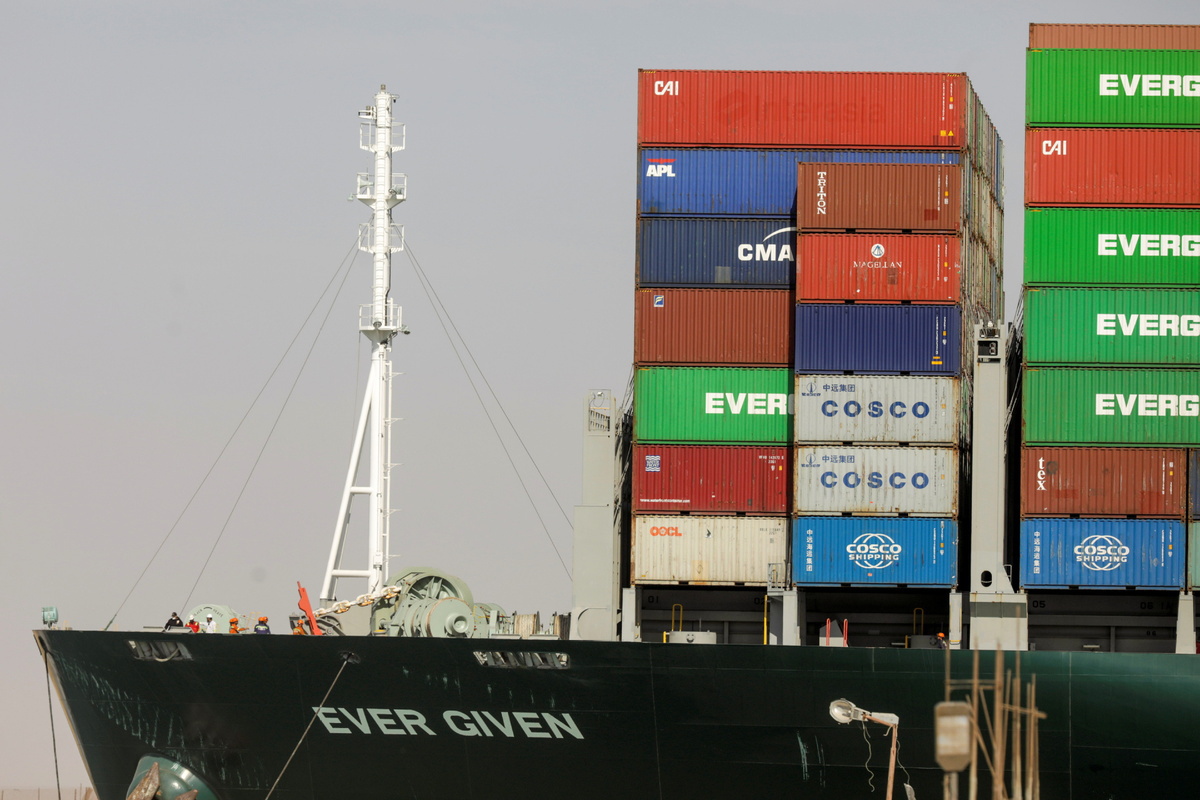
Many experts commented on the effects of obstruction at the Suez Canal and the ramifications on international trade and oil markets. Throughout history, the Suez Canal played an important role in global maritime affairs since it serves as an important economic pivot that facilitates around 30 percent of global container ship traffic each day. According to the Suez Canal Authority, nearly 19,000 ships, or an average of 51.5 ships per day, with a net tonnage of 1.17 billion passed through the canal during 2020. Due to the substantial dependency on the canal, the 1888 convention of Constantinople guaranteed the right of passage of all ships through the canal during war and peace. However, the Ever Given container blockage also gave rise to many debates on alternative trade routes.
Alternative routes to Suez Canal in near future
The Polar Silk Road or the Northern Sea Route (NSR) is the main focus of the Belt and Road Initiative which was also highlighted in the 2021-2025 Five Year Plan published in March 2021. The NSR was quoted over the years as an alternative route to reduce the stress on the Suez Canal, and at present with a warming arctic due to climate change, the arctic route is accessible for a few months each summer. A journey between East Asia and Western Europe is around 21,000 kilometers via the Suez Canal but the NSR would reduce this to 12,800 km while cutting the transit time by 10 to 20 days. Many studies concluded that the NSR is likely to be free of ice during the summer by 2030 and it represents the highest commercial potential as it opens up a number of new routes for shipping.
Due to the opportunity cost of transiting through the Suez Canal, the development of the Polar Silk Road would also reduce transportation costs and put the industry in a better scenario.
China's Belt and Road Initiative and its land-based transportation network to Europe
Eighteen European countries have already signed MoU's with China's Belt and Road Initiative, and freight trains linking 48 Chinese cities to 42 European destinations have already completed over 15,000 journeys. The Belt and Road Initiative -- with its three sea routes, three land routes and three corridors -- created alternative land-based trade routes which can be linked to maritime routes or cut short the maritime journey.
Extensive construction in the last few years under China's BRI will link the Arabian Sea to the South China Sea and North Pacific Ocean via a land-based corridor. The shipments unloaded in South China Sea ports and North Pacific ports could now reach the Bay of Bengal, the Arabian Sea, and North Atlantic Ocean by three sea routes, three land routes and three corridors.
The free movement of the trade ships in international waters or permission for ships to move freely as much as possible is a principle that is agreed upon internationally. The formation of this principle goes way back to the 15th century in the old Dutch Republic where "mare liberum or "free seas" conveyed the idea that "a free ship makes for free goods."
The Dutch jurist Hugo Grotius, who is considered as the founding father of international law, integrated this principle into a legal context, advocating for a shift in maritime norms that would make the high seas free for transport and shipping, regardless of the country of origin of the ship. This cornerstone international principle is now also codified as Article 87(1)a of the 1982 United Nations Convention on the Law of the Sea, which highlights Hugo Grotius's ideas of sovereign equality and international interdependence.
The re-emerging Silk Road under the Belt and Road Initiative is a testament to upholding this international principle by recreating alternative trade routes by linking distant cities which can benefit millions of people all over the globe. Since more decentralized connectivity builds more robust systems, alternative trade routes will stabilize international markets, especially during a crisis such as the 2021 Suez Canal blockage.
Yasiru Ranaraja is a researcher on maritime affairs and BRI development expert. He graduated from Dalian Maritime University, and in 2016 was awarded the Chinese Government Scholarship to complete his LLM at Ocean University of China. Yasiru currently serves as a director to Belt & Road Initiative Sri Lanka.
The opinions expressed here are those of the writer and do not necessarily represent the views of China Daily and China Daily website.
If you have a specific expertise and would like to contribute to China Daily, please contact us at opinion@chinadaily.com.cn, and comment@chinadaily.com.cn.





