Reporter's log: Foreign media misses poverty alleviation mark







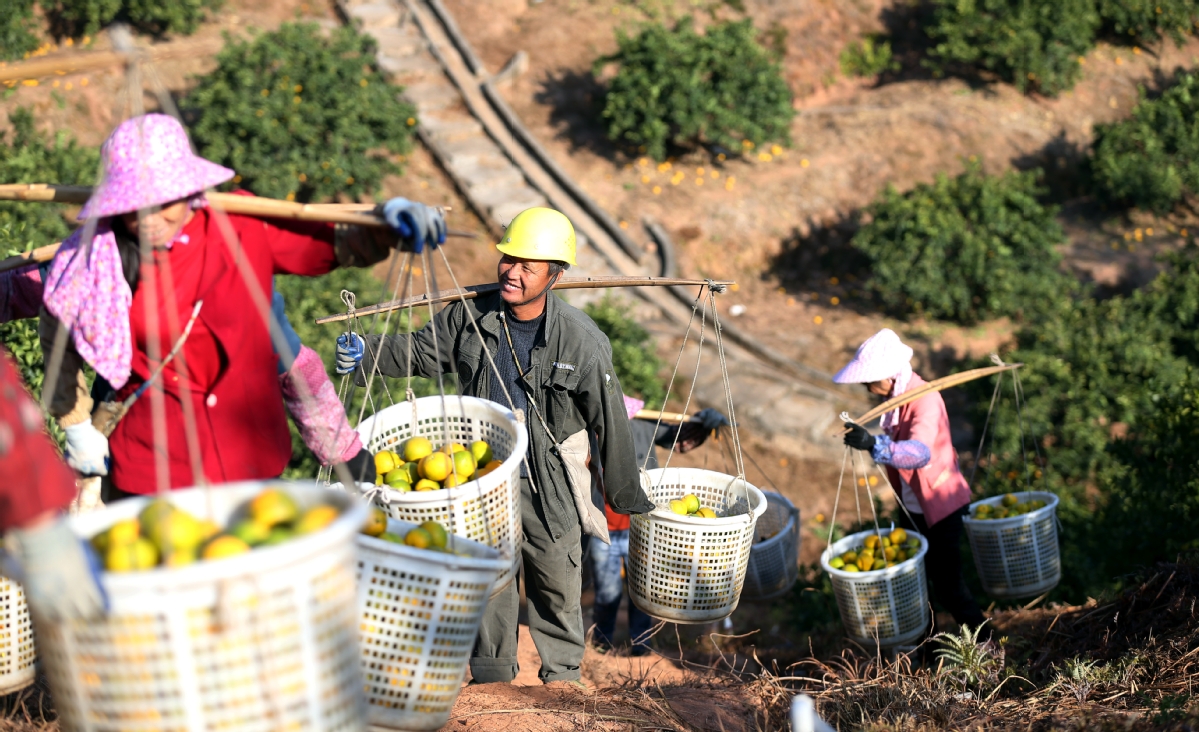
At a gleaming hall packed with masked reporters last week in Beijing, one with the Associated Press of Pakistan rose with a question for the CPPCC National Committee session's spokesman.
He asked if the threshold that China uses to track its poverty relief campaign is lower than the global norms.
One day later, at the same venue, another with Singapore's Strait Times made a similar inquiry to the NPC session's spokesperson.
Please explain how the Chinese threshold differs from its global counterparts, she said in earnest.
Since last week, the world has beheld the Chinese capital for the two sessions-the annual meetings of the country's top advisory body, the Chinese People's Political Consultative Conference National Committee, and the country's top legislature, the National People's Congress.
The dual gatherings opened on Thursday and Friday, respectively, at the Great Hall of the People.
An hourlong news conference customarily precedes each, serving as a barometer of the global interests in China's domestic affairs.
I kind of expected the spike in interest surrounding China's sweeping anti-poverty drive, which I have followed for years.
That's partly because two weeks ago President Xi Jinping announced the historic end of absolute poverty on the Chinese mainland.
However, I was a bit surprised as well by the limited knowledge outside China about even the campaign's basics.
The ignorance is partly reflected in the enthusiasm to mechanically hold China's poverty threshold against the global variations.
By doing that, some have subconsciously, if not maliciously, hidden the fact that China's definition for poverty alleviation is in practice multidimensional.
That is the message that Zhang Yesui, spokesman for the NPC session, and Guo Weimin, spokesman for the CPPCC National Committee session, attempted to convey.
To put their words bluntly, China cares about poor farmers' incomes. It also cares about whether the poor can afford sufficient food and clothing, and whether they can afford to visit hospitals, attend schools, live in safe homes and drink clean water-a set of standards that officials employ to assess poverty in the field.
The nonmonetary threshold, however, is less known to the outside world.
Over a span of eight years, China hoisted the income of almost 100 million poor farmers above the 2,300 yuan ($354) annual per capita income threshold.
It was set in 2010 and adjusted annually for inflation.
When central authorities put forward the "targeted poverty alleviation" strategy in 2015, the benchmark was inherited to track the progress in the field.
At the time, the other alternatives included a $1.90 a day threshold, set by the World Bank in 2015, and a $1.25 a day threshold that the United Nations adopted in the same year in its 2030 Agenda for Sustainable Development.
Zhang stressed on Thursday that the Chinese threshold is actually higher than both alternatives when purchasing power parity is taken into account.
That has done China justice.
Some have accused China of using the World Bank's lower standard.
Indeed, the World Bank rolled out higher thresholds for better-off nations.
Those include a $3.20 a day threshold for lower-middle-income countries and $5.50 a day threshold for higher-middle-income countries.
But it was in 2018, three years after China decided on the 2,300 yuan threshold. And they are intended as a reference.
The timeline alone shows the conspiracy theory is false.
While on a November pilgrimage to Longnan, Gansu province, a showcase of how farmers escaped poverty using e-commerce, I had a brief but insightful talk with Matteo Marchisio, the East Asia head of the International Fund for Agricultural Development, a UN agency.
He contended that quibbling about the exact rate of poverty risks missing the bigger picture-China has managed to raise the income of hundreds of millions of people above the poverty line in a very few years.
That is the reasoning that applies in the debate about the poverty threshold.



- Lantern Festival lights bring the Dunhuang grottoes to life
- China's 2026 Spring Festival travel rush to begin
- Knocking on the stone-framed door
- Shanghai Science and Technology Museum to reopen soon
- Shanghai celebrates Spring Festival with intl students
- Pegasus fondant artwork ushers in Year of the Horse in Shanghai