



Strong exports suggest higher growth







China's economy ended 2020 on a stronger note than we expected, with growth in industry being especially rapid. In the fourth quarter of 2020, China's GDP growth increased to 6.5 percent year-on-year, or 2.9 percent quarter-on-quarter in seasonally adjusted terms in our (Oxford Economics') estimation, comfortably beating our forecast of 2.2 percent and the consensus, underpinned by an acceleration in industrial value added, investment and exports.
The strong fourth quarter lifted China's GDP growth to 2.3 percent last year and will have a substantial carry-over impact on this year's economic growth.
We have revised up our outlook for exports, and, relatedly, manufacturing investment, mainly because of the strong recent export and export order data for the Chinese mainland, Taiwan and the Republic of Korea, plus an upward revision of the forecast for the United States' economic growth following increased likelihood of substantial additional fiscal stimulus there.
We downgraded our forecast for China's first quarter growth, due to the impact of the recent (mild) novel coronavirus outbreaks and new restrictions, including on Chinese Lunar New Year travel. But for all of 2021, we have raised our growth forecast from 8.1 percent to 8.9 percent, with seasonally adjusted quarter-on-quarter growth expected to be 1.5 percent from the second to the fourth quarters, after 0.2 percent in the first quarter.
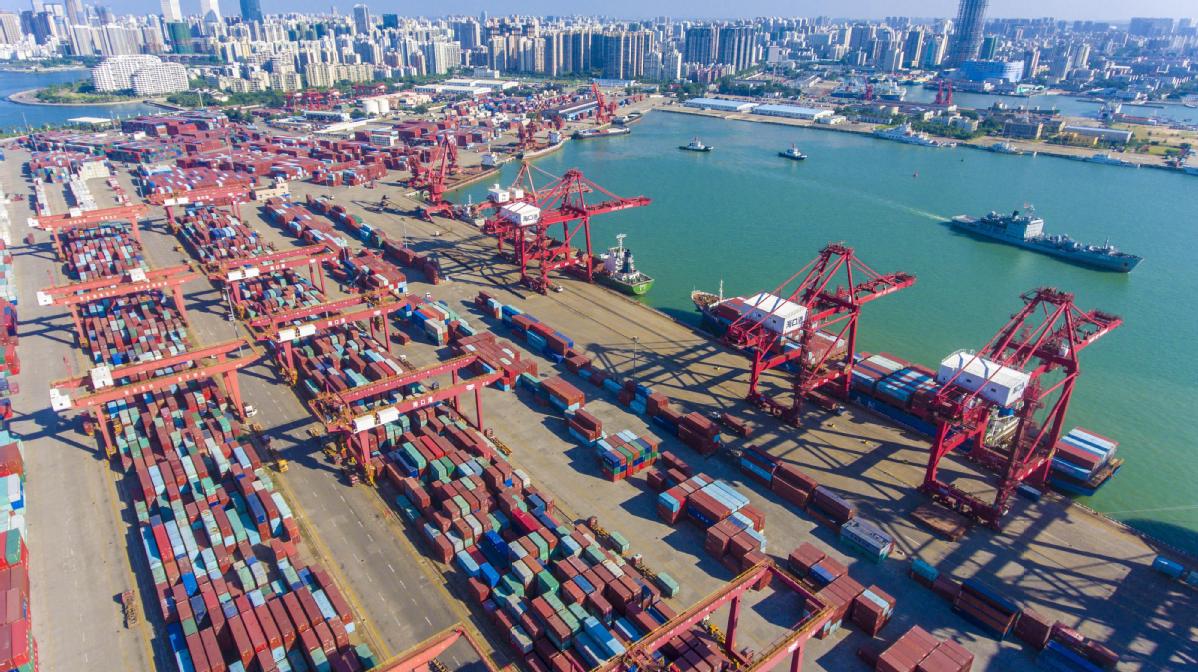
The performance of China's export-oriented manufacturing sector since the onset of the COVID-19 pandemic has been much stronger than expected. We have always been relatively constructive about China's role in global supply chains, given the fundamental competitiveness of its industrial sector. But China's export strength since the second quarter of 2020 has defied even our expectations. Indeed, despite recent moderation, China's global market share has risen significantly since the coronavirus outbreak, instead of, as widely expected, coming down.
More generally, there has been less "decoupling" by developed countries than expected so far. China's exports to the US have staged a particularly impressive comeback in spite of the Donald Trump administration's efforts to decouple the US economy from China's and its imposition of high tariffs.
China's signing of the Regional Comprehensive Economic Partnership with the 10-member ASEAN, the ROK, Japan, Australia and New Zealand, as well as the wrapping up of negotiations on the Comprehensive Agreement on Investment with the European Union underscore that, despite complaints about key elements of China's policy setting, most governments of developed economies are keen to continue their economic engagement with China.
Besides, surveys of US and European enterprises indicate a relatively favorable view on their current situation and prospects, and little intention to retreat from China.
These developments have led us to raise our long-term growth forecast, following significant downward revisions to our long-term growth profile in 2020. Last year, we lowered our expectations as we incorporated more scarring on the global economy due to COVID-19 and more decoupling from China by developed countries, led by the US.
We see such decoupling as weighing on productivity growth in China (and in the economies that decouple). But the more modest extent of decoupling now leads us to moderate the impact on China's long-term outlook. Still, our path for China's GDP remains weaker than what we forecast in December 2019, before the pandemic broke out and US-China relations touched rock bottom.
Depending on developments in 2021, we may need to raise our medium- and long-term forecast further.
With China's economy having grown in 2020, while most other major economies shrank, its share of the global economy has increased further. We estimate that, in real terms (in 2015 prices), its weight rose 1 percentage point to 17.9 percent, compared with 11.6 percent in 2010. In market exchange rates, the increase was about 1.3 percentage points to 17.6 percent, versus 9.2 percent in 2010.
China's strong recent performance and the upward revision of our long-term outlook have brought a bit more forward the year 2029 when we expect it to overtake the US economy. But this is still two years later than we expected 15 months ago.
Moreover, in current prices and market exchange rates China's per capita GDP is expected to be only 24 percent of the US level by that time. And rebalancing of the pattern of growth toward a larger role for consumption has experienced another setback.
Consumption has been the weakest link during the recovery from COVID-19, lagging behind the rest of the economy last year as investment was boosted by the economic stimulus and a robust real estate sector. We estimate that over the whole of 2021, real household consumption fell by about 4 percent while investment rose by about 5 percent.
This is a repeat of a familiar pattern. Over the last 12 years, every time there is downward pressure on growth, the government's stimulus policies focus especially on boosting investment, with a small share of the stimulus package channeled to directly support household consumption. This pattern is a key reason why there has been only limited progress with the rebalancing of the growth pattern to raise the role of consumption and diminish that of investment.
While progress with raising the role of services and lowering that of industry has been swifter, the lack of a meaningful increase in the role of consumption in the last five years increases pressure on the government to make more progress during the 14th Five-Year Plan period (2021-25).
Our forecast assumes progress on this front over the medium term, but there is a risk of being too optimistic, especially if efforts to boost the weight of household income and reduce income inequality via reforms to the hukou (household registration) system and in the fiscal area don't materialize.
The author is head of Asia economics at Oxford Economics.
The views don't necessarily reflect those of China Daily.
JIN DING/CHINA DAILY





