The case for a higher minimum wage







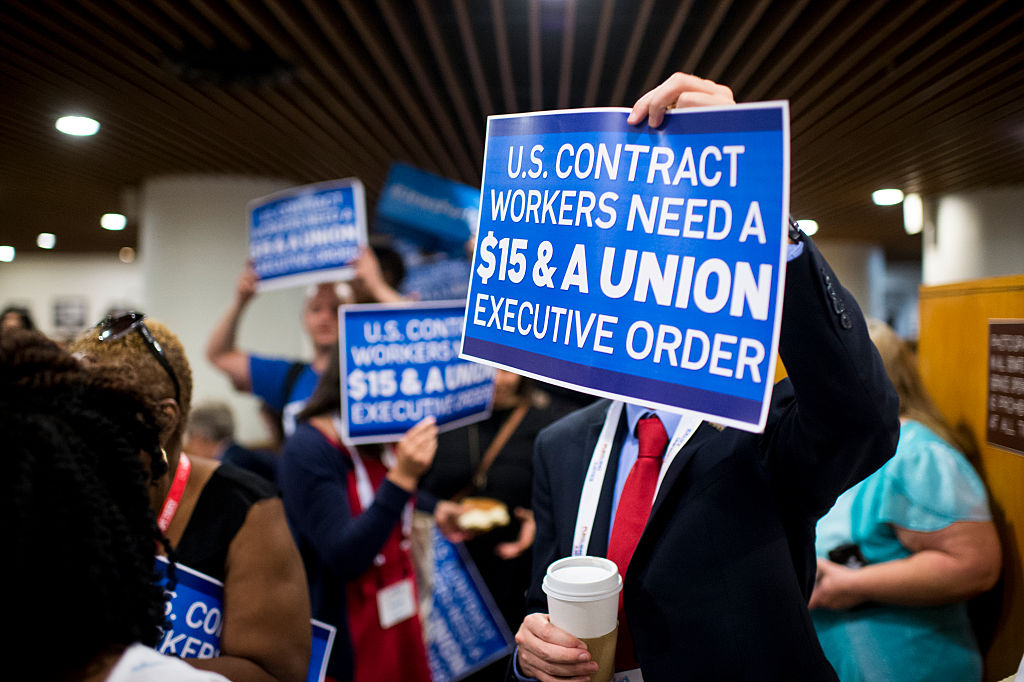
Efforts in the US to increase the federal minimum wage from $7.25 to $15 per hour have gained steam now that the Democratic Party controls the White House and Congress. Such a move makes sense both economically and politically.
Economists are no longer as skeptical of minimum wages as they once were. It used to be assumed that labor markets worked flawlessly, thereby denying employers the monopoly power with which to extract "rents" above the fair return for their physical capital investments. Under such circumstances, basic economics predicts that a higher minimum wage would reduce employment.
But research since the late 1980s has, for the most part, failed to find major disemployment effects from modestly higher minimum wages. The first salvo came from David Card of the University of California, Berkeley and the late Alan B. Krueger of Princeton University (partly building on joint work with Lawrence F. Katz). Their seminal work – summarized in their book "Myth and Measurement: The New Economics of the Minimum Wage" – found that reduced employment did not follow minimum-wage hikes; in some cases, employment actually rose when wage floors were raised.
Although these findings incited controversy at the time, additional evidence based on larger samples and more fine-tuned empirical approaches confirmed them. If minimum wages don't reduce employment by much, if at all, it may be inferred that large employers of low-wage workers (like McDonald's or Walmart) do have market power with which to earn rents (though the jury remains out on this question).
The earlier economics literature may also have underestimated other potential gains from minimum wages. After all, such policies do more than merely increase low-wage workers' earnings. My own work finds that minimum wages tend to discourage low-pay employment and create an impetus for the creation of good jobs with higher wages, more security, and possibilities for career advancement. Now that opportunities are dwindling for workers without a college degree – many of whom must resort to the gig economy and zero-hour contracts – the need for such an impetus has become more urgent.
True, some economists worry that minimum wages can discourage skills training and other investments in worker productivity. But as Steve Pischke of the London School of Economics and I have shown in the "The Structure of Wages and Investment in General Training", this concern has been exaggerated. When employers are earning rents – as seems to be the case in US low-wage markets – they can accommodate a small increase in the minimum wage without having to fire their employees. Better yet, when an employer must pay its workers higher wages, it has a stronger incentive to boost their productivity.
Moreover, while Democrats are already on solid empirical ground for advocating a higher minimum wage, the case for doing so is even stronger when one considers non-economic factors. As the philosopher Philip Pettit explains, humans strive for freedom from "dominance," which he defines as living "at the mercy of another, having to live in a manner that leaves you vulnerable to some ill that the other is in a position arbitrarily to impose." One is being dominated when one is "subject to arbitrary sway; being subject to the potentially capricious will or the potentially idiosyncratic judgment of another."
This definition captures the experience of those throughout human history who have lived in servitude. But as James A. Robinson and I emphasize in our book "The Narrow Corridor", even though most workers in the West no longer need to worry about the most brutal forms of labor coercion, the absence of job security and pay sufficient to meet one's needs means that one is still subject to "dominance."
Of course, neither Pettit nor James and I were the first to seize on this point. One of the architects of the British welfare state, William Beveridge, argued in 1945 that "Liberty means more than freedom from the arbitrary power of governments. It means freedom from economic servitude to Want and Squalor and other social evils; it means freedom from arbitrary power in any form. A starving man is not free." Likewise, Article 23 of the 1948 Universal Declaration of Rights states that "Everyone who works has the right to just and favorable remuneration ensuring for himself and his family an existence worthy of human dignity."
Viewed in this light, the Democrats' efforts to increase the minimum wage and expand worker protections should be viewed as a return to a social agenda that has been ignored for too long. In an increasingly unequal and stratified economy, policies to level the playing field and reduce dominance are long overdue.
As always, policy design matters. At some point, raising the federal minimum wage probably would start to produce disemployment, and it is reasonable to question whether the same minimum wage should be applied to all parts of the country, considering the cost-of-living differences between New York and Mississippi, or Massachusetts and Louisiana. Hence, some economists call for state minimum wages to be calibrated to average earnings in local labor markets. But most states have not taken the initiative to raise their minimum wages, leaving the federal government to set a new floor.
A higher federal minimum wage would have a powerful economic as well as symbolic effect; but it's no panacea. Without a voice in the workplace and a safe working environment, workers will remain under the "arbitrary sway" of their employers. If raising the federal minimum wage is the only substantive labor-market policy the Democrats enact during President Joe Biden's first term, they will not have achieved much, and may even have created stronger incentives for employers to automate more tasks.
The biggest problem facing Western economies today is a shortage of good jobs, owing to an excessive focus on automation and insufficient efforts to develop new technologies and tasks that benefit workers from all backgrounds. A minimum-wage hike would represent an important first step, but it must be accompanied by policies to redirect technological change and provide incentives for employers to create good jobs and better working conditions.
Copyright: Project Syndicate, 2021.