



Tapping the quality dividend







Imperative to make effective investment in human capital to meet the needs of a changing job market
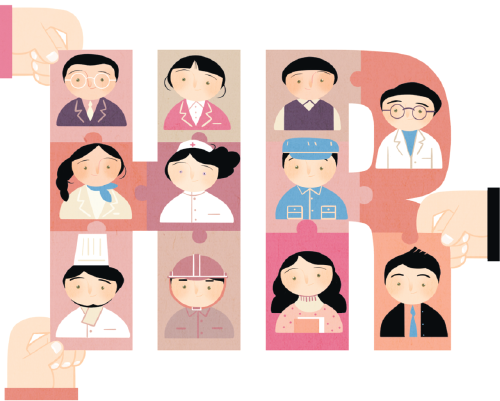
The job market in China has remained stable over the past few years, with more than 13 million new urban jobs created annually from 2013 to 2019. However, some structural problems-such as disparities between urban and rural areas, different regions and different industries, youth employment and quality of labor supply-have emerged.
The skill set of the rural labor force often fails to meet the demands of modern industry while the basic public services in the cities can hardly cope with the increased demand as millions of migrant workers become city dwellers.
Regarding the regional imbalance, China's inland regions enjoy a comparative advantage over coastal regions as labor costs surge in the latter. It has led to a tide of industrial transfer from the southeastern coastal regions to the central and western inland regions, which has changed the old structure of labor supply.
But youth group, such as college graduates and young migrant workers, face great employment pressures, as their professional skills do not match the requirements of the changing job market. So even though the number of college graduates has been hitting record highs in recent years, they face mounting pressures while seeking jobs and businesses are plagued by a constant labor shortage.
An aging population and dropping fertility rate will further compound China's labor supply woes as the labor force participation rate across working-age groups will drop. Going by the experience of developed countries, it could drop to less than 50 percent in the post-industrial era.
It is predicted that from 2020 to 2030, China's working-age population will drop from 989 million to 963 million, with the labor force participation rate dropping from 68.44 percent to 65.17 percent. Consequently, China's labor force supply will shrink to 627 million in 2030.
Against this backdrop, cultivating the quality dividend of the Chinese workforce through effective human capital investment becomes imperative.
The economic slowdown brought about by the outbreak of the novel coronavirus will also slow the creation of new jobs, although the sheer size of employment will continue to expand. Since opening-up, China has witnessed a long period of fast economic growth. The number of new jobs created for every 1 percent rise in GDP growth increases as the economic aggregate expands, meaning the number of new jobs created for every 1 percent rise in GDP growth in 2019 was much higher than that in 2009. Therefore, the economic slowdown does not mean a sharp decline in job opportunities. As the economic aggregate and market size expands and industrial structure diversifies, the demand for labor continues to expand in China.
Technological advancement is another game changer, having a "replacement effect", wherein new technology replaces some people's jobs. However, it will also have a "creation effect", with the enhancement of productivity and expansion of new products creating new job opportunities. As long as the number of new jobs created exceeds that of those lost, the problem of mass unemployment will not occur.
Labor demand hinges on economic growth, capital and technological endowment and a country's industrial structure. It is estimated that from 2020 to 2030, the labor demand of primary industry will decline from 187 million to 109 million and the secondary industry's demand will fall from 200 million to 160 million. The tertiary industry's demand, however, will increase from 380 million to 490 million. Overall, the total demand for labor will reach 760 million in 2030.
Looking ahead, China should continuously bolster labor market reform to enhance the development and allocation efficiency of human resources with the aim of achieving high-quality and full employment.
First, China should expand the scale of labor supply and enhance the labor force participation rate. It could unveil policies postponing the retirement age, to cushion the impact of a rapidly aging population in the labor market, and encourage people to have more children to tackle the declining fertility rate's short-term and long-term impacts. In the meantime, the social security system and child support policies should be improved to mitigate a working-age person's burden in supporting a family as the total dependency ratio increases.
Second, structural obstacles such as gender and regional discrimination in the job market should be reduced. China should exploit the potential of women, study the characteristics of different employment groups and promote equal employment opportunities. Furthermore, the basic public services for employed persons and business startups should be improved to promote the employment of key groups including college graduates and migrant workers by reducing their job-seeking costs and institutional barriers.
Third, China should further promote the flow of labor between urban and rural areas. On the one hand, China should guarantee the basic rights and interests of migrant workers, accelerate reform of the household registration system, or hukou, in metropolitan areas, city clusters and megacities, promote the equalization of basic public services in cities and increase the public service capacity, such as children's education, medical services, social insurance and housing, to encourage them to settle in the cities where they work. On the other hand, as well as their transformation from farmers into city dwellers, China should promote the transformation of migrant workers into modern industrial workers by further increasing their working skills to meet the new demands of industrialization.
Finally, the human capital supply structure should be optimized to increase the quality of labor in China. To solve the structural problem in China's labor market, in addition to increasing support for higher education, China should increase investment in preschool education, basic education and vocational education, accelerate reform of the curriculum in technical secondary schools and higher education and better match the supply and demand of the labor market through demand-oriented education such as school and enterprise joint training and enterprise customization strategies.
The author is an associate researcher at the Development Research Center of the State Council. The author contributed this article to China Watch, a think tank powered by China Daily. The views do not necessarily reflect those of China Daily.
If you have a specific expertise and would like to contribute to China Daily, please contact us at opinion@chinadaily.com.cn, and comment@chinadaily.com.cn.





