



Tech for the aged







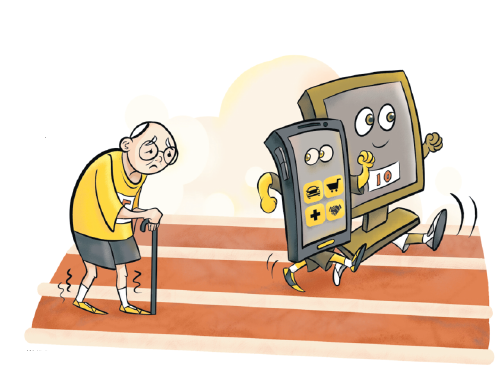
Elderly must not be left behind in the digitization era
Compared with other countries, China faces a larger aging problem in terms of both size and speed.
What's more, the aging of China's population coincides with the new digital revolution. Aging and digitization create a new challenge-an intergenerational digital divide against the backdrop of an aging society.
Since digital products and applications have rarely been developed and designed with the elderly in mind, senior citizens have lagged behind in digital literacy. Older people are therefore ill-informed, obstructed and voiceless, which amplifies intergenerational differences in lifestyle and emotional expression, and further exacerbates the estrangement, divide and conflicts between generations.
A digital divide refers to an information gap and the trend of further polarization during digitization due to differences in ownership, application and innovation of information and internet technologies between countries, regions, industries, businesses, communities and groups. The generational digital gap refers to the digital divide between the older and younger generations, brought about by the information gap, mobility barriers and the trend of further intergenerational estrangement caused by differences in digital capabilities between the aged and the young.
The intergenerational digital divide has become more of a problem in China in recent years. Having difficulties in hailing taxis, getting medical services, shopping and social interactions, many seniors are being marginalized in many aspects, such as dining, travel, healthcare and recreation, which inconveniences hundreds of millions of older people in their life, work and learning, creating and intensifying intergenerational estrangement and even conflicts.
The digital divide has also reduced the social participation of the elderly who account for nearly one-fifth of China's total population, and aggravated social inequality and injustice. With accelerated adoption and popularization of various digital applications since the novel coronavirus outbreak, such as QR codes, health codes, online shopping and the widespread use of smartphones, the intergenerational digital divide is widening and its problems are on the rise, thus attracting more and more attention. In fact, the divide affects not only the elderly, but also people of all ages. Everyone will be directly or indirectly implicated, thus undermining the equality, fairness and efficiency of the whole society.
There are two main reasons for the intensification of the intergenerational digital divide in recent years:
First, with digitization gaining momentum, senior citizens have become even more uncomfortable with technology, which exacerbates the intergenerational digital divide. By the end of 2019, there were about 250 million people aged above 60 in China, accounting for 18.1 percent of the population, but as of March 2020, although the number of netizens in China totaled 904 million and the internet penetration rate was 64.5 percent, netizens aged 60 and above only accounted for 6.7 percent. Constant innovation of digital technologies and expedited digitization over the past 20 years have been widening the digital gap for the elderly, resulting in more and more conspicuous discomfort and imbalance.
Second, the number of the elderly and their percentage in the population are rising rapidly, making the intergenerational digital divide more universal. It has only taken about 22 years for people aged 60 and above in China to increase from 10 percent of the population around 1999 to 18 percent in 2019 and 20 percent is expected around 2022. Some areas are even more aged, for example, people aged 60 and above account for more than one-fourth of all the residents in Beijing and more than one-third in Shanghai, while Northeast China and the countryside are far more aged than the national average. Twenty years ago, aging-related challenges only concerned the specific needs of particular groups and only required limited responses. Now, aging has brought about livelihood, economic, social, political and cultural challenges affecting the whole country and people of all ages, because of the growing elderly population and its rising share in the total population.
Addressing the maladjustment of the elderly to technology is the key to bridging the intergenerational digital divide. Aging itself is not a problem, nor is digitization itself. The problem is that the economic, social, political and cultural institutions that fit a young society are incompatible with an aging society. We should confront and redress the maladjustment, thereby solving the related problems. The intergenerational digital divide is essentially the incompatibility between the elderly when using technology and social norms, that involves a wide range of areas, such as technology, commerce, education, public policy, social ethics and cultural psychology. To address such incompatibility, we must first build the digital capacity of the elderly, innovate and improve digital products and applications, promote technology for good, for inclusion and for the elderly, and narrow or close the divide with new social norms.
New social institutions need to be established to narrow or close the divide, strengthen the interaction between government, market and society, and adopt public policies suitable for an aging society, so that they become an indispensable part of the new digital dividend and digital inclusion.
Confronted with the digital divide between generations, we should put in place a design, evaluation and service system for people of all ages. From the point of view of those developing technology, the elderly should be fully considered in terms of their physical capacity, behavior patterns and daily habits in the design of physical or digital products and interfaces. From a user's perspective, seniors should be encouraged and helped to access various new technology products so they can better embrace digital life.
Going forward, preparations for and responses to an aging society are becoming a key element of the core competitiveness of businesses, cities, regions and even countries, representing an immeasurable opportunity as well as a challenge.
The author is director of the Aging Society Research Center at the Pangoal Institution.





