Mainland's new phase, HK's new opportunities







Today's world is witnessing historic changes. Asia may play a prominent role in the development of the world's civilization as it once did a few centuries ago.
And recently, China has set out clear development objectives. By 2035, it will achieve socialist modernization. By 2050, it will develop into a modern socialist country that is strong, prosperous, democratic, culturally advanced, harmonious and beautiful.
It would be a huge disaster if China and other Asian countries reached modernization in the same way as Europe, the United States and Japan. Over-exploitation and an increasingly fragile environment have already sent out warning signals.
Sustainable development is the only way forward for humanity. In 2020, President Xi Jinping announced that China will strive to reach peak carbon emissions by 2030 and carbon neutrality by 2060.
China has made great progress in green development. Currently, China's installed renewable power capacity accounts for roughly 30 percent of the global total. And energy consumption per unit steadily decreased by about 25 percent over the past eight years.
We should try to achieve more efficient and higher quality development. Today, as input intensity of traditional production factors declines, innovation should become the key driver of modernization.
We need to deepen policy reforms in the areas of science, technology, education and finance, and nurture more talents. The financial system should better support venture capital, engineering projects and basic R&D.
We should aim for more equitable and secure development. We will continue to equally support the development of the public and nonpublic sectors. We stand firmly against monopoly and unfair competition. We insist that financial innovation be placed under prudential regulation. And we will endeavor to prevent and mitigate various risks.
We should strive for common prosperity and improve the quality of people's lives. The urban-rural gaps in development and income are narrowing. China's middle-income population has been growing, up from 100 million to over 400 million in the past 10 years. While the fair market determines the factor returns, we will improve the second and tertiary income distribution mechanisms, to better the distribution structure of income and wealth.
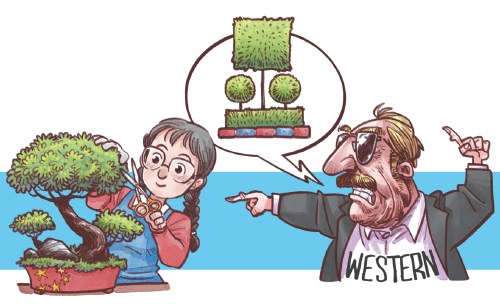
For a long time, China's economic development and social development have had positive global impacts. Over the past decade, China contributed 30 percent on average to global growth. Yet internationally, there were some negative remarks on China.
Twenty years ago, it was said that China was not a market economy and needed a transition. More recently, they accused China of State capitalism. This is a big misunderstanding.
Five points should help clarify this issue.
First, the private sector now accounts for 60 percent of China's economy. Before 1978, there was hardly any private-sector presence. If there were so-called State capitalism and State protection, how could this be achieved?
Second, China's industrial policies have been consistent with the market-oriented reform. At the end of 1970s, China encouraged light industry and lifted import restrictions on consumer goods. From TV sets to washing machines, and from sedans to trucks, the large inflow of foreign goods made China an "expo of brands of all nations".
Since late 1980s, our main policies have been to prevent duplicated constructions resulting from over-competition. In the past 10 years, we have closed down lots of high-energy-consuming, high-polluting and over-leveraged companies.
Third, State-owned enterprises in general are subject to negative subsidies from the government budget. The average tax on SOEs is almost twice that on private companies. SOEs have undertaken more corporate social responsibilities. The SOE-related government budget has been mainly used to resettle redundant workers, subsidize social security and public services.