



Fateful events leave unresolved consequences







After high-profile killings, Iran weighs responses to attacks amid strains with US
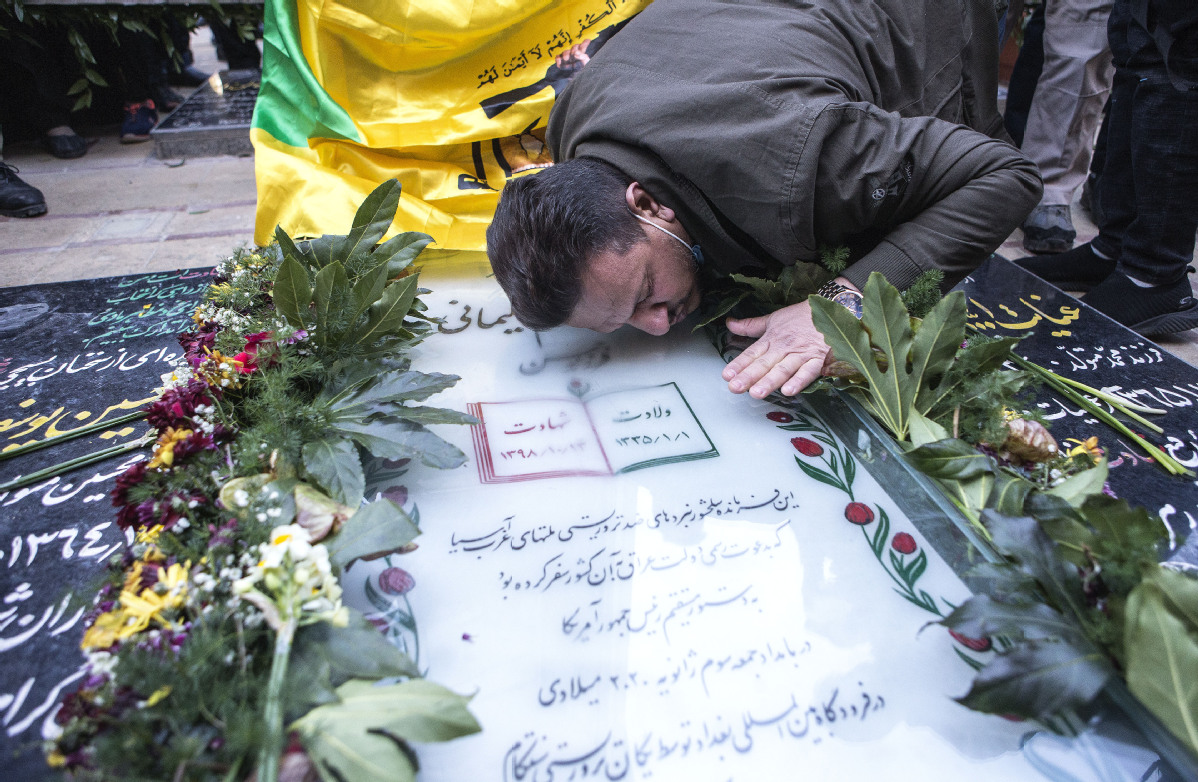
Iranians are unable to forget the events of a year ago when powerful military commander Qasem Soleimani was killed in a US drone strike in Iraq on Jan 3.
The deadly strike immediately inflamed passions in Iran, with the ripples from the incident felt across the entire Persian Gulf region. The effects linger to this day.
On Dec 27, Iran expanded the list of US citizens suspected of involvement in the assassination from 45 names to 48, said Hossein Amir Abdollahian, spokesman for the Popular Committee for the Celebration of the Anniversary of the Martyrdom of General Soleimani.
At a news conference on the judicial measures regarding the case, Abdollahian voiced hope to see a court ruling "in the near future", and said six countries have been given warrants from Iran for the arrest of the culprits.
A "harsh revenge" for the killing of the high-ranking Iranian commander is still on the agenda of the Iranian authorities, he said.
On that deadly Friday, Iran's Islamic Revolutionary Guard Corps confirmed that Soleimani was killed "in the raid of US helicopters" at Baghdad International Airport. The strike also killed Abu Mahdi al-Muhandis, the deputy chief of Iraq's paramilitary Hashd Shaabi forces.
The Pentagon, which was later listed as a terrorist organization by Iran, said in a statement that the strike was at the direction of US President Donald Trump as a "defensive action" against Soleimani. The move was aimed at "deterring future Iranian attack plans", the statement said.
On the same day, Iran's Supreme Leader Ayatollah Ali Khamenei vowed "severe revenge" to those who shed the blood of Soleimani and his companions.
The world also held its breath on fears the action could sharply escalate tensions in the Persian Gulf region.
Trump warned Iran the next day that the US had targeted 52 Iranian sites and Iran would be hit "very fast and very hard" if it attacked any US citizen or assets of the country.
Two days later, on Jan 5, Iran distanced itself from the 2015 nuclear deal, one of the more visible consequences in the fallout from the assassination.
The country said it would "take the final step to reduce commitments to the Joint Comprehensive Plan of Action", and would not observe restrictions in operational areas, including uranium enrichment capacities, enrichment percentage, the volume of enriched material and research.
Iran's actions came as no surprise as the tensions between Washington and Teheran were rooted in Trump's decision in May 2018 to withdraw the US from the Iran nuclear deal.
Iran retaliated against Soleimani's killing by launching a volley of missiles at bases in Iraq housing US troops on Jan 8. But amid the high tension, that day it "unintentionally" shot down a Ukrainian passenger jet shortly after takeoff from Teheran, killing all 176 people on board.
A war mentality has been rooted in Iran after the assassination, said Li Shaoxian, a Middle East studies expert at Ningxia University.
"Without the assassination, there would be no high tension in the regional situation," Li said. "The US bears responsibility for this situation and the painful accident."
'Prepared to react'
As the anniversary of the assassination drew nearer, the US said in late December that "we are prepared to defend ourselves, our friends and partners in the region, and we're prepared to react" if Iran launched any attack to mark the event.
In November, tensions in the Middle East erupted anew when top Iranian nuclear scientist Mohsen Fakhrizadeh was assassinated near Teheran.
The incident came just days before the 10th anniversary of the assassination of leading Iranian nuclear scientist Majid Shahriari, and less than a year after that of Soleimani.
For a figure who had spent years in the shadows, the image of the high-ranking nuclear physicist suddenly was seen everywhere in Iranian media. His widow spoke on state television and officials publicly demanded revenge for the scientist's killing.
It was no doubt another harsh blow to the Islamic republic.
"The Iranian nation will not allow the crime to remain unanswered," the official IRNA news agency quoted President Hassan Rouhani as saying. The country would respond to the assassination at an "appropriate" time, he said.
No one has claimed responsibility for the assassination. The Iranian government suspected that it was carried out by Israel's Mossad intelligence agency, media reports said. Israel has neither confirmed nor denied the allegation.
Khamenei called on the authorities to seriously "probe this crime and punish the perpetrators", and said the scientific and technological efforts of Fakhrizadeh would continue.
He was heading a program that Israel and the West have alleged was a military operation looking at the feasibility of building a nuclear weapon.
"This is not the way to solve problems. We're not going to prevent Iran's nuclear (program) by killing their experts and nuclear scientists," said Josep Borrell, foreign policy chief of the European Union.
There are people who do not want the nuclear deal to be revived, he said.
The agreement, known as the Joint Comprehensive Plan of Action, or JCPOA, was signed in July 2015 between Iran and China, Russia, the US, the United Kingdom, France, Germany and the EU.
After Trump's unilateral decision to withdraw the US from the deal in May 2018, the US president began reimposing a series of economic sanctions, triggering more conflicts and escalating the tensions between the US and Iran.
The assassination of Fakhrizadeh again cast a shadow on the future of US-Iran ties.
All the while, Iran has been acting with restraint since Soleimani's death, notwithstanding the at times fiery language it has used against the US.
In January last year, Iran called an end to its military action in retaliation against the strike that killed Soleimani, and Iranian Foreign Minister Mohammad Javad Zarif said Teheran does not "seek escalation or war".
Following the November attack against Fakhrizadeh, Rouhani stressed that the country will seek its revenge in "due time" and not be rushed into a "trap". There have since been no overt military actions.
Restraint may be a better choice for Iran and its long-term interests, as such an attitude can arouse sympathy and support from the international community, said Wang Lei, assistant research fellow at the Institute of World Economics and Politics at the Chinese Academy of Social Sciences.
For its part, the US does not want to embark on a path that may trigger greater retaliation from Iran, especially a war requiring a large commitment of troops and funds.
After US military facilities in Iraq were hit by Iran in revenge for the Soleimani killing, Trump appeared to be sending signals that de-escalation was desirable.
He said US did not necessarily have to hit back. He also said that Teheran appeared to be standing down, calling it "a good thing" for all parties concerned.
As for the nuclear deal, US President-elect Joe Biden had made it clear during his campaign that his administration would favor a return to the JCPOA, if Teheran returns to full compliance.
In a joint statement released on Nov 30, six former senior European officials urged the EU to call on the incoming Biden administration and Iran to swiftly come back into full compliance with the JCPOA.
"The Trump administration's maximum pressure campaign against Iran has failed, with the unprecedented sanctions negatively impacting ordinary Iranians," said the letter signed by figures such as former Swedish prime minister Carl Bildt, former NATO secretary-general Javier Solana and former German ambassador to the US Wolfgang Ischinger.
- Washington should return to Iran deal ASAP: China Daily editorial
- Iran warns against 'hostile moves' on Soleimani assassination anniversary
- Iran-US tension continues to escalate ahead of Biden's inauguration
- Assassination of Iranian nuclear scientist?blow to improvement of Iran-US relations: China Daily editorial










