A growing number of Chinese museums are interpreting their exhibits to develop cultural and creative products in versatile ways, Wang Ru reports.
During the War of Resistance Against Japanese Aggression (1931-45), archaeologist Wu Jinding wrote a letter to his contemporary, Liang Siyong, in which Wu expressed his worries about Liang's safety besides describing his recent discoveries at work. In the end, he wrote "niannian", which means, "I miss you" in Chinese.
The letter was shown in an exhibition of more than 100 Tsinghua scholars' handwriting and letters at Tsinghua University Art Museum in 2019.
The museum used the niannian element to develop cultural and creative products related to the exhibition. And these products won the first prize in the 2020 Cultural and Creative Design Competition's cultural heritage category.
The final was staged in Beijing on Dec 26. The event was organized by the Beijing Municipal Administration of Cultural Heritage and the Beijing Cultural and Creative Industry Promotion Center.
Since July, the competition collected 5,824 works related to museums and cultural heritage, including Beijing's central axis, 24 solar terms and ancient puzzle toys from many places in China. Fifty made the final.
Their products developed by Tsinghua University Art Museum and cultural company AIO Lab aim to "tell impressive stories in its former exhibitions", AIO Lab co-founder Yan Yunfei says.
"We can see many other affectionate letters like Wu's in the exhibition, like modern scholar Hu Shi's letter to his friend's daughter, trying to persuade her not to study too hard, and writer Zhu Ziqing's letter to his nephew, congratulating him on his marriage. They all moved us deeply. So, we summarized them and infused impressive elements from the letters into our cultural and creative products' designs."
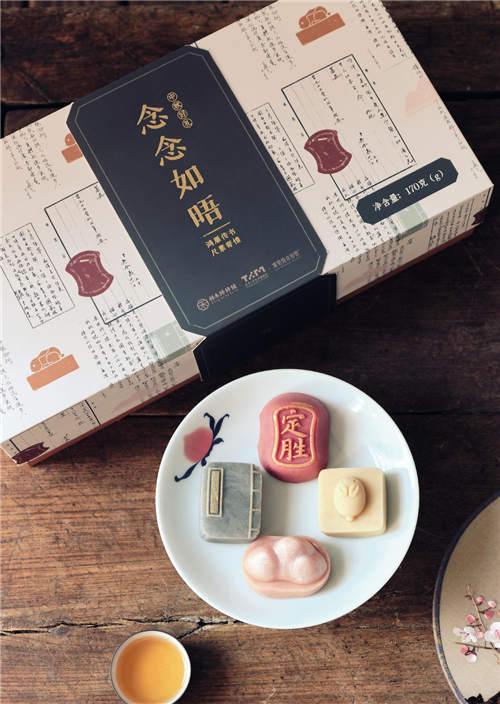
For example, using niannian from Wu's letter, they designed a dessert gift box called Niannianruwu, which means, "I miss you and hope this gift finds you well."
The box was launched during last year's Mid-Autumn Festival, a holiday during which people often express their love for family and friends. Over 7,000 were sold in the first month.
The gift box contains four desserts in the shape of a penholder, an ink stick, a book, a seal, a reproduction of a bowl from the museum's collection and copies of the three letters that offered inspiration for the box.
"We hope our gifts will be like the Tsinghua scholar's letters to help people express their affection to their loved ones," Yan says.
The Beijing Society of Museums' secretary-general Qi Qingguo, who is also a competition judge, says: "Tsinghua University Art Museum's works won the first prize, since they contain good ideas while showing features of the university and the humanity of the Tsinghua scholars. They have many elements of traditional Chinese culture with good artistic taste and seem fashionable enough to meet young people's consumption."
Another prize winner is a series of works based on Beijing's central axis developed by the Beijing Institute of Architectural Design Group. They produced a ruler called Capital's Growth.
"Many buildings on the axis traveled from ancient times to the present day, just like milestones that witnessed the growth of this city," BIAD designer Tang Xinzhu says.
"We can see the axis is growing longer and has more architecture on it like Beijing Daxing International Airport that began operating at the end of 2019. So, we regarded growth as a theme for the axis.
"Moreover, the buildings are located linearly along the axis like a ruler. So, we developed a growth-themed 'capital ruler' for children to measure their growth, including height."
Images of buildings on the axis are placed in order on the ruler with introductory words and stickers, so children can learn about the city's architecture and planning when using it with their parents.
The competition has been staged for three consecutive years.
"The participants are making obvious progress every year," Qi says.
He says many young designers and groups have submitted sophisticated works. Many large companies and institutions have joined. And competitors have sought more academic support to improve their designs and products.
But Qi also mentions problems remain in the interpretations of museum exhibits into cultural and creative products.
"Such transferences require cooperation between museums that offer their resources and other professional institutions that design or develop products. But we've found such cooperation still needs improvement," he says.
"Sometimes museums are active on some projects, but their design or development efforts seem to lag. Or, the design may employ creative ideas but those are difficult to make into good products. Or, the museums may not provide enough resources. I hope cooperation improves."
Another problem is the legal issues surrounding translating exhibits into commodities.
"When museums are public, no profits are generated, and that's OK," Qi says.
"But when the exhibits are rendered into profitable products, we need to make copyright clear. We've done some research and made some achievements, but many issues still need to be resolved.
"We need to encourage the use of museums' numerous resources to be rendered as products that serve society, instead of restricting such attempts. Then, we need to perfect issues like the details surrounding copyright and create relevant laws and regulations."