



Cooperation can help overcome 2021 risks







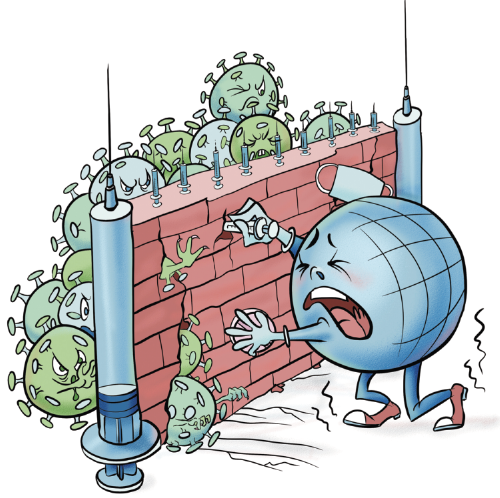
The COVID-19 pandemic is likely to be largely controlled, the world economy is expected to be on the track to recovery, and major-country relations are projected to remain relatively stable in 2021. Yet the world will still face risks.
Risk of improper global response
A new wave of COVID-19 infections hit the northern hemisphere as autumn set in, forcing major Western countries to re-impose restrictions. After the approval of some vaccines in December, several more are likely to be approved for use in 2021. But the rush to buy those vaccines by developed countries led by the United States, which has ordered three times more vaccine doses than its total population, could prevent the equitable distribution of the vaccines, even affect vaccine production, distribution and use.
So it remains to be seen whether the vaccine implementation plan of the World Health Organization will work as envisaged.
Although extensive inoculation programs across the world is likely to start in the second half of 2021, there remains the risk of the epidemic continuing to spread in countries that cannot carry out extensive inoculation programs due to lack of policy coordination or policy disagreements among countries, which will greatly increase the medical and debt risks of developing countries and thus affect the global economic recovery.
Risk of major-country power games growing
Many observers say that after Joe Biden assumes office as the new US president, major-country relations will return to normal, and instability and uncertainty will diminish. However, political polarization and social divisions in the US have become more serious, as the presidential election showed, and there is limited room for improvement in China-US ties.
The risk of increased competition and part "decoupling" of the US and Chinese economies, especially in the field of science and technology, will continue to intensify, making the devising of international rules and standards even more difficult, at least in the short term. As for geopolitics, new conflicts may erupt due to changes in the world order.
Risk of large-scale network security
As big data, cloud computing, artificial intelligence, 5G and the internet of things drive the booming digital economy, the total volume of human data will exceed 60 zettabytes from 1 Zb 10 years ago. By 2023, global data are set to double again, with a total of 48.9 billion networking devices. This colossal volume of network information and data flows has created unprecedented security risks for all countries.
With a third of the population working from home during the height of the COVID-19 pandemic, a large volume of private and confidential information became more vulnerable to theft. For example, in the first 10 months of 2020, more than 1,000 enterprises, including energy and electricity companies around the world were attacked by "ransomware". And with most of the economies in the world set to recover and countries expected to reopen their borders, the flow of data will skyrocket, increasing the risk of cyberattacks, data breaches, and disruptions in infrastructure operations.
Risk of climate change, environmental damage
Moreover, despite Biden promising that the US would return to the Paris Agreement, and a growing number of countries pledging to become carbon neutral by the middle of this century, worsening climate change, apart from causing increasing losses of life and property in recent years, will have a long-term impact on human society.
The year 2021 could also see an increase in extreme weathers, including rainstorms, typhoons and hurricanes in coastal regions, major forest fires, floods, droughts and locust-caused devastations in major grain-producing regions, the Arctic becoming more ice-free in summer and the Antarctic losing more of its ice sheets.
These large-scale natural disasters driven by human factors may not only cause food and survival crises for millions of people, but also trigger a real global epidemic crisis, because the possibility of new viruses and epidemics devastating the world due to the complex effects of climate change cannot be ruled out.
Risk of unemployment rising due to use of AI
The integrated application of artificial intelligence, the internet of things and robotic technology could see a large number of blue-collar workers, even some white-collar workers, losing their jobs. Many companies have been replacing humans with robots in production, transportation, storage, trading and other fields at a faster rate since the pandemic broke out to prevent disruptions in the industrial and supply chains.
If enterprises continue to replace humans with robots on such a rate, a large number of people will lose their jobs and the divide between the rich and the poor will further widen, undermining social stability and giving rise to anti-globalization and populist movements.
Risk of liquidity crisis in developing nations
Owing to the COVID-19 pandemic, the spending of all countries on health and related fields has increased while their tax revenues have seen a dramatic decline. At the same time, global sovereign and corporate debts have soared, and banking institutions' bad debts have increased. By the end of 2020, global debt was likely to have soared to $277 trillion. And though the debt of developed countries rose by 50 percent year-on-year to four times the GDP, the debt of emerging economies increasing to 2.5 times the GDP is more worrying, because their debt increase in large part comes from non-financial institutions.
So far, the debt accumulation of developing countries has been far beyond the level of the 2008 global financial crisis. But with the monetary and fiscal policies the central banks' used as economic stimulation likely to end in 2021-as the COVID-19 crisis is expected to gradually dissipate next year-some countries and non-financial institutions with high foreign debt ratio and low solvency could face a liquidity crisis. This, if not properly handled, may cause a chain reaction leading to a global financial crisis.
Risk of fluctuations in global commodity prices
The COVID-19 outbreak has led to an increase in agricultural reserves, a shortage of metal minerals due to China's strong demand, and a reduction in energy production due to insufficient demand in developed countries, forcing the prices of commodities such as soybean, copper and iron ore to increase to six-year highs.
In terms of trend, the agricultural and mineral product index has recovered to the pre-epidemic level and continues to grow, while the energy index has bottomed out and entered a fast track to recovery. But if the US dollar continues to weaken, commodity prices could rise beyond expectations in the first half of next year.
Given that two-thirds of foreign exchange receipts and payments in developing countries are associated with commodity prices, while 60 percent of developing countries depend on commodity imports to meet their domestic demand, if price fluctuations in 2021 cause local hyperinflation, it could lead to severe trade and financial imbalances in South Asian, African and Latin American countries, and eventually result in a debt, economic, or even a sociopolitical crisis.
Risk of a new type of terrorism emerging
Since 2014, the "terrorism activity" index has shown a downward trend in 70 percent of the countries. Most terrorist attacks have taken place in regions already in the grip of civil strife, and the ability of transnational terrorist outfits to launch large-scale attacks has weakened. But terrorist groups have taken advantage of the pandemic and ethnic conflicts to undergo alarming changes in 2020.
First, terrorist outfits in sub-Saharan Africa and South Asia are expanding. Second, the number of racist attacks carried out by far-right outfits in North America, Europe and Oceania have significantly increased. And third, the pandemic has disrupted anti-terrorist operations, giving terrorist outfits a chance to regroup and build in strength.
More importantly, terrorists, using the pandemic to their advantage, have been trying to gain access to chemical and other weapons of mass destruction, medical radioactive wastes and other dangerous products to launch more lethal attacks.
The above mentioned eight kinds of risks are interconnected. And to avert these risks and foster a stable and sound global economic recovery, the most important thing to do is to eliminate the global governance deficit and strengthen international coordination and cooperation.
In this regard, China and the US share important common responsibilities. And only by working together to overcome the global challenges and deepen bilateral and multilateral cooperation can the two countries, along with other nations, lead the world out of the COVID-19 crisis, and create an environment conducive to global peace and development.
The views do not necessarily reflect those of China Daily.
The author is a research fellow at the Institute of World Economics and Politics at the Chinese Academy of Social Sciences.
If you have a specific expertise and would like to contribute to China Daily, please contact us at opinion@chinadaily.com.cn, and comment@chinadaily.com.cn.





