Understanding culture is key to understanding political differences








Mutual understanding is a prerequisite for friendly ties between nations, just like any other relationship. More often than not political agenda dominates international or geopolitical relations, but in reality, politics is deeply rooted in culture. A true understanding of culture will make many political conflicts and ideological disputes look futile and far-fetched.
Many of my fellow countrymen admire United States and its highly effective government. However, they have become doubtful since the outbreak of the COVID-19 pandemic.
They fail to understand why so many Americans refuse to wear face masks. It costs little effort yet reduces chances of virus infections effectively. And the government seems unable to do much to control the pandemic, which has gotten out of hand. "This is incomprehensible" is the comment you hear everywhere throughout China these days.
My fellow countrymen don't understand that Americans value their lawful "rights" more than anything else. Those Americans who reject masks are defending their right to breathe freely; a right they believe is bestowed on them by God. Americans maintain one's right is indisputable and whether it is right or wrong is a secondary matter. One can air his or her grievances but people's rights are not to be encroached upon.
That is a matter of culture, not politics or ideology. We tend to judge things and others by our own standards and expect others to behave the same way. That may be a root cause to conflicts and misunderstanding between nations.
Hofstede uses six dimensions when looking at cultures in different parts of the world. One of them is individualism and collectivism. The United States and China seem to stand on the opposing end of the spectrum. That could conveniently serve as the key to understanding the differences, political, social and behavioral, of the two nations.
America's individualistic culture has been shaped in its colonial history. When first settlers tried to survive in a new world without outside assistance, they exercised complete control of their own destiny in the fight against adversities. Therefore, independence, freedom, and right to pursue happiness have become their core values.
It is understandable that they insist on limiting the power of government and employ check and balances to avoid the government from infringing on people's rights. Their epoch-making success in becoming the world's number one power has made them believe the American way is the only right way.
China has a different cultural background. Until a few decades ago it had been an agricultural nation. Ninety percent of its population was tied to the land and poor transportation means kept people from traveling far and wide. The same families lived in same villages for dozens of generations and for thousands of years. The mode of production and collective way of existence had nurtured a different set of values, namely harmony, stability and unity.
Culture is "collective unconscious" and takes ages to change. Farmers used to save enough food to prepare for possible famines in the coming years. Even today, the Chinese are careful in expenditure planning. They tend to both spend and save. That is why our national saving stays as high as 50 percent of GDP.
In a collectivistic society, equality was vital to harmony. Disparity of wealth distribution often led to wars and peasant uprisings. The "world commonwealth" was an ancient yearning and that explains why China preferred communism to any other political institutions over a century ago.
To keep the country, community and family harmonious, Confucius advocated self-restraint and the "ritual", a high-low dualistic scheme of king and courtiers, official and civilians, parents and kids, husband and wife, teacher and students. The high was obliged to take care of the low, while the low was supposed to be deferential to the high. Each and all were to comply with a designated set of moral obligations and abide by established code of conduct. Individual rights of each category were clearly defined and undisciplined behavior was seen as bad manners.
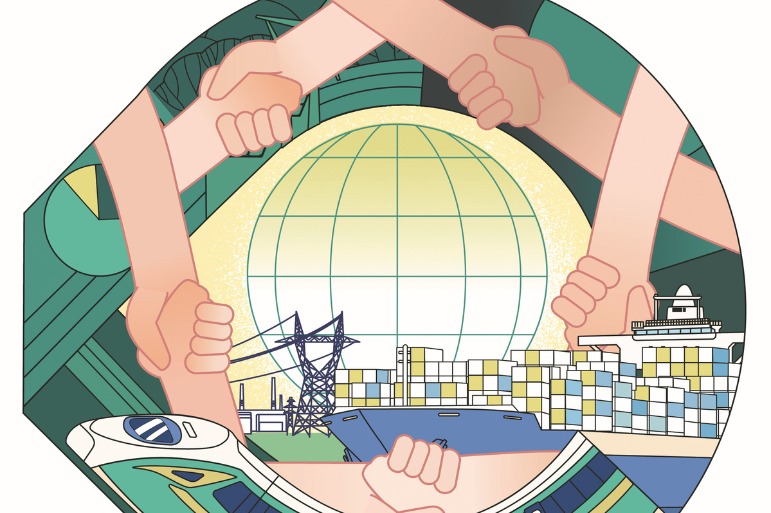
Political systems are not to be exported or imposed upon. The political institution of the United States grew out of an adventurous new continent. China, in its course of modernization, has modeled on the Western-style republic and adapted to its cultural tradition. Both have succeeded. There is no issue of right or wrong nor superior or inferior. In line with their collective mindset, the Chinese believe both will be stronger if the United States and China work together.
The author is a freelance writer. He previously worked at Tianjin Foreign Studies University and Nanjing University, and served as a postdoctoral fellow at Harvard University,visiting professor at Tsinghua University, Peking University and Renmin University.
The opinions expressed here are those of the writer and do not necessarily represent the views of China Daily and China Daily website.
If you have a specific expertise and would like to contribute to China Daily, please contact us at opinion@chinadaily.com.cn, and comment@chinadaily.com.cn.