



Will China-India relationship continue to fluctuate?







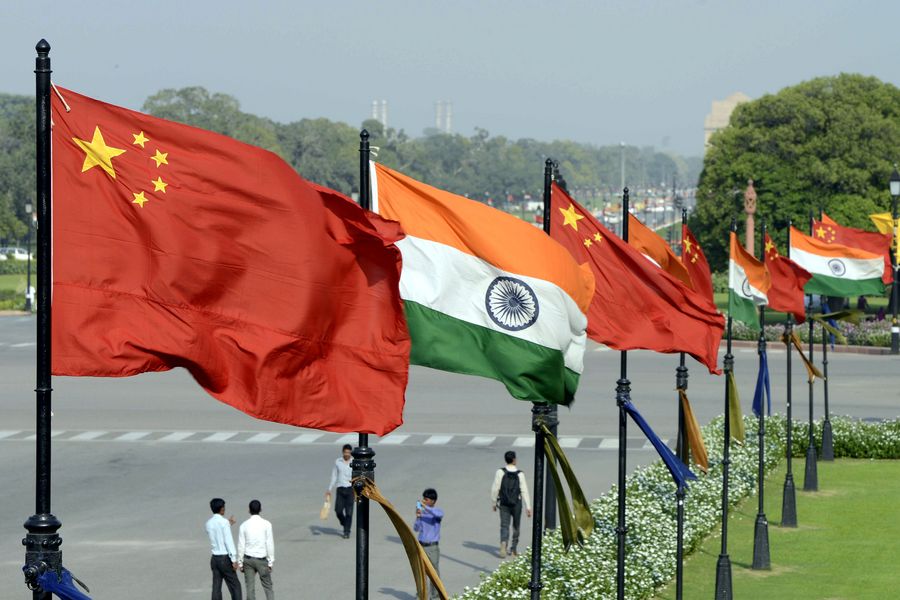
Although 2020 marks the 70th anniversary of the establishment of diplomatic relations between China and India, the two sides could not formally observe the occasion because of the novel coronavirus pandemic and the military standoff in the Galwan Valley on the non-demarcated Sino-Indian border.
Given the pandemic's devastating impact on the global economy and the international community, which could lead to changes in international relations and global governance, the two countries need to more carefully handle bilateral issues.
The China-India relationship is marked by structural problems such as trust deficit, cognitive differences and asymmetry of threat perception caused by the differences in their national strength. Some of the other factors affecting bilateral ties are the changes in India's political environment including the rise of right-wing nationalism and third-party effects. Since June, China and India have held eight rounds of corps commander-level meetings, four meetings of the Working Mechanism for Consultation and Coordination on India-China Border Affairs, and one meeting each between the two sides' defense ministers and foreign ministers.
Yet to resolve the border issue, the two countries need to hold more talks.
The border standoff has also led to economic frictions, with India banning more than 200 Chinese-made apps over the past six months. So, to ease the situation and put bilateral ties back on the right track, the two countries should revisit the principles of crisis management.
First, both sides should stick to the consensus reached at the 8th round of corps commander-level meeting that their front-line troops should exercise restraint and avoid misunderstanding and miscalculation. Since the deployment of troops on both sides of the border is still high, it is all the more important that the two countries realize that any untoward incident could further shrink the space for negotiations. As such, the two sides should work toward a phased settlement of the issue.
Second, the policy framework of China-India border issues needs to be improved. The unilateral changes being made by India along the Line of Actual Control-including building highways and airports, and modernization of military facilities-is the real cause behind the border problem.
The other cause is the complicated nature of the border issue, not least because it is related to the possibility of the overall power gap between China and India widening further. But if China and India can be realistic enough to see the border issue as a part of overall bilateral ties, they can better manage the disputes. And since the border disputes cannot be solved in the short term, crisis management could become a permanent feature of overall China-India border talks.
Third, the two sides should consider permanent de-escalation of troops along the border. India has hyped up the "China threat" theory while trying to decouple the Indian and Chinese economies on the pretext of safeguarding national security, thereby harming bilateral ties.
Economic ties and people-to-people exchanges have played very important roles in bilateral relations. But due to the rise of right-wing nationalism in India, the Indian government has boycotted Chinese products and modified foreign direct investment laws, which has reduced the bilateral trade volume. Data from India show bilateral trade dropped to $16.55 billion in the first quarter compared with $21.42 billion in the same period last year, and India's trade deficit declined from $13.1 billion to $5.48 billion year-on-year.
Besides, India has imposed stricter limits on visas, and canceled elective Chinese courses in schools, which will affect Indian youngsters' understanding of China and therefore further widen the differences between the two peoples.
Thanks to the pandemic, India faces its worst economic downturn. Yet it has banned Chinese apps and imposed stricter limits on Chinese companies, ostensibly because the Narendra Modi government wants to nurture domestic industries. Instead of pandering to the nationalist forces, however, the Modi government should weigh the pros and cons of working with China.
China is close to building a moderately prosperous society in all respects. Peace and development will remain China's goal during the 14th Five-Year Plan (2021-25) period. It has also decided to create a positive environment for high-quality development during this period.
So, hopefully, China-India relations will be back on the right track next year. However, to ensure that happens, the two countries have a lot to do. For example, they should implement the consensuses their leaders have reached and increase military-to-military and diplomatic-level communication, while making more efforts to resume bilateral economic dialogue. And the media outlets in the two countries should play a more constructive role in promoting mutual understanding and mutual trust.
In the age of 5G technology and artificial intelligence, China and India are natural development partners, not a development threat to each other, so their main aim should be to promote benign competition while increasing cooperation in order to integrate their industrial and supply chains.
The views don't necessarily represent those of China Daily.
The author is an associate research fellow at the National Institute of International Strategy, Chinese Academy of Social Sciences.
If you have a specific expertise and would like to contribute to China Daily, please contact us at opinion@chinadaily.com.cn , and comment@chinadaily.com.cn





