



Sustainable Development of Transport in China







Panel 1 Beijing Daxing International Airport
On September 25, 2019, Beijing Daxing International Airport opened for business. After full completion, the airport is expected to cover 45 square kilometers and have six runways to handle over 100 million passengers per year.
Renewable energy accounts for 16 percent of the airport's energy use, and over 60 percent of operational vehicles in the airport control area are powered by new energy. All facilities are environment-friendly, 70 percent of which meet the highest green building standards in China. The airport has the world's largest terminal, which is both functional and aesthetic.
The construction took less than five years and the airport entered service smoothly, fully demonstrating China's strengths in engineering and infrastructure, and the Chinese spirit. The airport is China's new gateway to the world and new source of national development.
Strengthening systematic planning for urban transport infrastructure. By the end of 2019, the total length of urban roads across the country was 459,000 km, the road area per capita 17.36 sq m, the road network density in the urban built-up areas was 6.65 km/sq km and the road area ratio 13.19 percent. The government has strengthened planning for a comprehensive urban transport network and improved effective transport connections between cities and neighboring areas.
With a concept of "narrower roads and a denser network", China has built an urban road network featuring a reasonable composition of expressways, arterial roads, sub-arterial roads and branch roads friendly to green travel. The transport authorities have improved road space allocation to fully ensure the needs of green travel and regulated the provision of traffic safety and management facilities. The country has carried out campaigns to clear up sidewalks and build bike paths to improve the environment for green travel.
? Building integrated transport hubs. By giving full play to the hub economy and actively fostering new drivers of growth, China has promoted the integration of transport, logistics, and information with society and the economy. Considering the national urban configuration, the country has built international transport hubs in Beijing, Shanghai and Guangzhou, and created more transport hubs at national and regional levels. Highlighting the need for integrated transport terminals, a group of such projects has been completed, such as the Beijing Daxing and Shanghai Hongqiao hubs, integrating airport transport seamlessly with high-speed and standard rail, and urban passenger transport.
The configuration of freight terminals and logistics parks has been optimized for multimodal and multilevel transport. A number of modern logistics hubs, such as Yangshan Port in Shanghai and the railway inland port in Zhengzhou, have helped to improve the transshipment capacity, enhance multimodal transport, and create a comprehensive transport system. The integration of various transport methods at these hubs provides strong support for optimizing the economic structure and modernizing the economic system.
2. Optimizing Transport Capacity and Quality
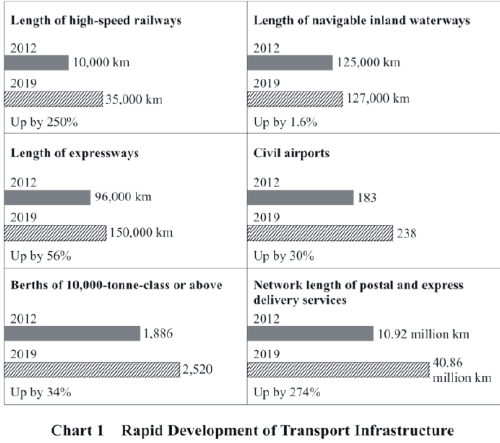
China has made all-round improvements to the quality of transport. The rapid growth of Internet Plus Transport and other new business models has offered more equitable access to more diversified services of higher quality, facilitating the movement of people and goods, and strengthening the accessibility and support functions of transport. Transport is playing a stronger role in supporting the nation's economic and social development, and in promoting investment, stimulating consumption, and sustaining growth.
? Enhancing freight transport capacity. China is one of the busiest freight hubs in the world. The increasing demand for freight capacity requires China to accelerate multimodal transport and create efficient and innovative transport links such as rail-highway, air-rail, rail-waterway and river-sea transport, ship-to-ship transfer, and roll-on/roll-off shipping.
China has also implemented programs to raise railway transport capacity, upgrade waterway transport, and regulate highway freight transport. The freight transport structure has been optimized, overall transport efficiency has improved, and logistics costs have been lowered. A marked decrease has been seen in transport pollution. The construction of pipelines for crude oil, refined oil and natural gas is accelerating. The proportion of rail transport in total freight transport is increasing. Visible results have been achieved in shifting more freight transport from road to railway. The cargo throughput and container throughput in China's ports both rank first in the world. Express delivery continues to flourish, and has led the world for the past six years. Substantial growth in transport service capacity has accelerated progress in reducing costs, increasing efficiency, and upgrading the logistics industry.
? Meeting the public's expectation for quality travel. Passenger transport is becoming more professional and personal, meeting the public's expectation for a better, faster, more convenient, more comfortable, and satisfying travel experience. With road transport as the base and high-speed rail and civil aviation as the direction of future development, the transport service structure is improving. The trend is for passengers on middle-and long-distance journeys to shift from highway travel to high-speed rail and planes. By the end of 2019, 12 billion trips had been made on high-speed rail, and its share of total rail passenger transport had risen from 4.5 percent in 2007 to 65.4 percent.
Panel 2 China's Postal Services
China has the world's largest postal system servicing its 1.4 billion people. An express delivery network connecting urban and rural areas, covering all corners of the country and reaching the world is in place. Remarkable progress has been made in express delivery in three respects: improving the service network in west China, promoting the sales of industrial products in rural areas and agricultural products in urban areas, and encouraging express delivery enterprises to expand their cross-border business. There are 54,000 postal outlets across the country, the coverage of express delivery in township outlets is 96.6 percent, and all administrative villages have direct access to postal services.
A host of competitive and robust market entities have emerged in the delivery industry, resulting in one enterprise with annual revenues exceeding RMB100 billion and five others exceeding RMB50 billion. China has become the fastest growing and most dynamic delivery market, with its package volume overtaking the combined figure in the US, Japan and Europe and ranking first in the world for the past six years.
The transport capacity and service during the Chinese New Year holiday, National Day holiday, and other travel peaks have significantly increased. People can now take a trip whenever they want, and enjoy quality and professional service that makes travel a comfortable and satisfying experience.
Prioritizing the sustainable development of urban public transport. Modern cities aspire to provide high-quality public transport, and take effective measures to strengthen urban traffic management and enhance the life quality of urban citizens. Great efforts have been made to improve urban rail services. By the end of 2019, a total of 40 cities had opened urban rail transit lines, with 6,172.2 km of track. While the role of rail transit is increasingly visible, the number of people using public transport for travel is also growing, and the level of comfort is improving.
Rapid development has also been seen in non-motorized transport. More than 70 cities have released administrative measures to regulate bike-sharing, and over 360 cities provide bike-sharing services. Public transport offers convenient travel by meeting the public's diverse travel needs.





