



How China leads in evolution of digital-era money, payments







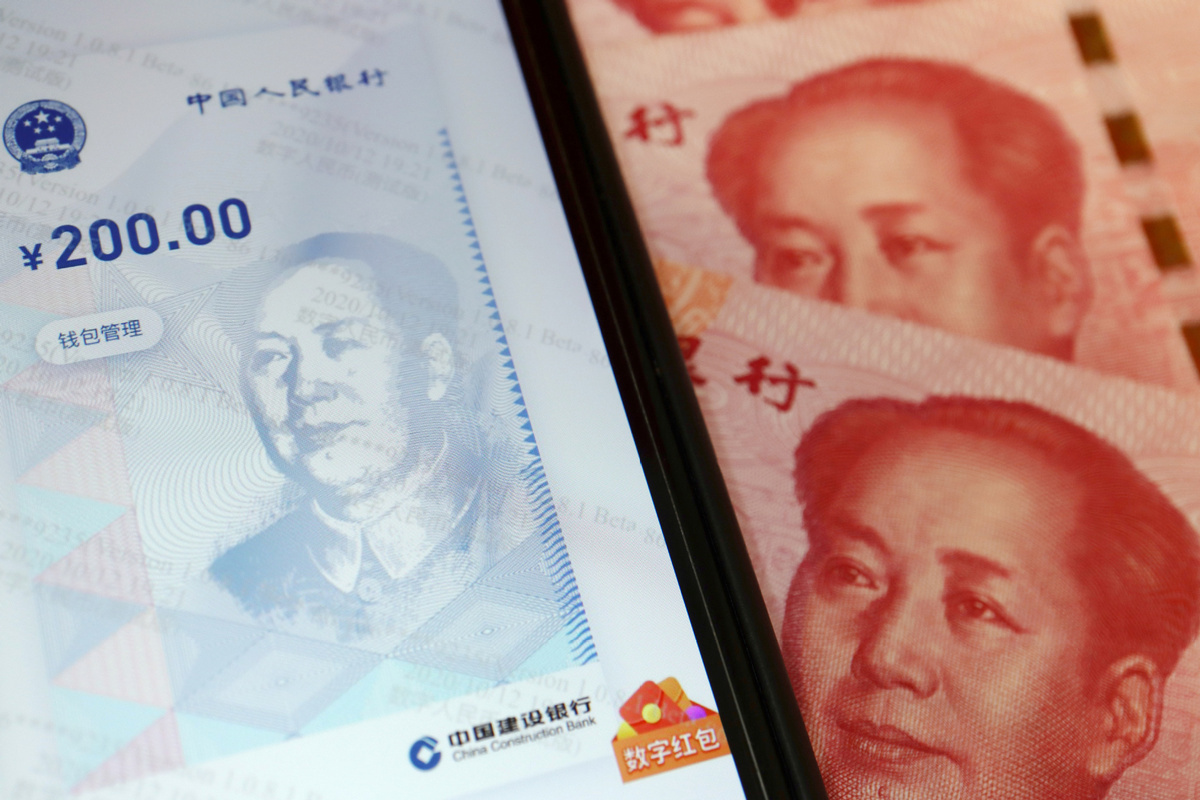
In concept, digital currency and electronic payment, or DC/EP is a "two-tier" research and development and pilot project plan of the People's Bank of China, the central bank. DC/EP is not a payment product.
The DC/EP project plan is like an umbrella or a platform that may encompass or spawn several payment products. Each product can be tested in trials and promoted later.
One such product is now formally known as e-CNY, the electronic Chinese yuan or digital RMB.
In the two-tier system of DC/EP, the PBOC is on the first tier. Commercial banks, telecom operators and internet payment platforms are on the second tier.
The second-tier entities can cooperate with each other, depending on their understanding of payment products and technical framework.
There are many concepts and operational aspects related to DC/EP that need clear understanding. For example, where should the R&D and pilot programs be guided to? With so many entities involved, how to demarcate roles and responsibilities? How to control the risks in the e-CNY design if/when they arise?
All these potential problems are worthy of study. The driving force of DC/EP research and development, pilots and possible promotion in the future will be mainly from the demand side, including the continuous improvement of the payment system, especially the efficiency of the retail payment system.
DC/EP products also need to reduce costs and improve convenience to better serve clients. This will make continuous technological progress possible.
Another driving force comes from the integration of various functions provided by the mobile phone, such as the functions of ID card, bank card and health status check. Other functions include news-reading and entertainment.
Recently, the PBOC announced that DC/EP transactions can be completed using the Near Field Communication or NFC technology, a protocol that allows direct device-to-device communication. This is a peer-to-peer way of payment.
With the improvement of network infrastructure, most regions will have access to the internet, especially wireless networks. In case there is no access to the internet, NFC will help complete the payment.
It is better for the central bank not to preset or identify a certain technology route, because technologies evolve or are updated/upgraded constantly. It is not very easy to identify which kind of technology is more suitable (as a completely new technology can develop very fast, potentially replacing existing technologies, even making them obsolete).
Intense discussions across the world suggest that special attention should be paid to the issue of "financial disintermediation", especially the potential risks of financial disintermediation that may arise in the second tier of DC/EP, for financial or operational institutions.
Besides, we have to prevent large fluctuations of virtual asset prices, which may lead to speculation and divorce the financial activities from the real economy.
In addition, we should attach great importance to the protection of personal privacy and prevent telecom and payment frauds. Frauds through mobile phones and other means are not uncommon in China, which was one of the reasons that necessitated the development of a safer, fool-proof digital currency.
To reiterate, in the two-tier DC/EP system, the central bank is on the first tier, and on the second tier are some institutions that have already started operations, including four large State-owned banks-Industrial and Commercial Bank of China, China Construction Bank, Bank of China, and Agricultural Bank of China-and major telecom groups such as China Mobile, China Telecom, China Unicom as well as payment platforms such as Ant Group's Alipay and Tencent's WeChat Pay.
Institutions on the second tier of DC/EP should shoulder more responsibilities. For example, they should have sufficient capital in order to reduce risks, especially for the payment system, which may lead to big shocks if risks arise.
As the main anti-money laundering bodies, these institutions should know their clients well. And they should protect clients' privacy. They also need to invest a lot in technology, equipment, operations and maintenance. There will be bargaining in the process.
The current digital currency project structure in China is mainly based on the digital RMB's dynamic, competitive two-tier operational system, which has multiple alternative plans.
In the process of technology evolution, users should be the key group to evaluate the technology and we should prevent monopolies. A monopoly sometimes hinders the choice of new technology route in the next step. Blockchain and the distributed ledger technology have always been part of the solution that is the two-tier digital RMB system.
At present, we are still in the process of research and development, constantly solving technical problems, especially the problem of information processing capacity. The number of transactions handled per second is still under development and improvement.
There are five technology plans for DC/EP-the account-based electronic wallet, the QR code, NFC(near field communication) payment, bank cards on mobile phones, and prepaid cards. These technologies are not quite the same as the so-called central bank digital currencies or CBDC developed in the G7 members, which is not even a methodology in the CBDC system.
The second-tier institutions of the DC/EP system actually have the ownership of e-CNY and the guarantee of payment, as well as the relevant system, technologies and equipment. The central bank has studied the bank note issuance mechanism in Hong Kong, which functions through three issuance commercial banks delegated by the Hong Kong Monetary Authority.
When we talk about the e-CNY and cross-border payment, we should consider issues related to anti-money laundering, anti-terrorism financing and drug dealing, which are all big concerns for the international community. In addition, China has another concern: gambling.
If the digital currency is to be traded across borders, it should be based on retail. Under such circumstances, we should also respect policies and legal provisions in different jurisdictions, respect currency sovereignty, exchange rate regimes, and exchange and remittance regulations.
Depending on the technical measures, many problems can be solved at the moment of payment, which would be very convenient. For example, during the payment process, whether or not the blockchain technology is used, there may be smart contracts or the control of payment conditions.
The development of digital currency in China can be steadily and slowly pushed forward. First, the goal is to establish a solid retail payment system. On this basis, we should first focus on the payment of cross-border tourism and payments for trade in goods and services, while respecting the mindset of some countries keen to prevent dollarization.
In this process, the internationalization of the RMB must not be based on coercion, and we should not make people worry that the RMB will dominate the international currency system. The central bank should mainly focus on the key link of clearing to maintain cross-border payment cooperation.
This is an abridged, edited version of Zhou Xiaochuan's speech at a seminar held by the National School of Development, Peking University, on Nov 27.
Zhou is chairman of the China Society for Finance and Banking and former governor of the People's Bank of China, the central bank.




















