China unveils standards for 'too big to fail' banks







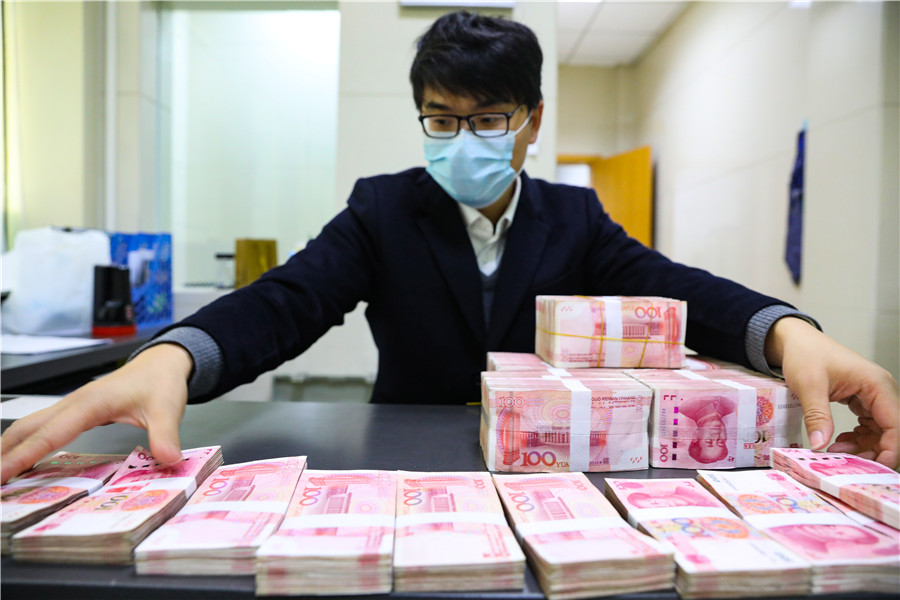
China has finalized a set of standards to assess domestic systemically important banks or D-SIBs and indicated that more specific and tighter regulations for these lenders will be announced soon, according to the People's Bank of China, the central bank.
Regulations for the D-SIBs, or banks which are deemed "too big to fail", were jointly published by the central bank and the China Banking and Insurance Regulatory Commission late on Thursday. D-SIBs are seen as lenders whose failure may lead to systemic financial risks.
Though the regulators have not designated any D-SIB yet, candidate banks must start providing the relevant financial reports to regulators for assessment, and a final list will be approved by the Financial Stability and Development Committee of the State Council, said a PBOC statement.
The upcoming new regulations focus on key indicators like additional paid-in capital, leverage ratio, large risk exposure, corporate governance and information disclosure. Banks will be asked to establish a mechanism to prevent systemic risks at an early stage and tighten internal controls, said the central bank.
The regulations will also strengthen banks' risk prevention and absorption capacity. The PBOC and the CBIRC will monitor factors like the macroeconomic environment, the need for banks to supplement capital and the requirement of serving the real economy.
"We will choose a proper time to launch additional regulations," said an official from the PBOC, who did not want to be named. The D-SIB list will be updated every year and the authorities will consider various types of regulations to achieve financial stability, he said.
Before the formulation of the D-SIB list and regulations, China's four large State-owned banks-Industrial and Commercial Bank of China, China Construction Bank, Bank of China, and Agricultural Bank of China have already been designated as global systemically important banks by the Financial Stability Board, an international financial standard setting body and an arm of the G20.
Wen Bin, chief researcher at China Minsheng Bank, expects 25 banks to be designated as D-SIBs in the first list, including the six State-owned commercial banks, two policy banks and one development bank.
"The measures are a signal that the authorities are tightening regulations for banks, and the upcoming new rules will impose a capital surcharge to reduce systemic risks and prevent risk contagion across various financial institutions. That is a significant part of the nation's macro-prudential regulatory framework," said Wen.
Large banks will face pressure to raise capital, as weaker profitability and the unprecedented shocks from the novel coronavirus pandemic have reduced their earnings capacity and prompted them to seek external financing, experts said.
Postal Savings Bank of China, one of the nation's largest State-owned banks, said on Monday that it was raising 30 billion yuan ($4.3 billion) through a private placement of shares to China Post Group, its parent company. The move will help address the higher capital requirements should regulators designate PSBC as a "systemically important" lender.
China Everbright Bank, a large joint-stock commercial bank, said in October that its parent, China Everbright Group Ltd, had converted 5.8 billion yuan of convertible bonds to equity capital. The move will help boost its "core tier-1" capital to risk-weighted assets ratio-a key gauge to measure banks' capital cushion-by 15 basis points, according to Moody's Investors Service, a global credit ratings agency.
"Nationally franchised banks, such as Postal Savings Bank and China Everbright Bank are candidates for D-SIB designation because they are likely to be on a shortlist of 30 candidate banks whose assets, as measured by the sum of a bank's on- and off-balance-sheet and derivative exposures, make them eligible," said Nicholas Zhu, a senior credit officer with Moody's.