Mongolia meets the challenges of COVID-19, climate change







After keeping novel coronavirus at bay inside its borders for nine months, Mongolia recorded its first local COVID-19 case this month, already surpassing the number of imported cases.
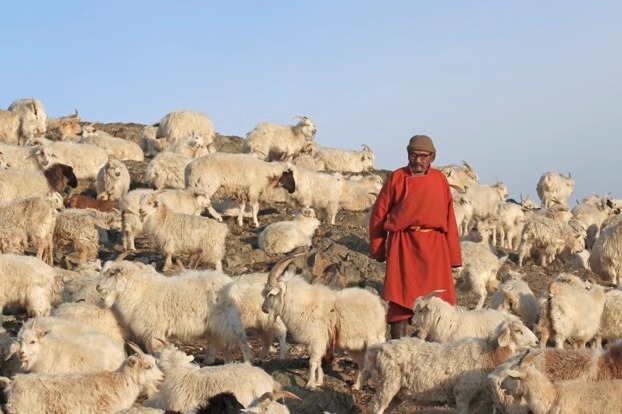
Mongolia locked down its capital with a few other provinces, and implemented travel restriction on inter-provinces. According to the recent survey run by the Mongolian National Chamber of Commerce and Industry of 3,530 companies, 7,000 workers have been laid off and 60 percent of companies have fully paused their business, while only 10 percent of companies let their employees work from home, with the exception of 13 sectors, such as hospitals, the military, the police and grocery stores. Urban residents are allowed to go out only to pick up necessities, like groceries. Rules are laxer for the 10 percent of the population living in Mongolia's hinterlands, where breeding livestock, especially goats raised for their extremely soft natural fiber, cashmere, is a way of life.
But though life mostly goes on without masking or social distancing, the coronavirus outbreak has presented new challenges for these herders as the price for cashmere plummeted. With climate change already threatening their way of life, herders are troubleshooting how to make it through two crises at once.
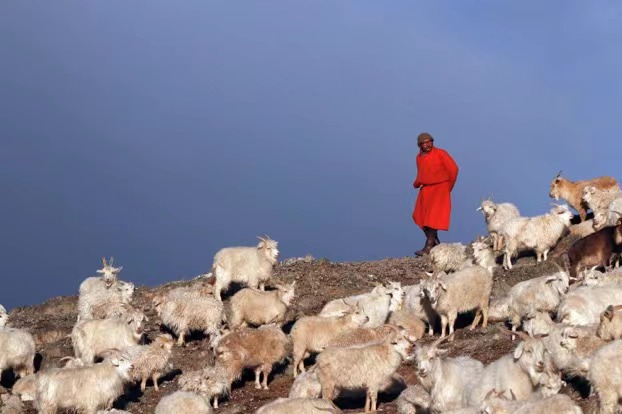
Banzragch, a 76-year-old herder who lives far from the crowds, 960 km away from the capital, Ulaanbaatar, in the far west of Mongolia, said he doesn't have the slightest fear of getting infected, but with demand for cashmere dropping, he is concerned.
"Cashmere prices fell whereas fodder prices increased. There is no grass to eat for livestock. I wonder how many of them can overcome the incoming harsh winter" said Banzragch.
Cashmere is considered the main source of income for 171,600 families, and more than one-third of the population is involved in its production. Mongolia is considered one of the top suppliers for the world's cashmere, its top non-mineral export, which makes up around 3.6 percent of its GDP.
In the wake of the pandemic, Mongolia's GDP decreased by 7.3 percent in the first 9 months of 2020, according to the National Statistics Bureau. Mining and service sec-tors — the two biggest money makers in the economy — both contracted, while agriculture was the only sector that boosted Mongolia's virus-hit-economy by 11.3 percent. Because of climate change, 26,600 households are migrating with 11.7 million herds for a better place this winter, as stated by Mongolian government.
But for Banzragch, one of the few herders who remain from the massive migration, and thousands of others are looking for grassy and better pasture at Segs Tsagaan Bogd, Bayankhongor province. There, reliance on the agriculture industry for stimulus is concerning when there's a larger existential threat at play: Climate change.
"When I was young, our valley used to turn yellow in the fall with tall broom-grass that could even block the views of horses. But now there is no grass to touch the livestock's' noses and broom-grass barely reaches ankle bones," he said.
Nomadic herders' travel distance used to be limited to about 100 km within their province, but now they are migrating hundreds of kilometers and moving from one province to another.
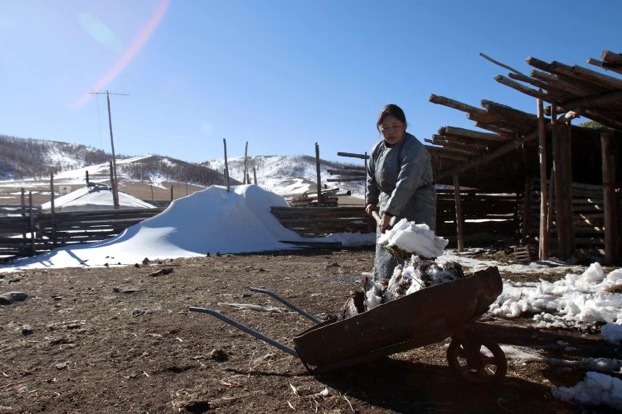
But these dual crises also bring opportunities, as herders find new ways to overcome challenges due to the impacts of COVID-19, climate change and overgrazing.
In a community in Ikh-Tamir soum in Arkhangai province, herders are organizing themselves into small community groups, planting and harvesting hay and fodder at communal lands to fight against pasture degradation and desertification, thus intensifying "sustainable cashmere" production, sorting out cashmere by its color during combing and focusing on animal welfare and proper pasture management to leverage cashmere profits.
"By introducing the experience of combing yak wool and teaching herders to separate the wool from the dirt and sort it by color, we were able to increase the price of our yak wool from 500 Mongolia Tughrik (20 cents) to 20,000 Mongolia Tughrik ($7)" said Altantuya.S, a leader of the "Blue Lake" herders' community in Ikh Tamir soum, Arkhangai province.
They're also preparing green fodder, aspen leaves and nettle silages in groups to prepare for the winter.
Owning to join herder's community group, they have been able to reduce the cost of hay and fodder by at least 3 times each year. "We harvested about 50 tons of green fodder from a 20-hectare land, which means that 50 households received it," said Nerguibaatar.L, head of the Tamir Tavan-Erdene herder's community, in the soum.
To the midst of COVID 19, all attention is directed to one single point amid the pandemic. But life goes on, herders are trying to maintain their "sustainable" production with these initial steps in pasture management. In the longer term, herders agreed to reduce the number herds to increase the value of their livestock products. They're even willing to pay for footprint taxes now if climate change lasts.
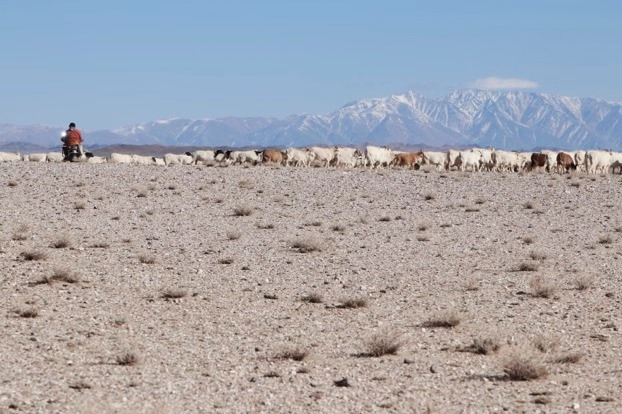
Whenever the situation is severe, the agriculture sector not only maintains jobs and its products, but also manages to secure the food supply for citizens. During economic crisis in the past, the agricultural sector has always been a balancer. Even at a time when the lockdown is expected to continue, herders are always busy trying to meet the food supply of the population.
Narantungalag Enkhtur is a freelance writer based in Mongolia.
The opinions expressed here are those of the writer and do not necessarily represent the views of China Daily and China Daily website.
If you have a specific expertise and would like to contribute to China Daily, please contact us at opinion@chinadaily.com.cn, and comment@chinadaily.com.cn.