



Bridging landlocked, coastal areas







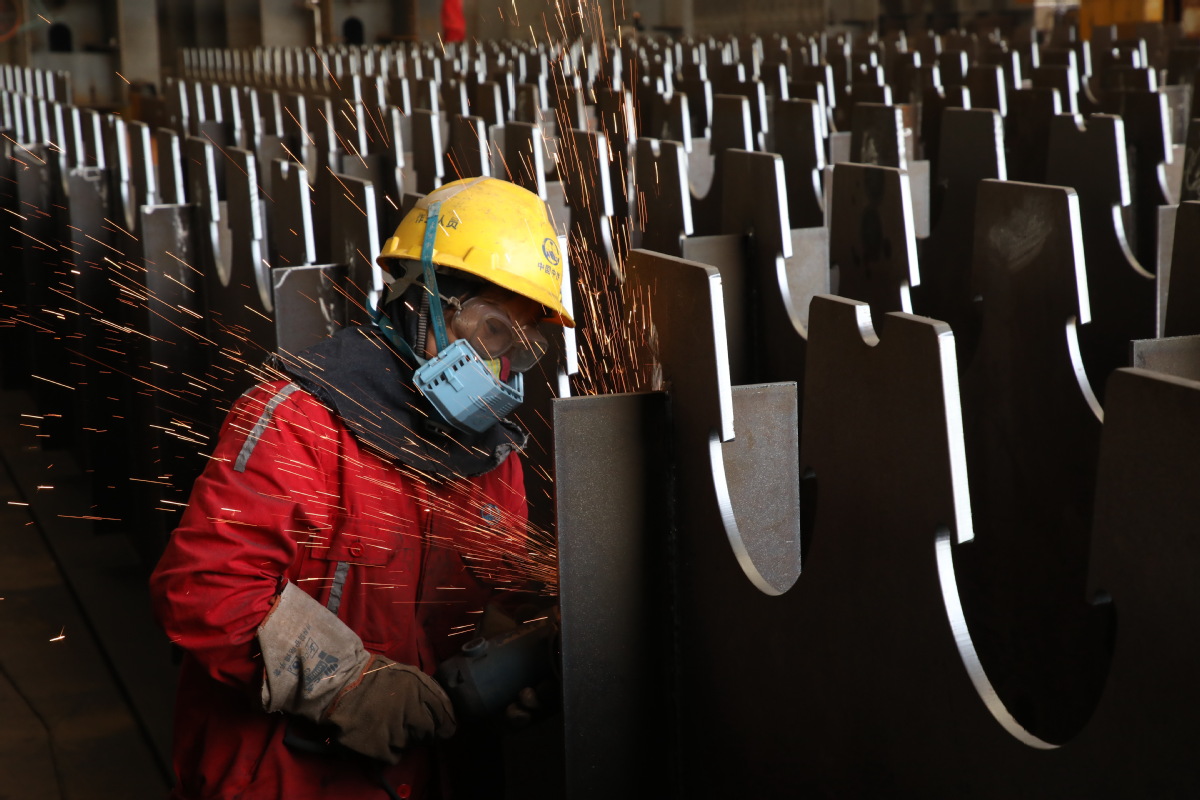
CRSBG's contributions strengthen the world's infrastructure projects across industries
In October, China Railway Shanhaiguan Bridge Group Co, a subsidiary of State-owned China Railway Hi-Tech Industry Co, reached a significant milestone with the opening of the new Slussen Bridge in Stockholm, capital of Sweden. CRSBG supplied the steel structures and key parts to its ninth steel bridge project in Europe.
Prior to that, it supplied steel structures to bridge projects in the United States. CRSBG also executed bridge projects in Ethiopia, Chad and Tanzania. Construction of bridges and export projects are part of its activities in economies participating in the Belt and Road Initiative.
The latest project is located in a historical, pedestrianized public space arranged around a navigation lock in downtown Stockholm, where the city's land and water transportation hubs meet.
The Slussen area of Stockholm has been rebuilt every century since the 1600s according to the needs of the time. The new bridge is a gigantic structure featuring variable-cross-sectioned steel box girders and integrating bridge and tunnel functions, said Lin Junke, chairman of the Hebei province-based State-owned enterprise.
Under such circumstances, he said the project not only required high-end materials and technologies but replaced the two old bridges as a transport project integrating highway, bicycle and pedestrian lanes. The total contract value for CRSBG to supply all the bridge building material was 97 million yuan ($14.73 million).
The bridge, 140 meters long and 45 meters wide, with the largest span of 58 meters in the middle, has three lanes and a designed life of 12 decades. The steel box girder weighs 3,400 metric tons, which was transported as a single unit from China to Stockholm on a vessel. It took 70 days to transport these items to the Nordic country.
The Chinese bridge maker said overseas business is expected to increase as a proportion of overall business during the period of China's 14th Five-Year Plan (2021-25), while focusing further on updating building quality through innovations with smart technology.
"Major projects in overseas markets can take years to complete, with some taking more than a decade," Lin said.
"Over the years our management experience and technological know-how have greatly improved. We are hoping to expand into more markets, especially countries and regions participating in the BRI."
Building more infrastructure facilities such as bridges and railroads in BRI economies can help narrow the gap between landlocked areas and coastal regions, he said.
By working together with other Chinese companies, such as China Railway Major Bridge Engineering Group Co, CRSBG established an assembly yard for the first time in 2014 to supply a part of steel structure products used in construction of the Padma Bridge, Bangladesh's largest infrastructure project.
The 25-meter-wide and 10-km-long bridge is built over the Padma River, one of the three major rivers in Bangladesh. Once completed, the travel time between the capital Dhaka and the southwestern city of Khulna will be shortened to around three hours from 13 hours.
With an eye on a larger global footprint and to offer more focused services, the company has set up marketing and management teams in a number of global locations such as the US and Germany.
Lin said the company no longer depends on advantages in terms of its price bids to win a contract, but focuses more on project quality and cost management. "Prior to bidding in overseas markets, we find partners first and then we bid," he said.
Automatic equipment and industrial robots can replace workers in risky and difficult parts of projects to improve quality and lower risks, such as construction in deep water or towering buildings, he said.
As a participating member of the Hong Kong-Zhuhai-Macao Bridge project in the Guangdong-Hong Kong-Macao Greater Bay Area, Lin said that CRSBG was the first in the industry to develop and assemble a welding system operated by industrial robots.
The company has also developed expertise in board unit manufacturing, with automation and intelligence driving the process. It solves the problem of poor welding quality and greatly improves the quality of the girder plate unit of steel box, and extends the service life of the bridge.
Apart from building bridges and supplying industrial and civil building steel structures, as well as railway and urban rail transit turnouts, CRSBG has also diversified into the manufacturing of cranes and power station equipment. The company also develops various castings and forgings, mechanical molds and other high-tech products for domestic and foreign clients.
Supported by over 4,000 employees and six manufacturing bases in Jiangsu, Guangdong and Hubei among other provinces, CRSBG has either built or supported steel structures of more than 3,200 bridges in China and more than 30 in overseas markets.
"Only by heavy investment in innovations will we be rewarded with handsome returns and an advantage in global competition," Lin said. "The priority goes to smart manufacturing and smart services."
While many countries are fighting hard to contain the spread of COVID-19, China's centrally administered SOEs involved in energy, infrastructure development and manufacturing have been teaming up with local partners and governments across the world to sustain trade flows, said Ren Hongbin, vice-chairman of the State-owned Assets Supervision and Administration Commission of the State Council.
Central SOEs from the manufacturing and construction sectors have also relied on China's advantage in having the world's most complete industrial system with the most diversified sectors, to boost the nation's foreign trade, and deliver products and construction projects on time to foreign clients, he said.
About 80 percent of central SOEs' overseas projects have overcome the impact of the pandemic and progressed steadily this year. Nearly 600 overseas projects have been successfully completed to date this year, according to the latest data released by the SASAC.
Thanks to the government's move to enhance Chinese companies' supply chain via additional investment, the fixed-asset expenditure of central SOEs surged 11.3 percent on a yearly basis to 1.8 trillion yuan in the first three quarters of this year. They gained 442 contracts in overseas markets with a total business value of $36.5 billion in the first half of this year.
Sufficient power supply, medical goods, international cooperation, stable trade flows, timely production of daily necessities and other materials for living are key to China's trading partners' ability to deal with the pandemic and revitalize their economies, said Ma Yu, a senior researcher at the Beijing-based Chinese Academy of International Trade and Economic Cooperation.
Backed by China's strong industrial and supply chains, domestic companies still have more options to further diversify their market channels overseas, given the accelerating globalization and many economies' demand for building or upgrading infrastructure facilities, he said.
China's proposal to explore third-party market cooperation can also generate decent financial returns for companies from areas such as services, project contracting, equipment and material supply in both developed and developing economies involved in the BRI, without causing a clash of interests, he said.




















