



Saying, paying it digitally








Central banks worldwide are speeding up the use of digital currencies to overhaul the international settlement system. The Chinese mainland has also made substantial progress in introducing the digital yuan to help drive its economic reforms. Chai Hua reports from Shenzhen.
The world is fast going digital, creeping into every sector of economic and social life. But can we cope with such an expeditious transformation? The answer, according to those in the know, is a resounding "yes".
Sovereign digital currency, issued by central banks, is the latest to come under the spotlight. It's a new variant of central bank money distinct from physical cash or a reserve account. It's a new arena for global financial powerhouses to restructure the international settlement system, where payment is held as an "irrevocable and unconditional transfer" of money from the payer to the recipient.
According to a survey by the Switzerland-based Bank for International Settlements, 80 percent of the world's central banks are already engaged in work related to digital currencies. It said about 10 percent of them have started pilot projects, while 40 percent have progressed from conceptual research to experiments or proof of concept.
China has had a digital yuan rollout in four cities. According to the People's Bank of China, there have been more than four million transactions involving about two billion yuan (US$299 million) in the digital currency to date.
In the United States, the Digital Dollar Foundation initiated the Digital Dollar Project in May to explore design options and approaches for the digital dollar. One of its main aims is to "support the USD as the world's reserve currency".
Pilot program in Shenzhen
In Shenzhen, the country's trial with its sovereign digital currency came in the form of a large-scale digital yuan test to pave the way for international cooperation in the use of the digital currency.
The pilot program, involving tens of thousands of ordinary consumers in mid-October, gave the public a close look at the digital currency. About 10 million yuan ($1.49 million) in digital renminbi was distributed to 50,000 users in the form of "red envelopes".
About two million Shenzhen residents applied for the "lucky draw". The winners were thrilled not only by the financial bonus but also the privilege of trying out the new money form at more than 3,000 stores.
Liu Haoliang said he was very excited to have been chosen because he was keen to see what a digital yuan looks like and wanted to try it out. "I shared a screenshot of the notice with my friends as soon as I received it," he said.
Liu showed that in the e-wallet "digital renminbi" application, the virtual image of the new form looks like a 100-yuan note and he could swipe up to pay or down to receive money.
Users could pay using the QR code or placing their phone close to the sale machine. Neither the payer nor the receiver needs an internet connection to execute payment.
If winners chose to continue using the app, they could transfer money from the Big Four State-owned banks — the Industrial and Commercial Bank of China, Agricultural Bank of China, Bank of China and China Construction Bank — but a bank account is not a must for setting up a digital yuan account.
Between Oct 12 and 18, more than 62,000 transactions in digital yuan had been performed. Many users had also transferred funds from their personal bank accounts after spending all the money on their "red envelopes". Self-transferred funds reached 900,000 yuan.
Shenzhen's pilot program is significant in the digital yuan's development, indicating the trial has moved from closed to open tests, said economist Song Qinghui. The central bank (PBOC) had set up a fintech subsidiary in the city two years ago.
The payment experience is similar to that of Tencent's WeChat Pay and Alibaba Group's AliPay, which have long dominated the Chinese mainland's online payments market, but Song pointed out they are fundamentally different.
The digital yuan is a kind of legal tender and the platform or stores can't trace consumers' personal spending data, he explained.
Shu Tao, professor of finance at The Chinese University of Hong Kong, Shenzhen, and associate director of the Shenzhen Finance Institute, said it's the digital version of China's physical currency, but AliPay and WeChat Pay are still the payment channels.
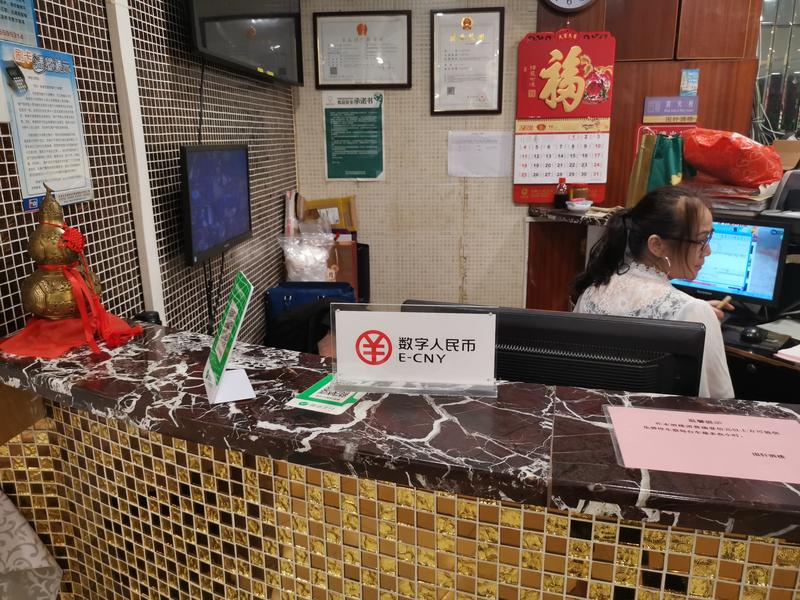
He said the payment function is overlapped and competition is unavoidable. One of the digital yuan's strengths is that no extra platform fee or interest is charged for users and businesses, he said. Third-party payment platforms usually demand a fee of about 0.6 percent from stores and service providers and about 0.1 percent for large people-to-people fund transfers.
Zhu Guanming, a restaurant owner in Shenzhen's Luohu district, welcomed the new payment mode. "I certainly prefer to use the digital currency to save platform fees."
Another advantage is that it can boost transaction efficiency. Manager Yi Zhaoxia at a bookstore in Shenzhen said the monetary value of sales is deposited directly into the store's bank account and there is no need to use a separate third-party account.
However, Shu reckoned that customers' choices will dominate the future of the payment structure. As the existing channels have almost covered all consumption scenarios, the digital yuan needs to make breakthroughs for broader acceptance.
He believes Shenzhen's successful experience is sufficient to be expanded to other major mainland cities, given the city's enormous economic volume and role as a national model for market-driven economic reforms.
The Central Committee of the Communist Party of China and the State Council last month unveiled a five-year plan to implement pilot reform projects in Shenzhen to turn it into a model socialist city with Chinese characteristics. The plan vows to establish a fintech innovation platform in Shenzhen to promote the application and international cooperation in the use of the digital currency.
Slated as the "new engine" in the development of the Guangdong-Hong Kong-Macao Greater Bay Area and being close to the two special administrative regions, Shenzhen is poised to take the lead in launching cross-boundary trial programs for the digital yuan, said Shu. But he said it will still depend on the progress of renminbi internationalization and a long testing period is likely.
The PBOC began research on a sovereign digital currency as early as 2014. So far, Shenzhen, Chengdu, Suzhou and Xiongan New Area in Hebei province have been approved for internal tests, along with pilot implementations during the 2022 Winter Olympics.
PBOC Deputy Governor Fan Yifei told a recent forum that 113,300 private and 8,859 corporate "digital currency wallets" have been opened as of August.
At the same time, more than 6,700 trial scenarios have been launched nationwide in almost all fields related to people's livelihood, such as payments for water, gas and electricity bills, government services and transportation.


- Hainan's 1st batch of daily consumer goods duty-free shops for island residents opens
- Cross-Strait affairs should be settled 'like family', official says
- Whale injured in collision with fishing boat near Weizhou Island
- Lizard found on high-speed train brought by passenger, rail authorities say
- Zeiss top exec: Learn from China speed
- Ancient tomb cluster in Changsha offers a glimpse into millennia of history











