Years of protection
Chen, the resident, recalls encounters with Xi in the 1990s-a time when Xi was showing keen interest in the ancient mansions in Sanfang Qixiang during his trips to the neighborhood.
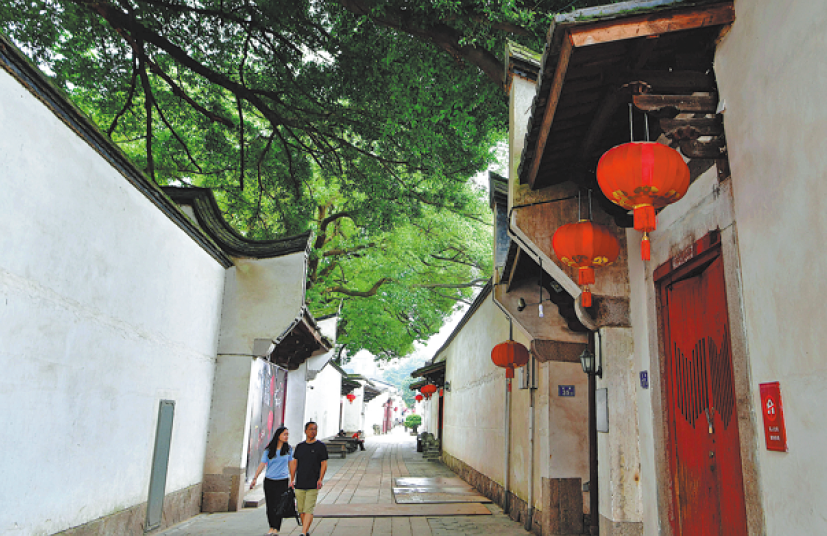
The area, one of the nation's largest preserved old-town districts, once boasted more than 200 examples of ancient architecture and was hailed as a "museum" for buildings from the Ming and Qing dynasties.
However, in the 1990s, many of the mansions were subdivided into squatter homes. Alterations were made to their original structures, and some were on the verge of demolition as the city stepped up real estate development.
One of the ancient buildings under threat was the birthplace of Lin Zexu, the late scholar, official and a native of Fuzhou who led the fight against opium smuggling during the Qing Dynasty (1644-1911).
Lin Qiang, a descendant, said in an interview with Study Times that Lin Zexu's birthplace, former residence and teaching room were occupied by different organizations and individuals in the early 1990s, with the building in a poor state of maintenance.
He recalls Xi paying his first trip to the Lin Zexu Memorial Hall soon after the latter began his work in Fuzhou.
In the coming years, Xi chaired a number of special meetings on renovation and heritage protection.
Lin Zexu's birthplace, another heritage site, was protected from developers after Xi chaired a meeting in 1996, which decided to form a special leading group to look at renovating the site. The city government allocated funding of 12 million yuan to compensate developers. Xi also spoke at a ceremony to mark the start of renovation projects.
The Lin family will never forget the close attention Xi paid to the restoration of Lin Zexu's former residence and cemetery, Lin Qiang said.
A summary from a special meeting on protecting cultural relics, chaired by Xi in March 1991, reads, "The protection of historic cities and cultural heritage is a matter of paramount importance during the course of urban development."
At that meeting, city officials approved decisions to protect and renovate the former residence of Lin Juemin, a revolutionary in the Qing Dynasty. More important, they approved a document on protecting the residences of historic figures and other heritage sites in Sanfang Qixiang and elsewhere in Fuzhou.
The document stipulates that no organizations or individuals, without authorization from the city government, can demolish or rebuild ancient buildings.
Under Xi's leadership, the authorities in Fuzhou set up the first city-level administration on protecting cultural heritage and also formed the city's first archaeological team. Funding for the restoration of cultural relics was raised from 80,000 yuan in 1990 to 1 million yuan in 1991.
Wu, the official, said, "The measures and approaches piloted by Xi in Fuzhou were groundbreaking and have shielded the city's cultural heritage from possible damage amid intense urban development over the years."
He said Fuzhou is an important "breeding ground" for Xi's thoughts on protecting cultural heritage, and over the years, city officials have followed his pioneering example.
Liu Qingzhu, a researcher with the Institute of Archaeology at the Chinese Academy of Social Sciences, said the emphasis Xi placed on protecting cultural heritage was groundbreaking in the 1990s, when the country was making all-out efforts to develop the economy.
"Since China's reform and opening-up in 1978, many cities have turned to demolition to make space for new metropolises. But Fuzhou, especially during the 1990s, did brilliantly in protecting its ancient towns," he said.