



'Decoupling' means one planet, two worlds







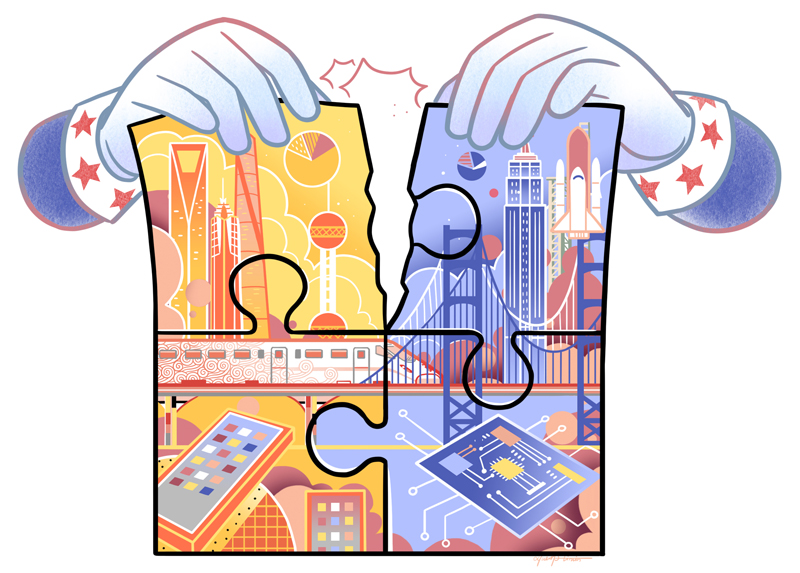
Twenty years ago, the ritzy five-star hotels of Beijing were hosting conferences every week on globalization, holding out a promise it could bring us all together and that barriers on trade and investment would be coming down. Businessmen, accountants, investment bankers and lawyers crowded during coffee breaks, and we all felt the buzz of something bigger than us that would somehow make the world more integrated and whole.
Chinese officials would take the stage in panel discussions with foreign business leaders envisioning a future where China would be part of the global community, and that community would be participating in China's growth and future. Nobody could have possibly imagined 20 years later we would be talking about a China-US decoupling, driven by a political administration in Washington that wants to de-globalize the world.
Yes, 20 years ago everyone was talking about this thing called globalization. However, at the time maybe we did not realize what globalization would really mean, or how it would look as it evolved. It seemed almost every week we had a business, finance or technology conference in Beijing with world experts, foreign and Chinese alike, all promising a better future through a more connected world and more inclusive planet.
However, everyone might not have had the same vision in mind, and this is where the differences began. At that time, the simplistic view was integration of global finance and capital markets, together with digital communication, would somehow bring down barriers and create more understanding, thus fostering unlimited prosperity and peace.
Little did anybody realize, two decades later we would be living in a world of greater localization, maybe more so than ever before. It certainly wasn't easy to predict the internet becoming the US deep state's insidious tool for stealing personal data to manipulate algorithms and political elections, fanning the winds of hatred, racism and anger in a way previously inconceivable.
Equally unpredictable was the gargantuan debt accrued through unprecedented Treasury debt buybacks, issuing over-leveraged liquidity to artificially prop up capital markets by investing in social media platforms that reinforce the Orwellian state, made possible only by the supremacy of a single currency.
How did we get here? Where is all this going to take us?
It all began in 1992 when US President Bill Clinton repealed the Glass-Steagall Act, put in place after World War II to prevent another Great Depression. It separated banking from investment banking, preventing the banks from investing or gambling with people's deposits -- a key factor that led to the Great Depression in 1929 and the war that followed.
The 1990s and decade on were like the "Roaring Twenties" of the past century. Suddenly profit and loss evaluations of companies did not mean anything. It was all about market share. Every company wanted to claim a bigger market share than the other to kick up stock prices, as the capital market was what counted, not real business. China as a market looked delicious.
Human memory is short. We make the same mistakes. Once again, with no restrictions applied, the financial sector went berserk with something called derivatives and then synthetic derivatives, creating an artificial market boom that crashed miserably in 2008 with the subprime mortgage crisis.
Quantitative easing or liquidity issued against debt created another market boom, and leverage on top of leverage, assuring the debt serfdom of most American households. The policy started under George W. Bush., continued under Barak Obama, spiked and then rocketed under Donald Trump.
This is where the finance and big tech marriage really solidifies. Fast-forwarding beyond market share as a measurement of corporate value, the tech-listing boom financed through quantitative easing required eyeballs and clicks to assure the value of a company. So the game became getting people to bang on their keyboard. That worked for Facebook and Twitter, but Chinese entrepreneurs had some ideas of their own.
Moreover, if eyeballs are the measure of corporate value, why should China just give away 1.4 billion of them to Facebook and Twitter when it can create alternatives like Weibo and WeChat and make the uneven playing field a bit more even? This was where conflict really began. The trade war is not about soybeans. It's about eyeballs, clicks, finance, and unsustainable debt leveraging, which if tipped, will sink the post-Bretton Woods system into the depths of a Great Depression like never before.
The insidious marriage between finance, tech monopolies, the military-industrial complex and deep state have created a new system of governance, assuring its sustainability by creating social stress and civil hatred. Trade and services are in free fall and everything functions around one principle-- keeping the capital market pumped up, through debt-backed funny money investing in a dozen monopolistic tech companies that program hatred and control minds, emotions and votes.
But you cannot control the minds and votes of people not looking at your stuff because there is better stuff to look at. Now are you beginning to understand why Trump, Zuckerberg and the deep state don't like TikTok and Tencent?
Not everyone wants the American model. That is where problems begin. China, on the other side of the planet, has been developing cutting-edge smart infrastructure using green finance for urban environmental repair, and switching the grid from fossil fuels to green energy. It wants to apply big data toward health care, pandemic control and prevention, and grid switching to support green energy.
It also wants to build real trading and service business relations with other countries, particularly developing ones facing similar challenges. This means prioritizing an end to poverty at home and sharing such approaches worldwide. There are many developing nations who see the need for un-ideological, pragmatic, integrated but mutually respectful development processes, recognizing one model does not fit all.
For China, decoupling from the US is not a choice. It has been pushed on China as a non-option from self-styled supreme leader Donald Trump. Decoupling is also being forced upon many nations. It is discomforting, given all that has been done to integrate the world up to now.
There is no reason in an integrated global trade environment to decouple. The nature of this decoupling process mirrors another era in the past century, leading us into another Cold War with the dangerous potential to become hot.
We are now living in a bifurcated world. In the future, there will be two worlds. One world will be built on the policies of multilateralism, multiculturalism and pragmatism. Another will be built on the principles of unilateralism, monoculture, theology and ideology.
One system will be working with policies like the Belt and Road, 5G, Ecological Civilization, poverty alleviation and the vision of a "shared common destiny of mankind." One system will be focused on dollar supremacy, big tech monopoly, fossil fuel promotion, continued spreading of poverty, and a vision of "America First". This is how our bifurcated world now looks.
Guess what? Back to the future. It's the Cold War blues. One planet. Two worlds.
The author is founding director of the Himalayan Consensus Institute and a research fellow at the Center for China and Globalization. The views don't necessarily represent those of China Daily.





