Shajiabang, an old water town in the Yangtze Delta region, is known all over China thanks to a Peking Opera.
One of the "model operas" during the "cultural revolution" (1966-76), Sha Jia Bang was created in the 1960s. It tells the story of an underground female member of the Communist Party of China. With the help of local villagers, she saves a group of wounded Chinese soldiers in the reed marshes and hides them from their enemies in Shajiabang, which is located in the suburbs of Changshu city in Jiangsu province.
However, many are not aware of the fact that the Peking Opera was adapted from a Huju Opera production named Ludang Huozhong, or Sparkles in the Reed Marshes, which was created in Shanghai in 1960.
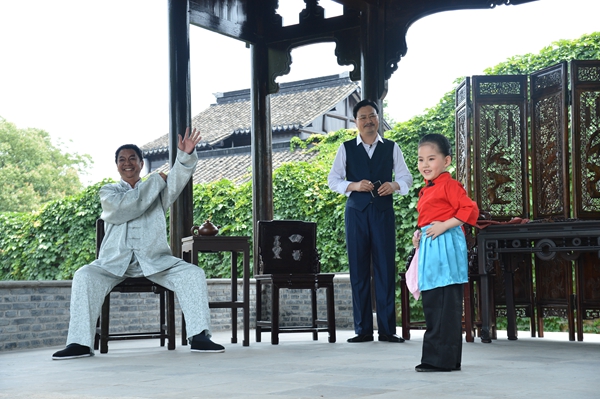
On July 1, Shanghai Huju Opera Company presented episodes of the story in the scenic area of Shajiabang. Songs were sung in a vintage teahouse and pavilion, as well as on waterfront lawns, where the actual stories the opera is based on took place. Company director, Mao Shanyu, announced afterwards that a new creative center for the company was launched at Shajiabang. Artists make regular visits and present immersive performances of the opera in the scenic area.
"Several generations of artists from Shanghai Huju Opera Theater have come to Shajiabang," Mao said during the performance. "They did farming work with local people, lived and ate with them. They were inspired by the life here and built strong ties with the area."
Sparkles in the Reed Marshes was conceived in 1958. Playwright Wen Mu created the work based on a nonfiction book by Cui Zuofu. It is about 36 Communist soldiers hiding in the reed marshes during the War of Resistance Against Japanese Aggression (1931-45). Local villagers took care of the wounded soldiers, and hid their locations from inspecting Japanese officers, and eventually helped them to go back to the front to fight against the enemy.
The opera which premiered in 1960 became one of the most successful repertoires of the Shanghai Huju Theater. "It marked a climax in the creativity of Huju Opera, with vivid depiction of the country life of the Yangtze Delta. It is intriguing storytelling with great characters," Mao says.
Huju is one of the youngest traditional Chinese folk operas, starting in the late 1800s. It gained popularity in the early 1900s. The opera, rooted in the local Yangtze Delta music, dialect and vernacular culture, has borrowed from pop music, modern rhythms and Western instruments such as the cello. Since the 1920s, a number of new operas about modern Chinese life were created. The modern setting and costumes featuring Western-style suits on men and Chinese cheongsam on women became a signature of the opera. Today, Huju is on the list of the national intangible cultural heritage of China.
The influence of Huju is limited to the Yangtze Delta region largely because the local dialect is not easily understood by people in other parts of China. The Huju opera Sparkles in the Reed Marshes features an assembly of diverse characters and highlights scenes that were successfully translated into the Peking Opera production, soon gaining national success.
That opera, with Mandarin pronunciations, is loved all over the country. Consequently, the adapted Peking Opera Sha Jia Bang also became popular. Today, sections of the Peking Opera are performed at the water town tourism area every day, and bronze statues of the main characters stand by the waterfront near the dock.
Tourism in Shajiabang began with China's opening-up in the 1980s. But transportation was underdeveloped and "villagers had to row their boats to bring in visitors", says Qu Xiaofeng, head of the tourism administration of Shajiabang. It was in 2004, when a TV series based on the story of Sha Jia Bang was made, that the water town became a well-established tourism spot, with a vintage-style teahouse, restored the village architecture and docks for boat rides.
Today, Shajiabang is a wetland park expanding across more than 400 hectares, and a tourism area featuring labyrinth-like waterways is surrounded by reed plants as tall as 3 meters. While many groups visit the area because of its revolutionary past and theatrical connection, some are attracted by the water and its products. In autumn, the area is especially popular with tourists eager to have a taste of the seasonal delicacy of crabs, because the area, being part of the Yangcheng Lake water region, is one of the most celebrated areas for hairy crabs.
This year, the pandemic has hit the region hard. Zhang Jinfeng, who runs a teahouse and snack bar in Shajiabang, says that she and other shop owners in the region received government subsidies that covered the rent for three months. "The price of admission ticket is also lowered from the regular 100 yuan ($14.3) to 60," she says. "June was usually a busy season with many group visitors, but this year, we had no more than a small part of the regular visitors."
"Tourists from the nearby provinces are gradually coming back," Qu says. "It will take a longer period before visitors from farther regions, such as the north, come back."
While many elderly people are attracted by the stories and characters of the opera, young people often want some different experience. "They want interaction and immersive experience, so we have provided military games such as shooting laser beams."