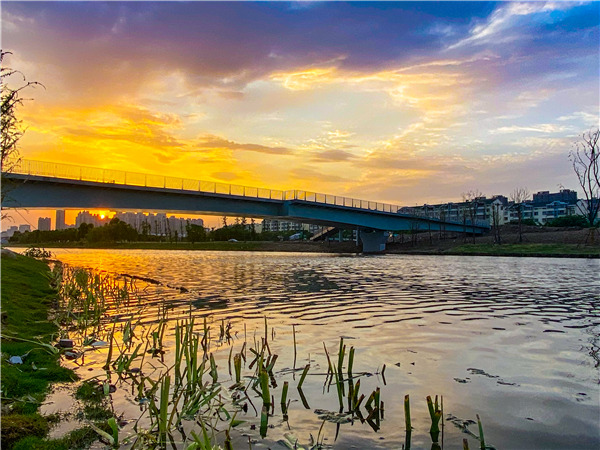
A series of cultural gathering activities, sponsored by the publicity department of Wuxi High-Tech Zone and the Jiangsu Newspaper Supplements Association, were held in Wuxi, East China's Jiangsu province earlier this month.
The activities, under the theme "Walking Along The Bodu River", included a visit to the former residence of Chinese scholar Qian Mu (1895-1900) and Qian Weichang (1912-2010), two of the most prominent literary and education masters in Jiangnan-the Yangtze River Delta region that has been eulogized by many generations of poets.
The event, which ran between July 5 and 7, sought to help locals and visitors from across the country appreciate the profound tradition of Jiangnan culture, with one of the highlights proving to be the intriguing experience of listening to The Moon Over a Fountain in the Erhu Cultural Park of Meicun village.
The masterpiece, which was composed for the erhu (a two-stringed Chinese musical instrument) by the legendary local figure Hua Yanjun, is among the most frequently played erhu pieces in China.
Walking into Meicun Erhu Cultural Park, visitors gazed at the statue of the engaging composer sitting on a stone near the lotus pond, and in the little theater they were intoxicated by the beautiful erhu melody.
"The music piece renders the spirit of Jiangnan beyond its tenderness, and also consolidates the status of Meicun in Wuxi as the hometown of the erhu," says Zhou Wei, executive vice-president and secretary-general of the Chinese Erhu Society.
At the erhu production workshop in Meicun, workers were busily engaged in making various parts of the ancient instrument.
According to statistics from the local district, 18 local erhu production workshops in Meicun produce nearly 40,000 erhu per year, accounting for 25 percent of the entire nation's middle and high-end erhu market. In 2011, Meicun's erhu production technique was included on the Jiangsu Intangible Cultural Heritage List.
During the event, local scholars held a seminar on life along the Bodu River from the past to the present day, starting with Taibo-the eldest son of King Tai of Zhou.
Mao Jianping, director of the Taibo Cultural Protection Institute in Wuxi's Xinwu district, explained that Taibo was born in what is now Northwest China's Gansu province. He started out from Qishan in Shaanxi province, arrived in Wuxi six years later. The locals had very different manners and attire from those of the central kingdom, sporting tattoos and disheveled hair.
"The Wu people wore their hair short to fish the river, and their tattoos were a form of deterrent to scare away water snakes. It can be seen that the Wu people depended on fishing and hunting for their livelihood," Mao says.
"It is said that after Taibo established the Wu Kingdom, he vigorously developed water conservation measures and developed agriculture for production and the Bodu River, the first artificial canal in Jiangnan, was built at this time," he adds.
Taibo traveled thousands of miles to dig the first artificial canal in Chinese history. Bodu River, with a total length of 24.1 kilometers, has a history of 3,200 years during which its fate and the history of Wu culture are closely intertwined.
The mother river of Wuxi, however, has been plagued over the years by malodorous problems. Five years ago, the local government enacted a comprehensive renovation project for the river, including the remediation of the main river and its tributaries-covering a total length of 36.6 kilometers.
A biological purification tank combining artificial wetland techniques and the bio-contact oxidation method was applied to improve the quality of the river water.
The local government believes that integrated management of ecosystems, as well as culture, will meet the demands of nature and people to address ongoing local development.
In order to further stabilize the water quality, since August last year, the Xinwu district government started to renovate the river and the ecology of its surrounding areas, creating a cultural and leisure waterfront. The project has a total investment of 250 million yuan ($35.7 million) and a planned area of 895,500 square meters.
At present, the first stage, consisting of about 175,000 square meters of green land area and a total length of about 7 kilometers of hydrophilic walkway, has begun to take shape.