



Blueprint for a moderately well-off society







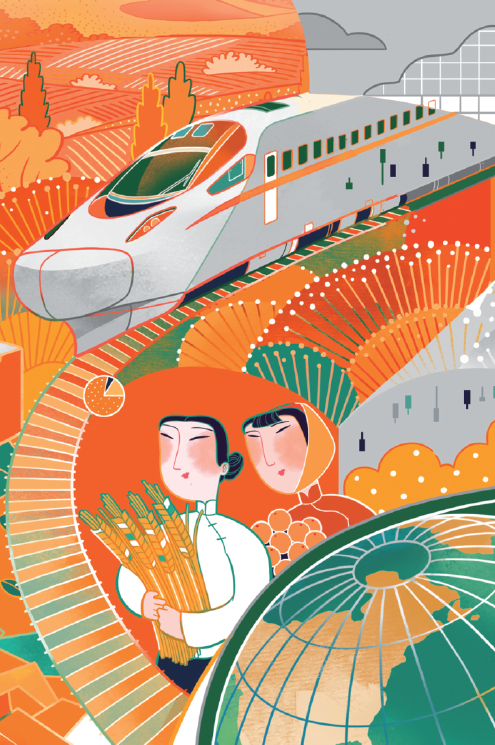
Understanding some of the key policies and priority choices of China over recent decades can help other countries draw up their own agendas to alleviate poverty
The poverty alleviation achievements in China have been dramatic. At the onset of reform and opening-up, nine out of 10 people in China were poor; by 2019, extreme poverty was practically eliminated. Based on the current official national poverty line, of 2,300 yuan ($325) per year for rural areas (2010 constant prices), rural poverty has declined from 97.5 percent of the rural population in 1978 to 3.1 percent in 2017, or from 770.4 million people to 30.5 million. And in 2019, the poverty headcount further declined to 0.6 percent of the population.
Using the World Bank's international poverty line of $1.9 per day (2011 Purchasing Power Parity or internationally comparable prices) between 1981 and 2015 the number of people living in poverty has fallen from some 875 million to 10 million. A parallel decline in mortality and rising life expectancy mean that a child born in China today will, on average, live three decades longer than a child born in China in the mid-20th century.
China's progress is impressive on a global scale. Without China's success, the United Nation's first Millennium Development Goal-h(huán)alving the number of people living in extreme poverty between 1990 and 2015-would not have been achieved.
China's success has sparked considerable interest in how the country achieved it. To a large extent, China's success in reducing poverty can be attributed to the rapid and sustained economic growth unleashed by reform and opening-up.
The country opened up for trade and foreign investment, gradually liberalized prices, diversified ownership, strengthened property rights, and kept inflation under control. Macroeconomic stability allowed savings to be turned into high investment and rapid urbanization, which in turn triggered rapid structural transformation and productivity growth.
Reforms took off in agriculture that dramatically increased agricultural productivity and rural incomes, and opening-up was initiated with the establishment of the special economic zones in 1980. These became a laboratory for market-oriented reforms. China used the decade of the 2000s to prepare for a different growth model, with greater investment in higher education and science and technology.
Growth in per capita income was further boosted by the country's demographic dividend. With the demographic dividend it enjoyed over four decades from the 1970s, China explicitly invested in attracting labor-intensive foreign investment.
And with the launch of reform and opening-up, poverty alleviation received political support from all levels of government. After initial reforms spurred economic growth, in 1986 a dedicated structure to drive poverty alleviation was established: the Leading Group on Poverty Alleviation and Development-concurrently Poor Area Development Office-was established within each rung of government, down to the county level.
The leading group oversaw poverty policy formulation, including setting the national poverty line, and the design of the poverty alleviation program. The development offices oversaw program implementation at the local level. Both were backed by top-level support and funding. Poverty programs were predominantly targeted at getting people sustainable livelihoods, that is poverty alleviation through development, and much of the programs were aimed at rural areas. Agricultural productivity remained a constant focus as rural regions were home to most of the poor. This focus and related implementation, to a large extent, driven by China's poverty-related institutions also helped China avoid another famine.
China's poverty reduction has not been uniform over time or across the country. The rate of poverty reduction was most rapid in the 1980s, and it has slowed over time, as the number of people living in poverty has declined and growth has slowed.
At the start of reform and opening-up, growth alone, especially in rural areas, delivered dramatic poverty alleviation. More recently, a direct and more targeted poverty alleviation agenda has evolved. It was understood that reaching the final pockets of extreme poverty in China would require information at the household and individual family member level. Poverty officials led a massive survey around 2014 that created a large database on the poorest households, originally including some 70 million people. In the last stretch of China's absolute poverty alleviation agenda, this database is continuously updated and serves to inform the "last mile" officials and shape policies to help those still living in poverty.
In the process, China has mobilized not only government officials-for whom poverty reduction features in their performance evaluation. Companies, banks, nongovernmental organizations and charities are all contributing in their own specific manner to poverty reduction. This "whole of society" approach is unique to China.
China's thriving e-commerce sector has become a vehicle for poor and remote communities to market their goods, and buy at lower prices. Government has supported this by building the infrastructure for internet access, as well as by supporting the capacity of communities to bring goods to market. Large e-commerce companies have equally been keen to support rural communities in the use of e-commerce. The internet and mobile technology has also been used to expand access to financial services, medical advice and services, and education, among others.
A downside of early reforms was a sharp and uneven decline in fiscal resources, increasing inequality in government services such as education and health. Recent efforts are now targeting that inequality, including via redistribution of fiscal resources, incentives for top teachers to work in the poorest regions, and by a matching process whereby richer educational regions and schools support a poorer region and school.
Although China's poverty alleviation success is justifiably a source of national pride, success has also been built upon international partnerships. The World Bank was among many development partners that provided direct and indirect poverty assistance. It offered advice and financial resources for sectoral reforms including in agriculture, transport, energy, urbanization, health, education, social protection, and also poverty alleviation. China's emphasis on building its own capacity for reforms meant that its government could localize the lessons learned from international experience, and introduce reforms with Chinese characteristics that fit China's own circumstances best.
Bert Hofman is the World Bank's former country director for China, Mongolia and Korea. Lauren A. Johnston is a research associate at School of Oriental and African Studies, London. The authors contributed this article to China Watch, a think tank powered by China Daily. The views do not necessarily reflect those of China Daily.





