Villagers in Ningxia needn't go out to fetch water-it comes to them







Uninhabitable place
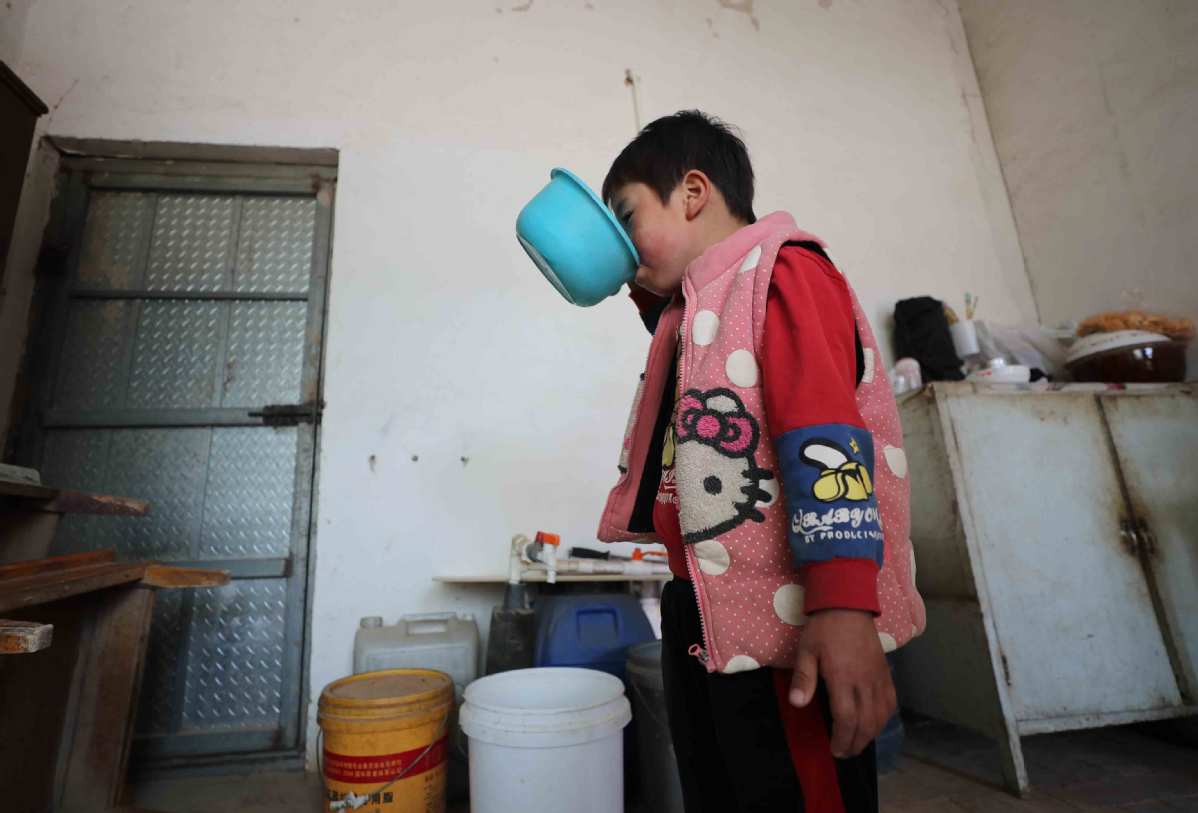
Home to some of the least fertile land in Northwest China, Xihaigu was named in 1972 by the United Nations World Food Programme as one of the world's most uninhabitable places. With an elevation ranging from 1,300 to 2,900 meters above sea level, the region was caught in a dilemma of ecological fragility and deep poverty.
Nearly 80 percent of the land in Xihaigu used to suffer from soil erosion, drought, hail, frost, flood and windstorms. The average amount of precipitation in the Xihaigu area is 471 millimeters, with July, August and September seeing the maximum amount of rainfall.
By early 1980s, some 1.3 million people, or 70 percent of its farmers, were impoverished.
Ma Hanwen, who also lives in Xihaigu, used to collect spring water in the mountains with his donkey, and store rainwater in his cistern. When that water was used up, he had to buy water 15 km away.
"I read from textbooks that water from lakes and rivers run into the ocean. It is beyond my imagination that how much water there could be," Ma said.
It is also rare to find clean water in the Xihaigu area when drilling a well, with most of them producing salty or bitter water. Soluble solids and sulfates exceed permitted levels by several times. Even local reservoirs are filled with salty water.
Drilling encouraged
Ma Hancheng, vice-governor of Ningxia, said local governments encouraged rural people in 1983 to drill cisterns, which could be as deep as 10 meters. The cisterns stored water from torrential rains in summer.
"A family usually had two cisterns. The local people believed that water in cisterns should stay for one year to be drinkable," Zhang Shixiang, Party head of Changcheng village, said, adding that it was the local way to "purify "rainwater.
Xihaigu has been channeling water from the Yellow River and Jinghe River, a tributary, and developing water-saving approaches, Xinhua News Agency said.
In 2002, local authorities started building two water supply systems in the Xihaigu area. One brought water from the water catchment areas through pipes to some rural people; the other one supplied tap water, Ma said.
"When tap water finally came to Pengyang, the quality of water was not good enough at the early stage," Zhang said.
As villagers' houses are dotted in the mountains, it costs too much to manage, and it was too difficult to control the water supply and charge the fare.
In 2017, Ningxia upgraded the water supply systems in the Xihaigu area through intelligent management.
With an investment of 4 billion yuan ($561 million), 1.1 million residents in the Xihaigu region now have access to safe drinking water.
Pengyang improved and expanded the old water network, installed intelligent water meters and realized automatic online monitoring and control of drinking water for the villagers.
Zhang Bo, who is from Changjiang Institute of Survey, Planning, Design and Research and in charge of the intelligent water supply project in Pengyang, said his team came to the county in April 2017.
"We came up with a system that combines internet and water supply for Pengyang county. The whole process, from the source to pumping stations, cisterns, water supply network and users, is automatically operating," Zhang said.
The water management staff can monitor the water volume and quality at any time and place via their smartphones. And local people in Pengyang can also check their water usage and buy water via cellphones.
"Now people in Pengyang county, whether they are living in cities or towns or rural areas, have the same quality water and pay the same fee," Ma said.