



Getting the most out of waste to make sure it's not rubbish







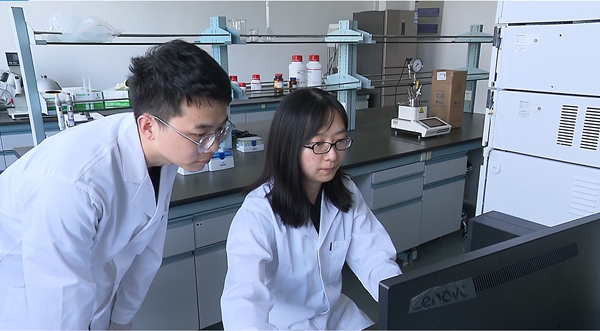
With more Chinese cities slated to implement compulsory garbage sorting regulations, teams from the China-UK Low Carbon College at Shanghai Jiao Tong University have been working to devise more efficient means of accomplishing this task through the use of high-end technology.
Among the ongoing projects in the college is a robot that can sort dry waste.
According to the team behind this project, the machine can identify a piece of dry waste before placing it in its respective container. The device currently boasts a 90 percent accuracy rating and can sort up to 5,400 pieces of waste per hour.
"Workers involved in manual sorting of unseparated domestic waste are exposed to unhygienic environments," says Li Jia, the project leader and associate professor at the college.
"The work also poses risks to workers' safety as there are sometimes items such as sharp metal pieces or broken glass that could hurt them."
Furthermore, it's getting more difficult to hire such workers given the harsh working conditions, Li adds.
"Robots would be useful for such repetitive and arduous tasks. Two robots operating for 24 hours a day can handle the workload of 54 workers, and with a higher efficiency," he says.
"Using robots will also improve the speed and quality of recycled waste re-entering the production process as valuable raw materials, thereby reducing the pollution associated with the manufacture of new materials."
Li notes that there is a lack of waste-sorting equipment in the domestic market, and such products developed by other countries are prohibitively expensive-a single unit could cost up to 10 million yuan ($1.4 million). Maintenance costs are high as well.
Equipped with three kinds of cutting-edge sensors and other technologies like contour identification, the machine can identify the color, shape and texture of an object, as well as what it is made of. An algorithm also enables the robotic arm to determine the most efficient way to fetch items.
According to Li, the team will cooperate with factories and companies to conduct performance assessments on the robot.
"The components of garbage are different in every city and neighborhood, and these varying elements will affect the performance of the machine," he says.
"The robots need to be trained to work in the real environment."
The college has also been cooperating with the National University of Singapore to create a system that can turn kitchen waste into electricity and heat.
Kitchen waste is conventionally collected and shipped by trucks to a center for centralized treatment. But the long-distance transportation creates problems, such as pollution from vehicle emissions and garbage odors.
"These issues could be solved by the wet waste treatment system we are developing," says Zhang Jingxin, the project leader and associate professor at the college. "It is a relatively compact 5.8-meter-long, 2.3-meter-wide and 2.3-meter-high mobile container that can fit in any neighborhood."
The core of the system is an anaerobic tank. Kitchen waste is ground before being pumped into the tank where it is broken down into biogas after coming into contact with anaerobic microbes. The system then converts the biogas into electricity and heat.















