



Industries creating work in southern Xinjiang







Promoting industries and recruiting poor farmers and local graduates to work for them has become an important way for the Xinjiang Uygur autonomous region to achieve stable employment and increase incomes in its southern prefectures.
Home to millions of people from different ethnic groups, the prefectures of Kashgar, Hotan, Aksu and Kezilesu Kirgiz in Xinjiang's southern desert area are among the most poverty-stricken in China.
Since China launched its poverty alleviation campaign in 2015, various measures have been taken by the central and regional governments to eradicate absolute poverty in southern Xinjiang, with the establishment of industrial clusters in Kashgar and Hotan prefectures achieving initial success in promoting economic development and delivering more jobs for locals.
Moyu, the most populous county in Hotan, built a 26.8-square-kilometer agricultural demonstration park in 2017. The value of output by the more than 30 agricultural enterprises set up in the park has topped 120 million yuan ($17 million), and they employ nearly 10,000 local people.
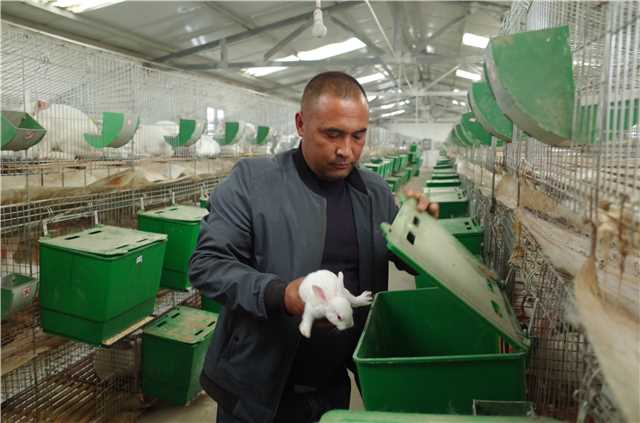
Zhou Dapeng, an entrepreneur from Gansu province who invested in a rabbit-breeding business in the park, said he had never thought of doing business in Moyu until he was convinced by a local official who was also a friend.
"Apart from the preferential policies launched by the local government for doing business here, I found the climate is suitable for raising rabbits after I visited Moyu," he said. "Besides, my company could contribute to local poverty alleviation."
After two years of development, Zhou's company has two breeding bases in the park that are now raising more than 100,000 rabbits. More than 400 local people work at the bases.
Farmer Mehmetabdula Rozmehmet, a 38-year-old member of the Uygur ethnic group in Moyu, did not have a stable income before he began working for Zhou's company two years ago. He is now deputy manager of a factory in one of the breeding bases.
"I did not have a stable income because I did not have a stable job," Mehmetabdula said. "I used to work for places that needed short-term hired labor. In August 2018, an official in my village introduced me to Zhou, and then I started to work for him."
Mehmetabdula said he could earn no more than 1,000 yuan before. Now, with a performance bonus, he can earn nearly 4,000 yuan a month.
"He quickly learned how to raise rabbits and became one of the best workers in our company, so we promoted him to deputy manager," Zhou said. "I think that as an essential worker in our company, he sets a very good example for many workers."
Chen Haicheng, director of Moyu's publicity department, said: "Zhou's company is one of the companies that took root and sprouted in Moyu. They not only benefit from the park, but are also making great contributions to the local community. I hope there will be more investment and more job opportunities created for locals."
According to the local government, the park is expected to introduce another 20 or more enterprises by 2025, taking its annual output value to 800 million yuan and employing another 15,000 locals.
After the first National Symposium on Work in Xinjiang in 2010, the central government set up an economic development zone in Kashgar. After 10 years of development, 18 billion yuan has been invested in infrastructure for the zone. More than 2,600 companies are registered there, offering 12,000 jobs for the poor and young graduates.
A company based in Qingdao, Shandong province, that manufactures household appliances has set up a factory in the bonded area of the zone that employs over 100 local graduates.
"Our factory went into operation in December 2019. We have temporarily transferred a few skilled workers from Qingdao to train new employees, and now most of them are able to work independently," said Xue Yanming, the factory's general manager.
Xue said all the new employees were Uygurs, and the factory was willing to recruit local graduates as they were good at Mandarin and could quickly acquire the skills.
Rozgul Akbar, a 22-year-old who just graduated from a junior college in Kashgar, applied for a job at the factory online in December and passed a subsequent interview.
"They trained me for a couple of weeks, taught me how to assemble a refrigerator, and after that, because of the novel coronavirus pneumonia outbreak, we closed for a month in February. Then, at end of the March, I signed a contract with the factory for three years," Rozgul said.
She said she can earn 3,000 yuan a month and the factory provides her with free food and accommodation.
"I am very satisfied with my job here, and I hope that with my hard work, I can get promoted and earn more money in the future," Rozgul said.
Yunus Dawut, a 19-year-old graduate from a small village in Kashgar, is now a good friend of Chen Zhengxin, a 23-year-old skilled worker from Qingdao. Chen has been teaching Yunus how to make metal plates since January.
"He is really clever and made rapid progress in work," Chen said. "On weekends, we often hang out together. I think he is my first Uygur friend and my best friend in Xinjiang. I hope some day he can visit my hometown in Qingdao."
Yunus said he is delighted to work in the factory, not only because he can earn more than 3,000 yuan a month, which is a great relief to his poor family, but he can also have a friend and teacher like Chen.
Xue said, "We will offer more opportunities for young local people to work in our company, especially Uygur graduates, because I think it is one of our responsibilities to bring benefits to the community."


- Ban on mercury thermometers sparks panic buying and market transformation
- Naozhou Island becomes sanctuary for sea turtles, aquatic wildlife
- Xinjiang's horse industry gallops with culture and tourism integration
- China Coast Guard vessels conduct a rights-protection patrol in the territorial waters of Diaoyu Island
- Philippines urged to stop political manipulation at sea
- China launches nationwide anti-piracy film campaign












