



Social distancing works, but how long must it remain in place?







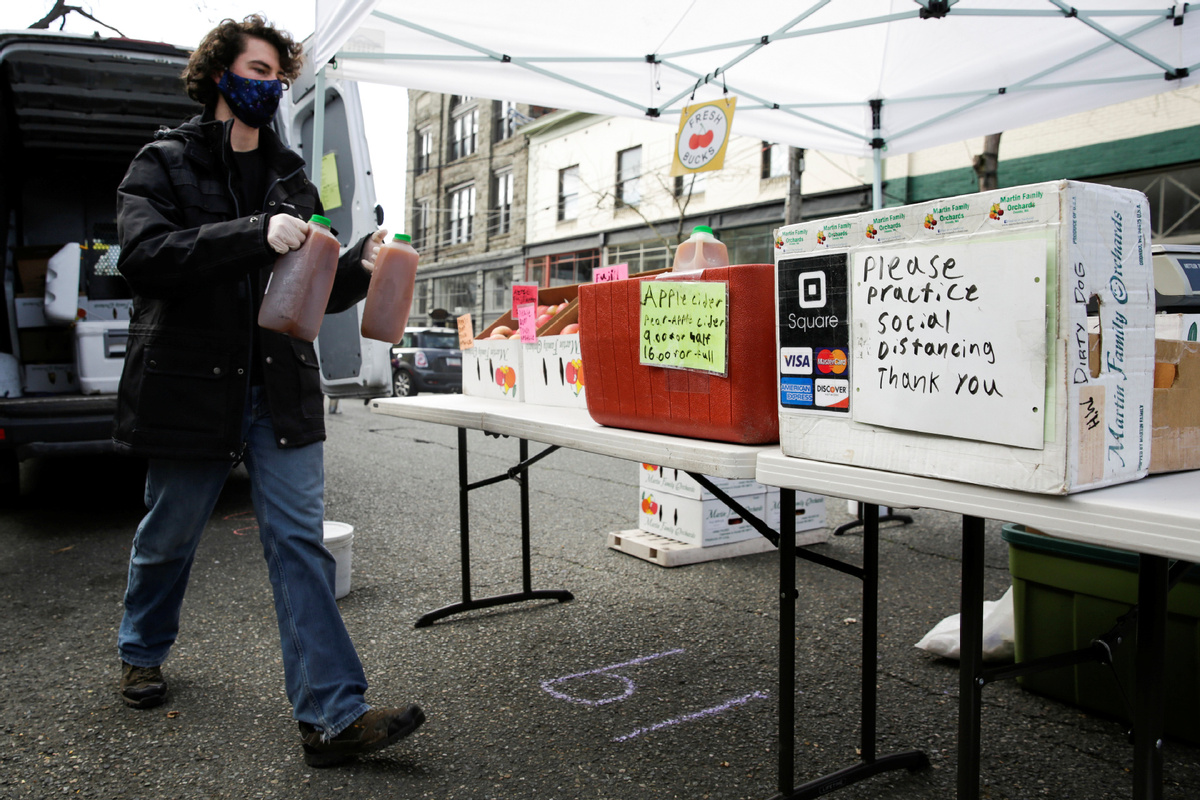
Embracing the concepts of "flattening the curve" and "social distancing", the American public is wondering when life will go back to normal. But some experts say the physical distancing practice may need to remain in place for the next two years.
For weeks, state and local governments across the US have closed businesses and mandated social distancing to cut off chains of the coronavirus' transmission. So far, 97 percent of the country's population is under stay-at-home orders.
"It factors in importantly the physical distancing measures that are absolutely essential," said Jonathan Fielding, professor in the Schools of Public Health and Medicine at UCLA, of the fight against COVID-19. "And it's important that we keep everybody compliant with these measures if we don't want things to get worse."
Experts say protective measures like social distancing are the key to "flatten the curve" of infection so that the total number of COVID-19 cases is spread over a longer term, preventing an influx of patients from overwhelming the healthcare system.
While bracing for a surge of coronavirus cases, the hospital of the University of California San Francisco (USCF) has kept the caseloads low. The hospital's COVID-19 unit with 600 beds had only 20 patients, according to an NBC News report on April 11.
The UCSF and its doctors took to social media to note that the new cases in San Francisco seemed to be flattening as a result of the city's early adoption of social distancing measures.
Robert Wachter, chair of the Department of Medicine at UCSF, created a graphic and posted it on Twitter to illustrate what San Francisco and California have done right in the pandemic.
According to the graphic, San Francisco had declared a public health emergency on Feb 26, before the first US death was reported on Feb 29 in Seattle.
The city and six surrounding Bay Area counties announced a "shelter in place" order on March 16, the first of its kind in the US. Three days later, California ordered all residents to stay at home, the first US state to do so. New York went to "shelter at home" on March 23, four days later than California.
The graphic indicates a wide difference in the death tolls of the two states. As of April 10, San Francisco and California had recorded 13 and 554 deaths, respectively, compared with 5,820 deaths in New York City and 7,844 deaths in New York state.
The key to San Francisco's "lighter hit" includes big tech companies' early action to allow employees to work from home, then bold steps by elected leaders, and the "crucial part" — people following the guidance, said Wachter.
Health experts say that the states that have taken social distancing seriously and early seem to be doing better than those that haven't.
Another early adopter of social distancing measures was Washington state, the early epicenter of COVID-19 in the US. It has not seen the same spike as New York.
Physical distancing strategy also seems to be working in hardest-hit New York state, as Governor Andrew Cuomo said this week: "The increase has slowed down; it flattens out for a period of time," he said.
However, the latest Google community-mobility report analyzing location data from cell phones estimates that physical distancing has reduced national movement to retail and recreational locations by only 49 percent, with deep differentials between states that have implemented stay-at-home orders and those that have not.
Arkansas shows only a 36 percent drop in retail and recreational behaviors, the lowest rate among all states, while Iowa has a 134 percent rise in park visitations, the highest rate in the country, according to the report.
The two states and five others still refuse to issue statewide stay-at-home orders, despite pleas from Dr Anthony Fauci, the country's top infectious disease expert and a member of the Trump administration's coronavirus task force.
"I don't understand why that's not happening," Fauci told CNN earlier this month, referring to the lack of stay-at-home orders in those states.
The governors of the seven states, all of whom are Republican, have various reasons for why they have not joined their colleagues across the country to tell people to stay home.
Iowa Governor Kim Reynolds insisted she has taken "significant steps" and criticized Fauci for "assuming that no action has been taken" in the state by "just looking at the map".
Despite the outbreak that has infected nearly 450 workers at a pork plant in Sioux Falls, South Dakota, Governor Kristi Noem has continually pushed back on the idea of a stay-at-home order.
President Donald Trump, who has repeatedly downplayed the pandemic, said at Wednesday's daily news briefing that data suggested the country had passed the peak on new coronavirus infections.
On April 16, he announced guidelines for reopening the economy in three phases and told the nation's governors they could decide when to follow the guidelines for their state economies.
California Governor Gavin Newsom has his own criteria to relax the social distancing measures, such as a decline in hospitalization and expanded testing and hospital capacity.
Asked about a timeline at Tuesday's news conference, Newsom said he would revisit the question in two weeks. "Let's not make the mistake of pulling the plug too early," he said.
Acknowledging the economic burden that prolonged social distancing may impose, researchers at the Harvard School of Public Health warn of "the potentially catastrophic burden" on the healthcare system if distancing measures are not implemented effectively or for long enough.
"Intermittent distancing may be required into 2022 unless critical care capacity is increased substantially or a treatment or vaccine becomes available," the researchers said in a study published Tuesday in the journal Science.










